Rotational
Kinetic Energy
Understand how spinning objects store energy, connect moment of inertia to angular velocity, and solve problems involving \( K_{\text{rot}} = \tfrac{1}{2}I\omega^2 \).
What is Rotational Kinetic Energy?
Every object that spins about an axis possesses kinetic energy due to its rotation, even if its center of mass is stationary. A flywheel on a shaft, a spinning figure skater, and a rolling wheel all carry this form of energy.
Moment of Inertia: The Rotational Mass
Moment of inertia \( I \) quantifies how mass is distributed relative to the rotation axis. The farther mass is from the axis, the larger \( I \) and the harder it is to change the object's spin.
All mass at distance \( r \)
Mass spread uniformly
All mass at the rim
Angular Velocity \( \omega \)
Angular velocity \( \omega \) measures how fast an object rotates, in radians per second. It is the rotational analogue of linear velocity \( v \).
The Core Formula
The rotational kinetic energy of a rigid body spinning about a fixed axis is:
This mirrors \( K = \tfrac{1}{2}mv^2 \) with \( I \) replacing mass and \( \omega \) replacing velocity. The units are joules (J), the same as all energy.
Derivation from First Principles
Translational vs Rotational
| Translational | Rotational | |
|---|---|---|
| Inertia | \( m \) (mass) | \( I \) (moment of inertia) |
| Velocity | \( v \) (m/s) | \( \omega \) (rad/s) |
| Kinetic Energy | \( \tfrac{1}{2}mv^2 \) | \( \tfrac{1}{2}I\omega^2 \) |
| Momentum | \( p = mv \) | \( L = I\omega \) |
| Force / Torque | \( F = ma \) | \( \tau = I\alpha \) |
Rolling Without Slipping
An object that rolls without slipping has both translational and rotational KE. Its total kinetic energy is the sum of both:
A cylinder skids, spins up, and finally rolls
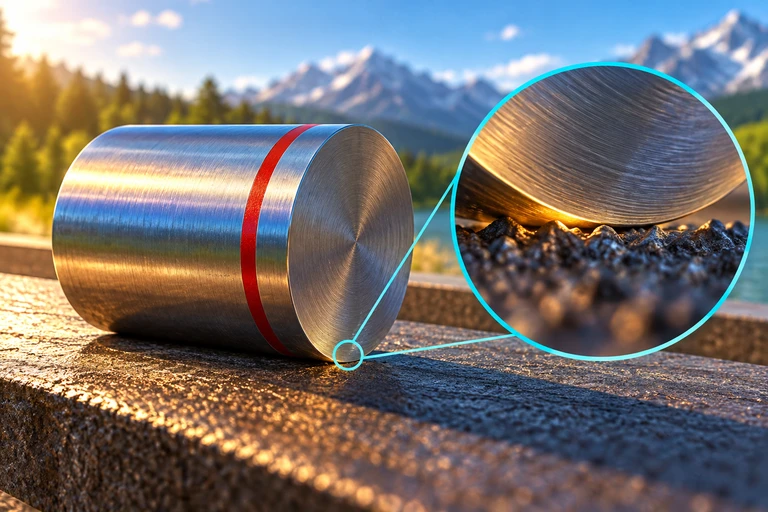 Kinetic friction slows the center of mass and increases the spin of an initially nonspinning solid cylinder. Slipping ends when v = Rω; one-third of the initial mechanical energy has been dissipated in this model.
Kinetic friction brings translation and spin together
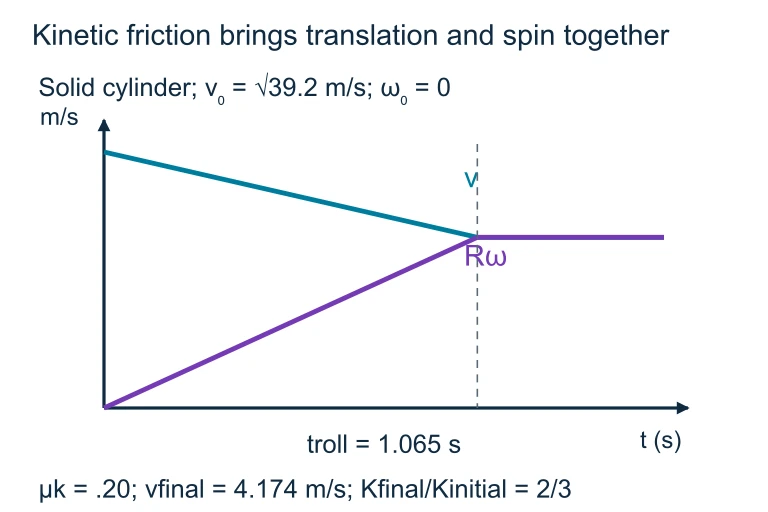 Kinetic friction slows the center of mass and increases the spin of an initially nonspinning solid cylinder. Slipping ends when v = Rω; one-third of the initial mechanical energy has been dissipated in this model.
Spin-up states have computed positions and rotations
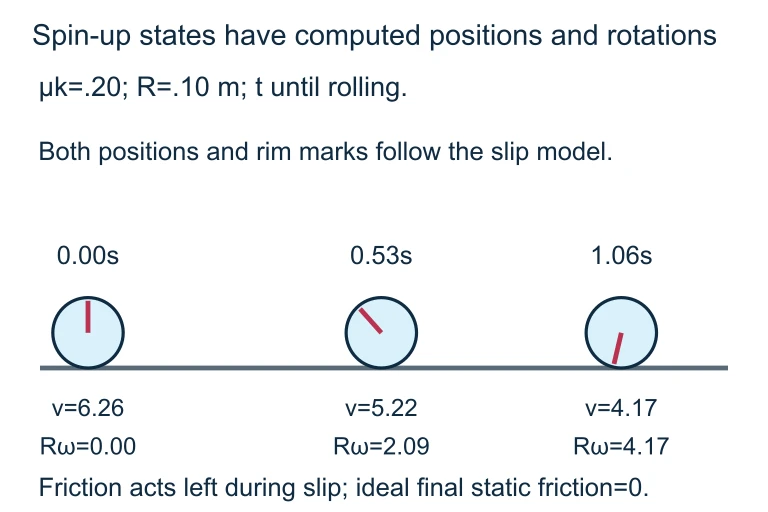 Kinetic friction slows the center of mass and increases the spin of an initially nonspinning solid cylinder. Slipping ends when v = Rω; one-third of the initial mechanical energy has been dissipated in this model.
How to Apply the Formula
Example 1: Spinning Disk
A solid disk of mass \( M = 4 \) kg and radius \( R = 0.3 \) m spins at \( \omega = 10 \) rad/s. Find its rotational KE.
Example 2: Flywheel at 3000 rpm
A flywheel (solid cylinder) has \( M = 20 \) kg, \( R = 0.25 \) m, and spins at 3000 rpm. Find \( K_{\text{rot}} \).
Example 3: Rolling Sphere
A solid sphere (\( I = \tfrac{2}{5}MR^2 \)) of mass \( 2 \) kg and radius \( 0.1 \) m rolls without slipping at \( v_{\text{cm}} = 5 \) m/s. Find the total KE.
Rolling Down a Ramp
Common Moments of Inertia
| Shape | Axis | \( I \) |
|---|---|---|
| Point mass | Distance \( r \) | \( mr^2 \) |
| Thin hoop | Center | \( MR^2 \) |
| Solid disk / cylinder | Center | \( \tfrac{1}{2}MR^2 \) |
| Solid sphere | Diameter | \( \tfrac{2}{5}MR^2 \) |
| Hollow sphere | Diameter | \( \tfrac{2}{3}MR^2 \) |
| Thin rod | Center | \( \tfrac{1}{12}ML^2 \) |
| Thin rod | End | \( \tfrac{1}{3}ML^2 \) |
Common Mistakes
Question 1 of 5
A thin hoop of mass \( 3 \) kg and radius \( 0.5 \) m spins at \( 4 \) rad/s. What is its rotational kinetic energy?
Question 2 of 5
Two objects have the same mass and radius. A solid disk and a thin hoop both spin at the same \( \omega \). Which has more rotational KE?
Question 3 of 5
A solid sphere rolls without slipping down a ramp of height \( h \). What fraction of its total KE at the bottom is rotational?
Question 4 of 5
A flywheel has \( I = 2.0 \text{ kg}\cdot\text{m}^2 \). If its rotational KE is \(400\) J, what is its angular velocity?
Question 5 of 5
If you double the angular velocity of a spinning object while keeping \( I \) constant, its rotational KE: