01 / 21

Rotational
Kinematics

Master the equations of angular motion: angular displacement, velocity, acceleration, and their deep analogy to linear kinematics.

AP Physics C: Mechanics

What is Rotational Motion?

When an object spins about a fixed axis, every point on it traces a circular path. Instead of tracking position in metres, we describe the motion using angles. This is rotational kinematics: the study of how things rotate without worrying about the forces that cause the rotation.

axis P \(\theta\) \(r\) rotation

The Three Angular Variables

\(\theta\) : Angular Displacement
The angle swept, measured in radians. One full revolution = \(2\pi\) rad.
\(\omega\) : Angular Velocity
Rate of change of angle: \(\omega = \frac{d\theta}{dt}\), measured in \(\text{rad/s}\).
\(\alpha\) : Angular Acceleration
Rate of change of angular velocity: \(\alpha = \frac{d\omega}{dt}\), measured in \(\text{rad/s}^2\).

Linear → Angular Analogy

Every linear kinematic quantity has a rotational twin. If you know the linear equations, you already know the rotational ones: just swap the symbols.

Concept Linear Angular
Displacement\(x\)\(\theta\)
Velocity\(v = \frac{dx}{dt}\)\(\omega = \frac{d\theta}{dt}\)
Acceleration\(a = \frac{dv}{dt}\)\(\alpha = \frac{d\omega}{dt}\)
Units\(\text{m, m/s, m/s}^2\)\(\text{rad, rad/s, rad/s}^2\)

The Rotational Kinematic Equations

For constant angular acceleration \(\alpha\), the same four equations apply with angular variables:

1
\(\omega = \omega_0 + \alpha\, t\)
2
\(\theta = \omega_0\, t + \tfrac{1}{2}\alpha\, t^2\)
3
\(\omega^2 = \omega_0^2 + 2\alpha\,\theta\)
4
\(\theta = \tfrac{1}{2}(\omega_0 + \omega)\,t\)

Visualizing \(\omega\) vs \(t\)

\(t\) (s) \(\omega\) (rad/s) 2 4 6 2 4 6 \(\omega_0\) Area = \(\theta\) slope = \(\alpha\)

Supplementary Physics C model

This illustration presents a separate Physics C model; compare its stated assumptions and values with the example already shown.

A centrifuge rotor starts from rest and accelerates uniformly at α = 150 rad/s² for 8.0 s, then spins at constant angular velocity for 60 s, and finally decelerates uniformly to rest over 12.0 s. Find (a) the maximum angular velocity, (b) the total angular displacement, and (c) the tangential speed of a point 0.10 m from the axis at maximum ω. During the acceleration phase, ω₀ = 0, α = 150 rad/s², t₁ = 8.0 s. Using ω = ω₀ + αt: ωmax = 0 + (150)(8.0) = 1200 rad/s.

Show answer and explanation

Step 1 — Find maximum angular velocity: During the acceleration phase, ω₀ = 0, α = 150 rad/s², t₁ = 8.0 s. Using ω = ω₀ + αt: ωmax = 0 + (150)(8.0) = 1200 rad/s. ω_max = 1200 rad/s ≈ 11 460 rpm Step 2 — Angular displacement during acceleration: θ₁ = ω₀t + ½αt² = 0 + ½(150)(8.0)² = ½(150)(64) = 4800 rad. θ₁ = 4800 rad Step 3 — Angular displacement at constant ω: During the constant-velocity phase, α = 0 and t₂ = 60 s. θ₂ = ωmax × t₂ = 1200 × 60 = 72 000 rad. θ₂ = 72 000 rad Step 4 — Angular displacement during deceleration: The rotor decelerates from 1200 rad/s to 0 over t₃ = 12.0 s. Using θ = ½(ω₀ + ω)t: θ₃ = ½(1200 + 0)(12.0) = 7200 rad. θ₃ = 7200 rad Step 5 — Total displacement and tangential speed: Total angular displacement: θtotal = 4800 + 72 000 + 7200 = 84 000 rad. In revolutions: 84 000 / (2π) ≈ 13 370 rev. The tangential speed at r = 0.10 m when ω = 1200 rad/s is vt = rω = (0.10)(1200) = 120 m/s. θ_total = 84 000 rad ≈ 13 370 rev; v_t = 120 m/s
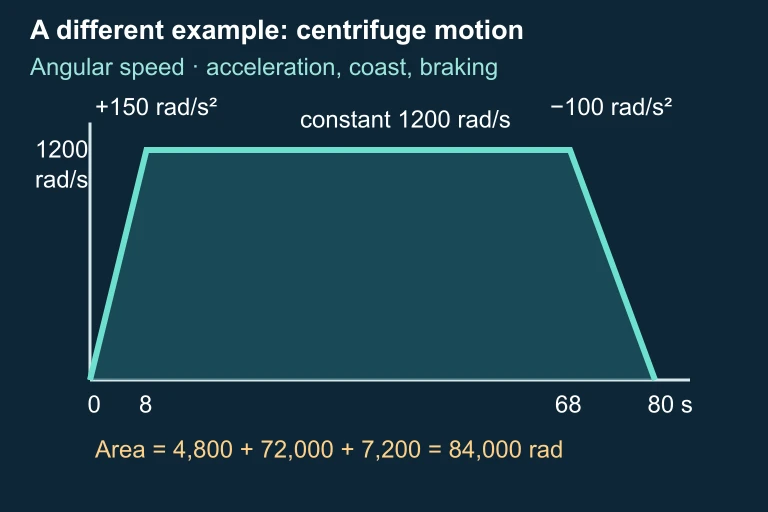
Separate centrifuge acceleration, coast and braking example.

Tangential vs Centripetal Acceleration

Tangential \(a_{\text{tan}}\)
Changes the speed of the point. \(a_{\text{tan}} = r\alpha\). Direction: tangent to the circle.
Centripetal \(a_c\)
Changes the direction of velocity. \(a_c = r\omega^2 = \frac{v^2}{r}\). Direction: inward toward axis.
P \(a_{\text{tan}}\) \(a_c\) \(v\) \(r\)

Bridge Equations: Angular to Linear

1
Arc length: \(s = r\theta\) : connects distance traveled along the circle to the angle swept.
2
Tangential speed: \(v = r\omega\) : the instantaneous linear speed of a point at radius \(r\).
3
Tangential acceleration: \(a_{\text{tan}} = r\alpha\) : the rate at which the tangential speed changes.
4
Centripetal acceleration: \(a_c = r\omega^2 = \frac{v^2}{r}\) : always points radially inward.

How to Solve Rotational Kinematics Problems

1
Identify knowns: List \(\omega_0\), \(\omega\), \(\alpha\), \(\theta\), and \(t\). You need exactly three to solve for the other two.
2
Check units: Convert RPM to rad/s: multiply by \(\frac{2\pi}{60}\). Convert revolutions to radians: multiply by \(2\pi\).
3
Select the right equation: Pick the kinematic equation that contains your three knowns and the unknown you need.
4
Solve algebraically: Isolate the unknown, substitute, compute. Watch signs for CW vs CCW.
5
Translate if needed: Use \(v = r\omega\) or \(a_{\text{tan}} = r\alpha\) to convert back to linear quantities.

Example 1: Spinning Wheel

A wheel starts from rest and accelerates uniformly at \(\alpha = 3\;\text{rad/s}^2\) for \(t = 4\;\text{s}\). Find the final angular velocity and total angle swept.

1
Knowns: \(\omega_0 = 0\), \(\alpha = 3\;\text{rad/s}^2\), \(t = 4\;\text{s}\).
2
Find \(\omega\): \(\omega = \omega_0 + \alpha t = 0 + 3(4) = \) \(12\;\text{rad/s}\).
3
Find \(\theta\): \(\theta = \omega_0 t + \tfrac{1}{2}\alpha t^2 = 0 + \tfrac{1}{2}(3)(16) = \) \(24\;\text{rad}\).

Example 2: Decelerating Fan

A fan blade spins at \(\omega_0 = 120\;\text{RPM}\) and decelerates uniformly to rest over \(t = 10\;\text{s}\). Find the angular acceleration and number of revolutions.

1
Convert: \(\omega_0 = 120 \times \frac{2\pi}{60} = 4\pi\;\text{rad/s} \approx 12.57\;\text{rad/s}\). Final: \(\omega = 0\).
2
Find \(\alpha\): \(\alpha = \frac{\omega - \omega_0}{t} = \frac{0 - 4\pi}{10} = \) \(-0.4\pi\;\text{rad/s}^2 \approx -1.26\;\text{rad/s}^2\).
3
Find \(\theta\): \(\theta = \tfrac{1}{2}(\omega_0 + \omega)t = \tfrac{1}{2}(4\pi + 0)(10) = 20\pi\;\text{rad} \approx\) \(62.8\;\text{rad} = 10\;\text{rev}\).

Example 3: Non-Constant \(\alpha(t)\)

A rotor has angular acceleration \(\alpha(t) = 6t - 2\;\text{rad/s}^2\). If \(\omega(0) = 5\;\text{rad/s}\) and \(\theta(0) = 0\), find \(\omega(t)\) and \(\theta(t)\).

1
Integrate for \(\omega\): \(\omega = \int (6t - 2)\,dt = 3t^2 - 2t + C\). With \(\omega(0) = 5\): \(C = 5\). So \(\omega(t) = 3t^2 - 2t + 5\).
2
Integrate for \(\theta\): \(\theta = \int (3t^2 - 2t + 5)\,dt = t^3 - t^2 + 5t + C'\). With \(\theta(0) = 0\): \(C' = 0\). So \(\theta(t) = t^3 - t^2 + 5t\).

Power entering and leaving a flywheel
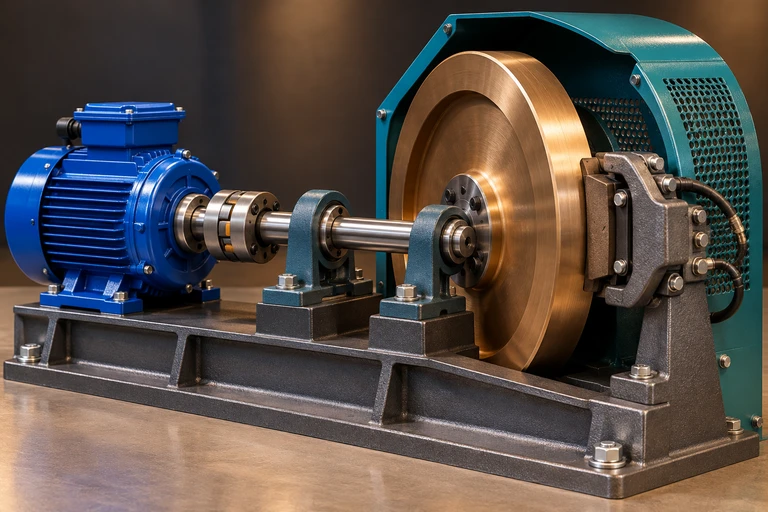
A blue motor drives a gold flywheel through a continuous horizontal shaft with two bearings. A fixed brake caliper contacts the wheel rim inside a partial protective guard.A flywheel subject to viscous drag slows with angular acceleration proportional to −ω. This exponential model uses a different torque law from a dry-friction brake.

Exponential angular-speed decay
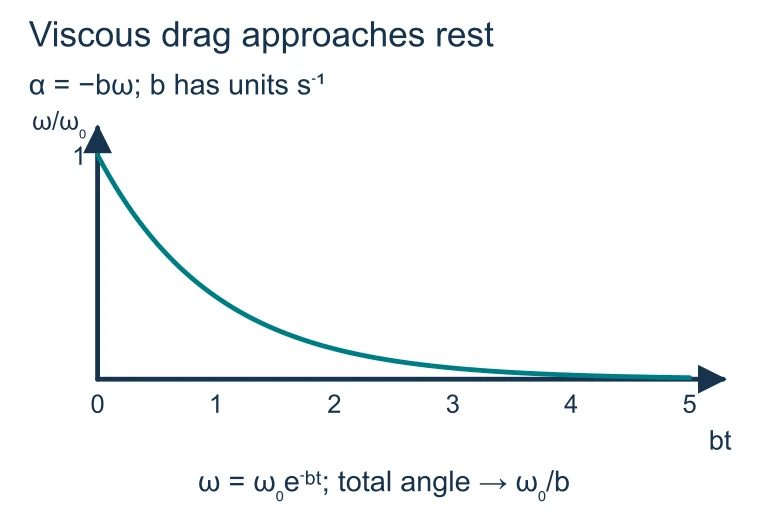
Exponential angular-speed decay. For α = −bω with b measured in s⁻¹, angular speed is ω₀e⁻ᵇᵗ. It approaches zero asymptotically while total angular displacement approaches ω₀/b.For α = −bω with b measured in s⁻¹, angular speed is ω₀e⁻ᵇᵗ. It approaches zero asymptotically while total angular displacement approaches ω₀/b.

Rolling Without Slipping

\(R\) \(\omega\) \(v_{\text{cm}}\) \(v = 0\) (contact) \(s = R\theta\)

Period and Frequency

Period \(T\)
Time for one complete revolution: \(T = \frac{2\pi}{\omega}\). Units: seconds.
Frequency \(f\)
Revolutions per second: \(f = \frac{1}{T} = \frac{\omega}{2\pi}\). Units: \(\text{Hz (s}^{-1}\text{)}\).

Common Mistakes to Avoid

✕ Using Degrees
The bridge equations \(s = r\theta\), \(v = r\omega\) only work in radians. Always convert first.
✕ Forgetting Signs
CW and CCW are opposite signs. A decelerating object has \(\alpha\) opposite to \(\omega\), not necessarily negative.
✕ Using Const-\(\alpha\) Equations for Non-Constant \(\alpha\)
If \(\alpha = f(t)\), you must integrate. The four kinematic equations will give wrong answers.

Summary Cheat Sheet

Equation Linear Rotational
Velocity\(v = v_0 + at\)\(\omega = \omega_0 + \alpha t\)
Displacement\(x = v_0 t + \tfrac{1}{2}at^2\)\(\theta = \omega_0 t + \tfrac{1}{2}\alpha t^2\)
Velocity-Disp.\(v^2 = v_0^2 + 2ax\)\(\omega^2 = \omega_0^2 + 2\alpha\theta\)
Average\(x = \tfrac{1}{2}(v_0 + v)t\)\(\theta = \tfrac{1}{2}(\omega_0 + \omega)t\)
Bridge: Position\(s = r\theta\)
Bridge: Speed\(v = r\omega\)
Bridge: Accel.\(a_{\text{tan}} = r\alpha\), \(a_c = r\omega^2\)

Question 1 of 5

A disk starts from rest and reaches \(\omega = 10\;\text{rad/s}\) in \(t = 5\;\text{s}\) with constant angular acceleration. What is \(\alpha\)?

Question 2 of 5

A wheel has \(\omega_0 = 6\;\text{rad/s}\) and \(\alpha = -2\;\text{rad/s}^2\). How many radians does it turn before stopping?

Question 3 of 5

A point on a spinning wheel is at radius \(r = 0.5\;\text{m}\). If \(\omega = 8\;\text{rad/s}\), what is the centripetal acceleration?

Question 4 of 5

A rotor has \(\alpha(t) = 4t\;\text{rad/s}^2\) and \(\omega(0) = 0\). What is \(\omega\) at \(t = 3\;\text{s}\)?

Question 5 of 5

A wheel rolls without slipping at \(v_{\text{cm}} = 4\;\text{m/s}\) with radius \(R = 0.2\;\text{m}\). What is the angular velocity?