Rotational
Inertia
Understand how mass distribution determines an object's resistance to angular acceleration, and master the calculations behind \( I = \sum m_i r_i^2 \).
What Is Rotational Inertia?
Rotational inertia (also called moment of inertia) is the rotational analogue of mass. While mass measures resistance to linear acceleration, rotational inertia measures resistance to angular acceleration.
The Key Idea: Mass Distribution
Rotational inertia depends not just on how much mass an object has, but on where that mass is located relative to the axis of rotation. Mass farther from the axis contributes more to \( I \).
Why Rotational Inertia Matters
Definition: Discrete Masses
Definition: Continuous Bodies
To evaluate this integral, express \( dm \) in terms of a spatial variable: for a rod of linear density \( \lambda \), we write \( dm = \lambda\, dx \). For a disk of surface density \( \sigma \), we write \( dm = \sigma\, dA \).
A density gradient and a missing piece you can see
 Compute rotational inertia by integrating squared distance from the selected axis against mass. Shifting to a parallel axis adds Md² to the central moment of inertia.
Integrating rotational inertia
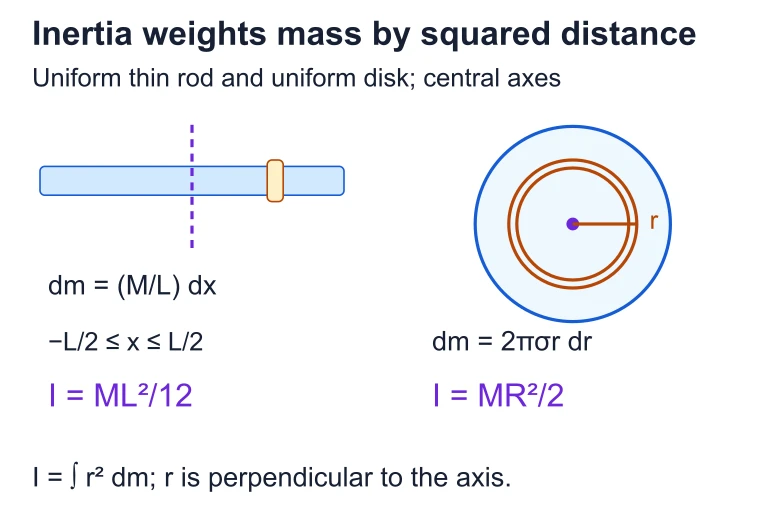 A uniform rod about its central transverse axis has I = ML²/12, while a uniform disk about its central normal axis has I = MR²/2. The rod uses dm = (M/L)dx; the disk uses annular elements dm = 2πσr dr.
Translational vs. Rotational
| Concept | Translational | Rotational |
|---|---|---|
| Inertia | \( m \) | \( I \) |
| Newton's 2nd Law | \( F = ma \) | \( \tau = I\alpha \) |
| Kinetic Energy | \( \tfrac{1}{2}mv^2 \) | \( \tfrac{1}{2}I\omega^2 \) |
| Momentum | \( p = mv \) | \( L = I\omega \) |
| Acceleration | \( a \) | \( \alpha \) |
Common Formulas for \( I \)
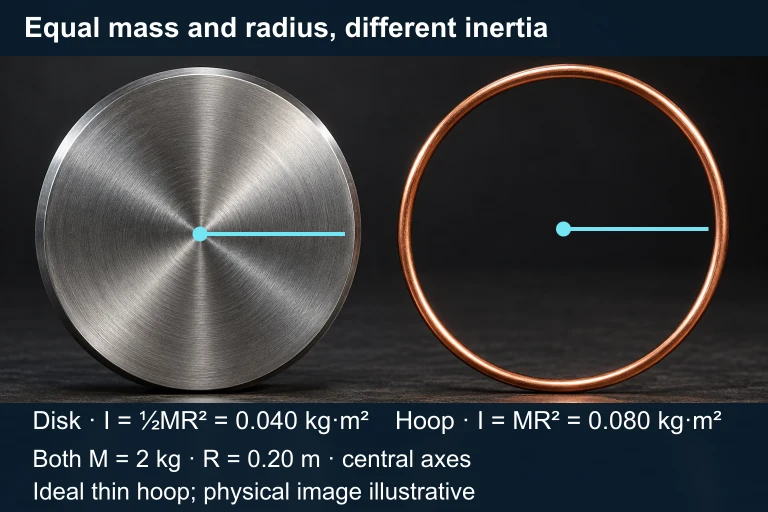
Supplementary Physics C model
This illustration presents a separate Physics C model; compare its stated assumptions and values with the example already shown.
The Parallel Axis Theorem
How to Calculate \( I \)
Example 1: Point Masses
Two masses are attached to a massless rod that rotates about its center. Mass \( m_1 = 3 \) kg is \( 0.4 \) m from the center and \( m_2 = 5 \) kg is \( 0.6 \) m from the center. Find \( I \).
Example 2: Deriving \( I \) for a Rod
Derive the moment of inertia of a uniform thin rod of mass \( M \) and length \( L \) about an axis through one end.
Example 3: Parallel Axis Theorem
A solid sphere of mass \( M = 2 \) kg and radius \( R = 0.1 \) m rolls about an axis tangent to its surface. Find \( I \).
Rotational Kinetic Energy
This is critical in rolling without slipping problems. Since \( v_{\text{cm}} = R\omega \), you can rewrite everything in terms of either \( v \) or \( \omega \). Objects with larger \( I \) store more energy in rotation and translate more slowly down a ramp.
Common Mistakes
Summary of Key Formulas
| Shape | Axis | \( I \) |
|---|---|---|
| Point mass | Distance \( r \) | \( mr^2 \) |
| Thin rod | Center | \( \tfrac{1}{12}ML^2 \) |
| Thin rod | End | \( \tfrac{1}{3}ML^2 \) |
| Solid disk/cylinder | Central axis | \( \tfrac{1}{2}MR^2 \) |
| Hollow cylinder (hoop) | Central axis | \( MR^2 \) |
| Solid sphere | Diameter | \( \tfrac{2}{5}MR^2 \) |
| Hollow sphere | Diameter | \( \tfrac{2}{3}MR^2 \) |
Question 1 of 5
A 2 kg point mass orbits an axis at a distance of 3 m. What is its moment of inertia?
Question 2 of 5
A uniform rod of mass \( M \) and length \( L \) is rotated about its center. Its moment of inertia is:
Question 3 of 5
Using the parallel axis theorem: if \( I_{\text{cm}} = 4 \;\text{kg}\cdot\text{m}^2 \), \( M = 5 \) kg, and the new axis is 2 m from the CM, what is \( I \)?
Question 4 of 5
A solid disk and a hoop of the same mass and radius roll down a ramp from rest. Which reaches the bottom first?
Question 5 of 5
If you double the distance of a point mass from the rotation axis (keeping mass constant), \( I \) changes by a factor of: