Rolling
Without Slipping
Master the physics of rolling motion: the elegant coupling of translation and rotation that governs wheels, balls, and cylinders.
What Is Rolling Motion?
Rolling is the simultaneous translation of the center of mass and rotation about the center of mass. Every point on a rolling object traces a cycloid path through space.
The Rolling Constraint
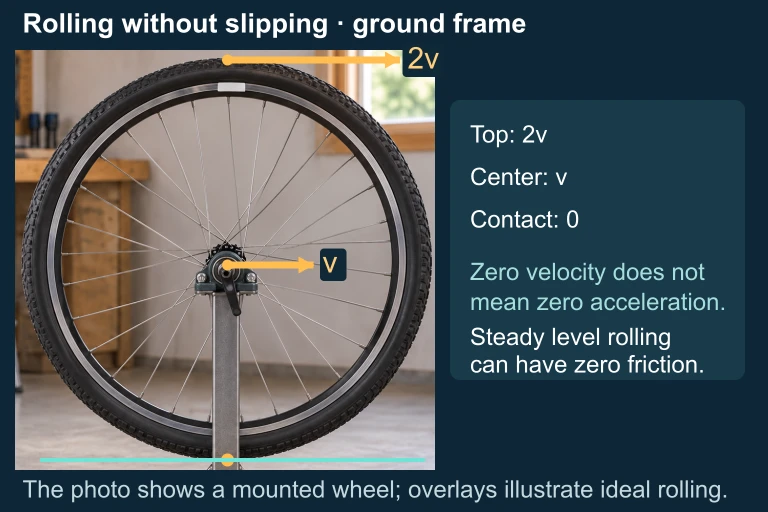
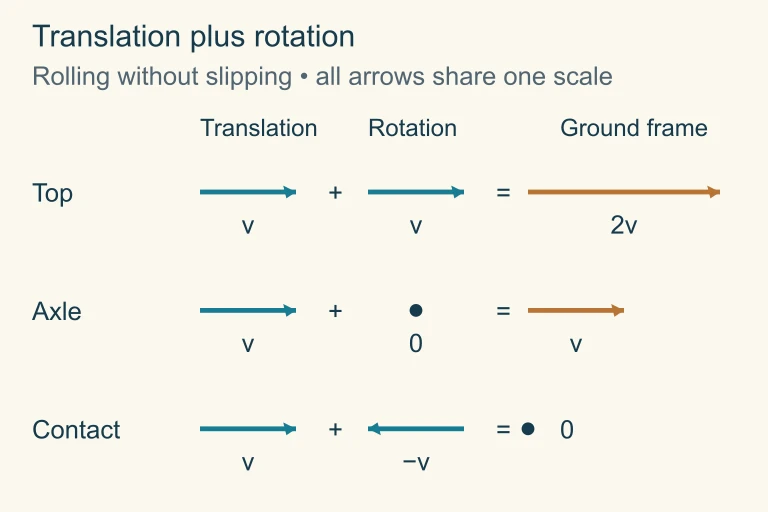
When an object rolls without slipping, the contact point has zero velocity relative to the surface. This couples the translational and rotational speeds:
Velocity Distribution in Rolling
Supplementary Physics C model
This illustration presents a separate Physics C model; compare its stated assumptions and values with the example already shown.
Kinetic Energy of Rolling
A rolling object has two contributions to kinetic energy: translational and rotational about the center of mass.
Using the rolling constraint \( v_{\text{cm}} = R\omega \), we can write:
Why Shape Matters
Different shapes have different moments of inertia, which changes how energy is distributed between translation and rotation.
Rolling Down an Incline
Energy Conservation Applied
Since friction does no work in rolling without slipping, mechanical energy is conserved. From rest at height \( h \):
Solving for the speed at the bottom:
Newton's Laws for Rolling
Apply both the translational and rotational forms of Newton's second law simultaneously:
Sliding vs Rolling
| Sliding (frictionless) | Rolling without slipping | |
|---|---|---|
| Contact point velocity | \( v_{\text{cm}} \neq 0 \) | \( v = 0 \) |
| Friction type | None | Static |
| Work by friction | N/A | Does no work |
| Speed down incline | \( \sqrt{2gh} \) | \( \sqrt{\frac{2gh}{1 + I/MR^2}} \) |
| Energy conserved? | Yes | Yes |
A cylinder skids, spins up, and finally rolls
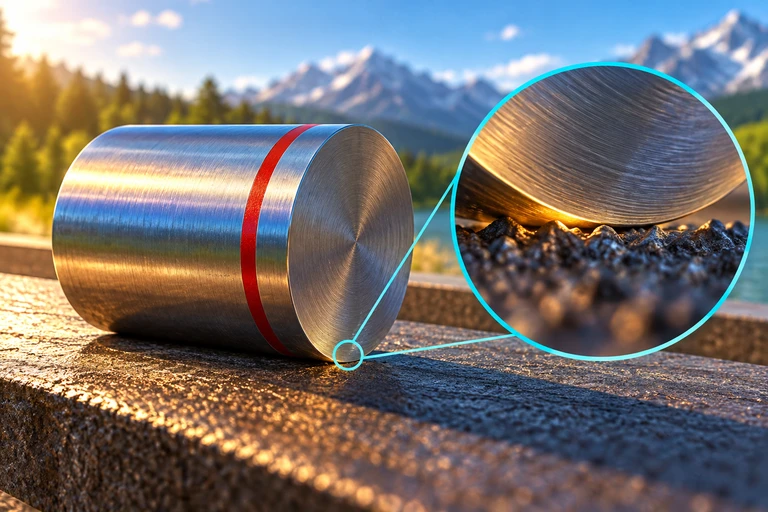 Kinetic friction slows the center of mass and increases the spin of an initially nonspinning solid cylinder. Slipping ends when v = Rω; one-third of the initial mechanical energy has been dissipated in this model.
Kinetic friction brings translation and spin together
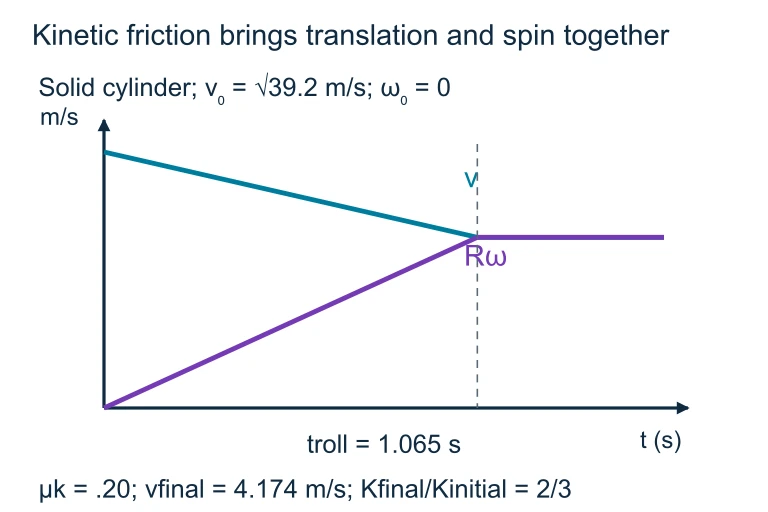 Kinetic friction slows the center of mass and increases the spin of an initially nonspinning solid cylinder. Slipping ends when v = Rω; one-third of the initial mechanical energy has been dissipated in this model.
Spin-up states have computed positions and rotations
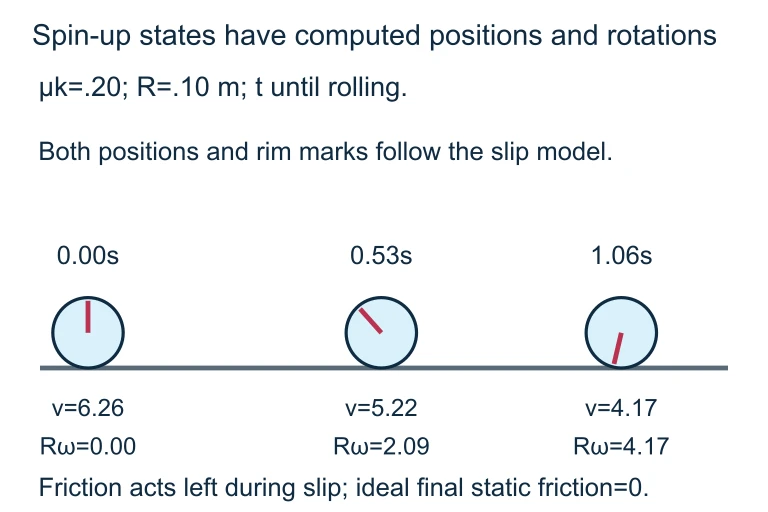 Kinetic friction slows the center of mass and increases the spin of an initially nonspinning solid cylinder. Slipping ends when v = Rω; one-third of the initial mechanical energy has been dissipated in this model.
How to Solve Rolling Problems
Example 1: Solid Sphere Down a Ramp
A solid sphere of mass \( M \) starts from rest and rolls without slipping down a ramp of height \( h = 3.0 \) m. Find its speed at the bottom.
Example 2: Acceleration and Friction
A solid cylinder rolls without slipping down a \( 30^\circ \) incline. Find its linear acceleration and the friction force.
Example 3: The Race Down the Hill
Four objects: a solid sphere, a solid cylinder, a hollow sphere, and a hollow cylinder all start from rest at the same height. Which reaches the bottom first?
| Object | \( I_{\text{cm}}/MR^2 \) | \( v_{\text{cm}} \) (relative) | Finish Order |
|---|---|---|---|
| Solid Sphere | \( 2/5 \) | Fastest | 1st |
| Solid Cylinder | \( 1/2 \) | Second | 2nd |
| Hollow Sphere | \( 2/3 \) | Third | 3rd |
| Hollow Cylinder | \( 1 \) | Slowest | 4th |
Common Mistakes
Key Formulas Summary
| Quantity | Formula |
|---|---|
| Rolling constraint | \( v_{\text{cm}} = R\omega \), \( a_{\text{cm}} = R\alpha \) |
| Total kinetic energy | \( K = \frac{1}{2}Mv^2\left(1 + \frac{I}{MR^2}\right) \) |
| Speed (from height \( h \)) | \( v = \sqrt{\frac{2gh}{1 + I/MR^2}} \) |
| Acceleration (incline) | \( a = \frac{g\sin\theta}{1 + I/MR^2} \) |
| Friction force (incline) | \( f = \frac{Mg\sin\theta}{1 + MR^2/I} \) |
| Contact point velocity | \( v_{\text{contact}} = 0 \) (no slip) |
Question 1 of 5
A solid sphere and a hollow cylinder of the same mass and radius start from rest at the top of the same incline. If both roll without slipping, which reaches the bottom first?
Question 2 of 5
For a wheel rolling without slipping on a flat surface, the velocity of the contact point with the ground is:
Question 3 of 5
A solid cylinder rolls without slipping down an incline of angle \( \theta \). What is its linear acceleration?
Question 4 of 5
The total kinetic energy of a solid sphere of mass \( M \) rolling at speed \( v \) is:
Question 5 of 5
In rolling without slipping, the friction at the contact point: