Resistive
Forces
Explore how drag and friction oppose motion, model velocity-dependent resistive forces, and solve differential equations for objects moving through resistive media.
What Are Resistive Forces?
A resistive force is any force that opposes the motion of an object through a medium. Unlike gravity or springs, resistive forces depend on the object's velocity: the faster you move, the harder the medium pushes back.
Why Resistive Forces Matter
In real physics, no object moves through a vacuum (except in space). Every projectile, falling object, and vehicle experiences resistance. Modeling these forces lets us predict terminal velocity, design aerodynamic shapes, and understand energy dissipation.
Two Models of Drag
Proportional to \( v \). Used at low speeds (small objects, viscous fluids like honey or oil).
Proportional to \( v^2 \). Used at high speeds (cars, baseballs, skydivers in air).
Core Equation: Linear Drag
Deriving \( v(t) \) via Separation
\( v(t) = \frac{mg}{b}\left(1-e^{-bt/m}\right) \)
Velocity vs. Time Graph
Quadratic Drag: \( f = bv^2 \)
For objects at higher speeds in air, drag is proportional to \( v^2 \). Newton's second law becomes:
Linear vs. Quadratic Drag
| Linear: \( bv \) | Quadratic: \( bv^2 \) | |
|---|---|---|
| Regime | Low speed, viscous | High speed, turbulent |
| Terminal Velocity | \( v_T = \frac{mg}{b} \) | \( v_T = \sqrt{\frac{mg}{b}} \) |
| Solution Form | Exponential | Hyperbolic tangent |
| Time Constant | \( \tau = \frac{m}{b} \) | \( \tau = \frac{v_T}{g} \) |
| Example | Pollen in honey | Skydiver in air |
A falling bead inside a transparent fluid column
 A bead released from rest accelerates until upward drag balances its weight in the model. Linear and quadratic drag give different equations and approach curves, with coefficients and conditions specified separately.
A linear-drag example
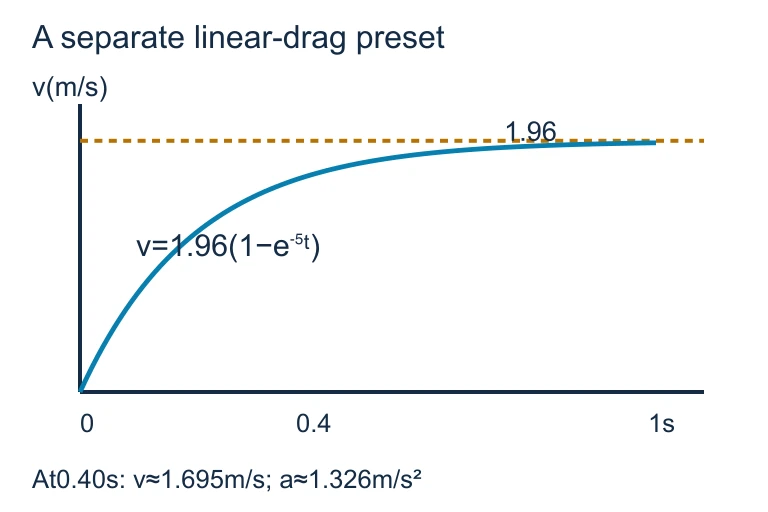 For v = 1.96(1 − e⁻⁵ᵗ) m/s, the terminal speed is 1.96 m/s. At t = 0.40 s, v ≈ 1.695 m/s and acceleration is about 1.326 m/s².
Comparing drag laws
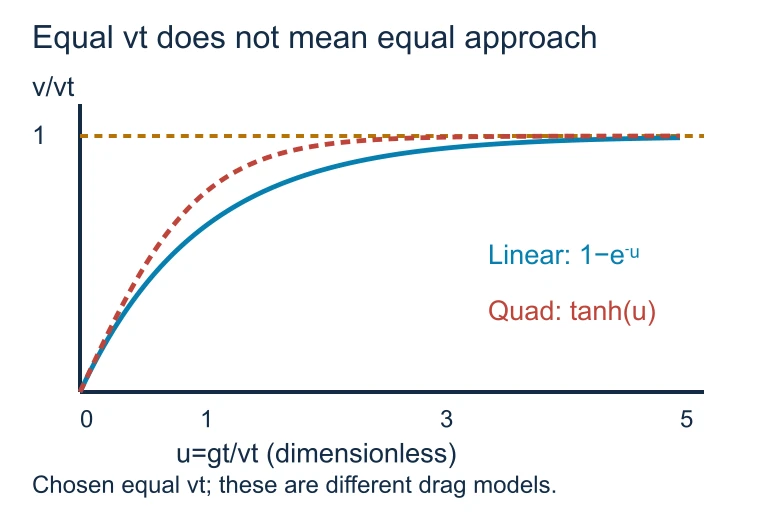 Choose coefficients so the two models share terminal speed vₜ and define u = gt/vₜ. The linear-drag curve is v/vₜ = 1 − e⁻ᵘ; the quadratic-drag curve is tanh(u).
Horizontal Motion with Linear Drag
An object launched horizontally with initial speed \( v_0 \) through a medium with linear drag (no gravity component along its direction):
How to Solve Resistive Force Problems
Example 1: Falling Raindrop
A raindrop of mass \( m = 3.0 \times 10^{-5} \) kg falls from rest through air with linear drag coefficient \( b = 6.0 \times 10^{-4} \) N·s/m. Find the terminal velocity and the velocity after \( t = 0.1 \) s.
Example 2: Sliding Block
A block slides on a frictionless surface through a viscous fluid. Its initial velocity is \( v_0 = 5 \) m/s, and the drag force is \( f = 0.2v \). The block has mass \( m = 2 \) kg. Find \( v(t) \) and the distance traveled as \( t \to \infty \).
Example 3: Skydiver (Quadratic)
A 75 kg skydiver falls with quadratic drag \( b = 0.25 \) kg/m. Find the terminal velocity and the velocity after 10 seconds.
Common Mistakes
Summary of Key Results
| Scenario | Equation | Solution |
|---|---|---|
| Falling, linear drag | \( m\frac{dv}{dt} = mg - bv \) | \( v_T(1 - e^{-t/\tau}) \) |
| Falling, quadratic drag | \( m\frac{dv}{dt} = mg - bv^2 \) | \( v_T\tanh(gt/v_T) \) |
| Horizontal, linear drag | \( m\frac{dv}{dt} = -bv \) | \( v_0 e^{-t/\tau} \) |
| Horizontal, quadratic drag | \( m\frac{dv}{dt} = -bv^2 \) | \( \frac{v_0}{1 + (bv_0/m)t} \) |
Question 1 of 5
An object falls from rest through a fluid with linear drag \( f = bv \). What is its terminal velocity?
Question 2 of 5
A ball of mass \( m \) is launched horizontally with speed \( v_0 \) through a medium with linear drag \( bv \). What is the maximum distance it can travel?
Question 3 of 5
For an object falling with quadratic drag \( bv^2 \), the velocity as a function of time is given by:
Question 4 of 5
The time constant \( \tau \) for a falling object with linear drag \( bv \) is \( \tau = m/b \). After a time of \( 3\tau \), the object's velocity is approximately what fraction of terminal velocity?
Question 5 of 5
Two identical spheres are dropped from rest. Sphere A falls through water (\( b = 0.5 \) N·s/m) and Sphere B falls through oil (\( b = 2.0 \) N·s/m). Both have mass \( 0.1 \) kg. Which statement is correct?