Representing & Analyzing
Simple Harmonic Motion
Master the equations, graphs, and energy relationships that describe oscillatory systems from springs to pendulums.
What is Simple Harmonic Motion?
Simple Harmonic Motion (SHM) is periodic motion in which the restoring force is directly proportional to displacement and directed toward equilibrium. Any system obeying this rule oscillates sinusoidally.
Key Parameters of SHM
Why SHM Matters
SHM is the foundation of wave physics, electrical circuits (LC oscillators), molecular vibrations, and mechanical engineering. Virtually every small-displacement oscillation near a stable equilibrium is approximately simple harmonic.
The Core Differential Equation
Newton's second law for a mass on a spring gives:
The general solution is:
Position, Velocity, & Acceleration
Graphing \( x \), \( v \), and \( a \)
Spring vs. Pendulum
| Mass-Spring | Simple Pendulum | |
|---|---|---|
| Restoring Force | \( F = -kx \) | \( F_t = -mg\sin\theta \) |
| Angular Frequency | \( \omega = \sqrt{k/m} \) | \( \omega = \sqrt{g/L} \) |
| Period | \( T = 2\pi\sqrt{m/k} \) | \( T = 2\pi\sqrt{L/g} \) |
| Depends on mass? | Yes | No |
| Approximation? | Exact (ideal spring) | Small angle \( \theta \ll 1 \) |
Energy in SHM
In an ideal (undamped) SHM system, total mechanical energy is conserved. Kinetic and potential energies exchange continuously.
Energy vs. Displacement
Watching a damped oscillator lose its spiral
 With linear damping, the phase trajectory contracts and mechanical energy decreases at the rate −bv². The undamped comparison has constant total mechanical energy.
Damping contracts the phase trajectory
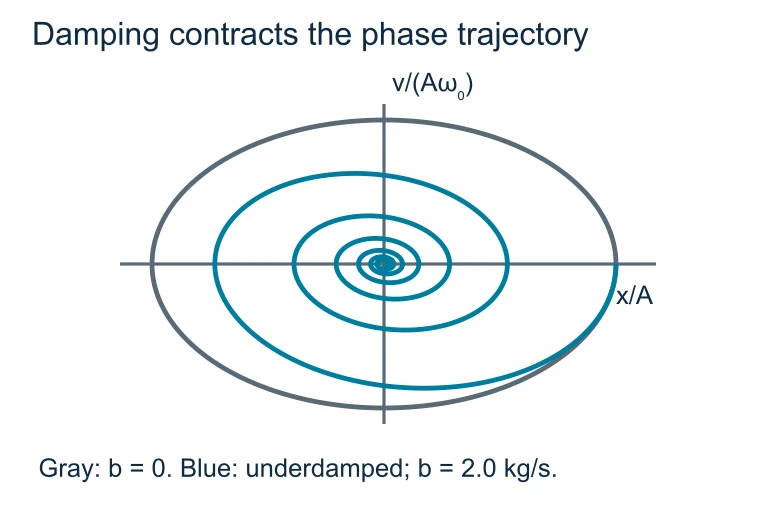 With linear damping, the phase trajectory contracts and mechanical energy decreases at the rate −bv². The undamped comparison has constant total mechanical energy.
Undamped energy exchange
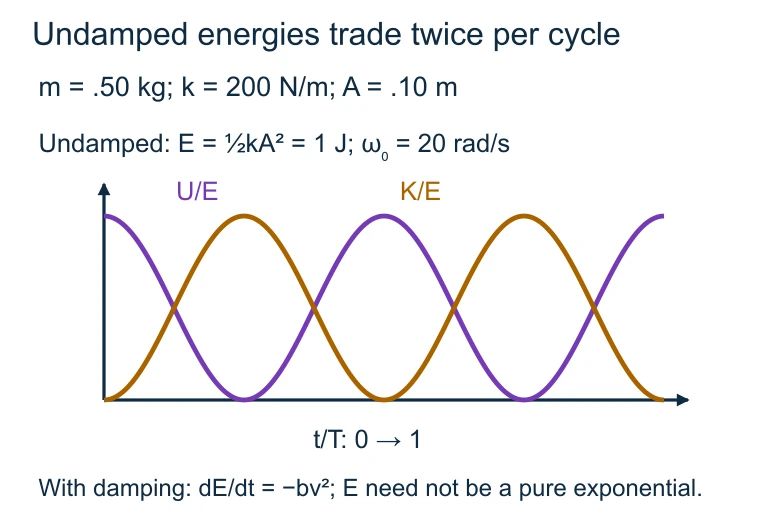 For m = 0.50 kg, k = 200 N/m and A = 0.10 m, total energy is 1 J and angular frequency is 20 rad/s. Kinetic and potential energies exchange at twice the displacement frequency.
How to Apply SHM Analysis
Example 1: Mass-Spring
A \( 0.50 \text{ kg} \) block is attached to a spring with \( k = 200 \text{ N/m} \). It is pulled \( 0.10 \text{ m} \) from equilibrium and released from rest. Find the period, maximum speed, and maximum acceleration.
Example 2: Finding \( \phi \)
A mass on a spring has \( \omega = 10 \text{ rad/s} \) and \( A = 0.20 \text{ m} \). At \( t = 0 \), the mass is at \( x_0 = 0.10 \text{ m} \) moving in the negative direction. Find \( \phi \).
Example 3: Energy Method
Using the system from Example 1 (\( k = 200 \text{ N/m} \), \( A = 0.10 \text{ m} \), \( m = 0.50 \text{ kg} \)), find the speed when \( x = 0.06 \text{ m} \).
Common Mistakes
SHM Quick Reference
| Quantity | Expression | Max Value |
|---|---|---|
| Position | \( A\cos(\omega t + \phi) \) | \( A \) |
| Velocity | \( -A\omega\sin(\omega t + \phi) \) | \( A\omega \) |
| Acceleration | \( -A\omega^2\cos(\omega t + \phi) \) | \( A\omega^2 \) |
| Kinetic Energy | \( \tfrac{1}{2}m\omega^2 A^2\sin^2(\omega t + \phi) \) | \( \tfrac{1}{2}kA^2 \) |
| Potential Energy | \( \tfrac{1}{2}kA^2\cos^2(\omega t + \phi) \) | \( \tfrac{1}{2}kA^2 \) |
| Total Energy | \( \tfrac{1}{2}kA^2 \) | \( \tfrac{1}{2}kA^2 \) (constant) |
Question 1 of 5
A block on a spring has amplitude \( A \) and angular frequency \( \omega \). What is the maximum speed of the block?
Question 2 of 5
In SHM, at what displacement is the kinetic energy equal to the potential energy?
Question 3 of 5
If the mass of a simple pendulum is doubled (length unchanged), its period:
Question 4 of 5
A mass-spring system has \( k = 50 \text{ N/m} \), \( m = 2.0 \text{ kg} \), and \( A = 0.40 \text{ m} \). What is the total mechanical energy?
Question 5 of 5
The acceleration of a particle in SHM is zero when the particle is at: