Reference Frames &
Relative Motion
Understand how observers in different frames describe motion differently, and master the velocity addition equation that connects them.
What Is a Reference Frame?
A reference frame (or frame of reference) is a coordinate system attached to an observer, used to measure positions, velocities, and accelerations. Every measurement of motion is made relative to some chosen frame.
Key Vocabulary
Why Relative Motion Matters
The laws of Newtonian mechanics take the same form in every inertial (non-accelerating) reference frame. This principle lets us pick the most convenient frame to solve a problem, then translate results to any other frame.
The Galilean Velocity Addition Equation
Read the subscripts as: "velocity of A relative to C equals velocity of A relative to B plus velocity of B relative to C." The middle label (B) cancels, like a chain.
The Subscript Chain Rule
The inner subscripts (B) cancel. You can extend the chain: \(\vec{v}_{A/D} = \vec{v}_{A/B} + \vec{v}_{B/C} + \vec{v}_{C/D}\).
Position & Acceleration Relations
One toss, two inertial views
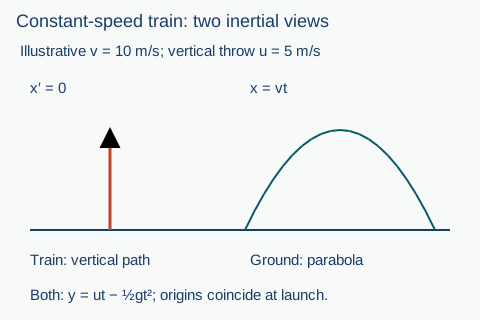 A train moves at constant 10 m/s while a ball is launched vertically at 5 m/s relative to the train. With g = 9.8 m/s² and negligible air resistance, the train observer sees a vertical path and the ground observer sees a parabola.Open full diagram
Inertial vs. Non-Inertial Frames
| Inertial Frame | Non-Inertial Frame | |
|---|---|---|
| Acceleration of frame | \(\vec{a}_{\text{frame}} = 0\) | \(\vec{a}_{\text{frame}} \neq 0\) |
| Newton's laws valid? | Yes, directly | Only with pseudo-forces |
| Galilean addition | Applies as written | Must include frame acceleration |
| Examples | Ground, constant-velocity train | Accelerating car, spinning turntable |
A tilted pendulum inside an accelerating car
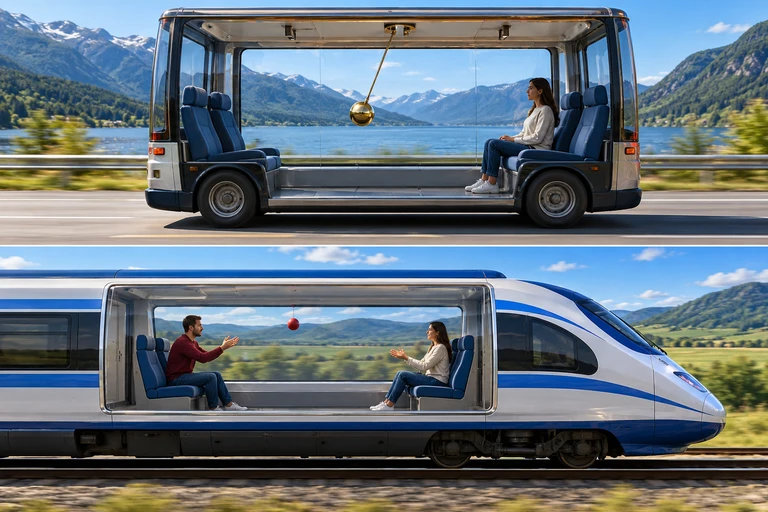 In the ground frame, tension and gravity are the real forces on a pendulum settled inside an accelerating cabin. The horizontal component of tension produces the cabin’s acceleration.
A tilted pendulum inside an accelerating car
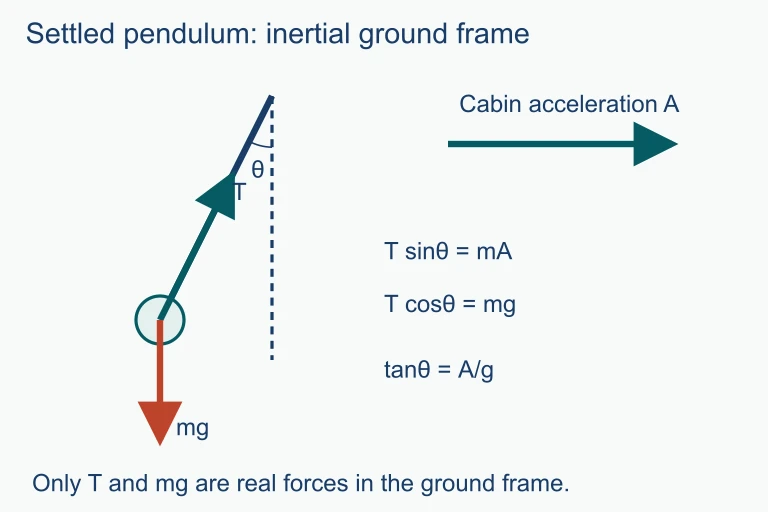 In the ground frame, tension and gravity are the real forces on a pendulum settled inside an accelerating cabin. The horizontal component of tension produces the cabin’s acceleration.
How to Apply Relative Velocity
Example 1: Ball on a Train
A train moves east at \(30\;\text{m/s}\) relative to the ground. A passenger throws a ball forward at \(10\;\text{m/s}\) relative to the train. What is the ball's velocity relative to the ground?
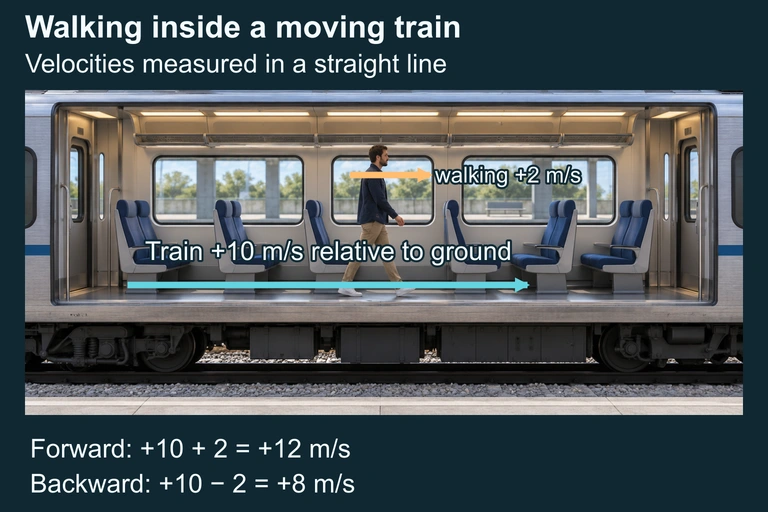
Supplementary Physics C model
This illustration presents a separate Physics C model; compare its stated assumptions and values with the example already shown.
Example 2: River Crossing
A boat heads due north at \(4\;\text{m/s}\) relative to the water. The river flows east at \(3\;\text{m/s}\) relative to the ground. Find \(\vec{v}_{\text{boat/ground}}\).
Example 3: Approaching Cars
Car A travels east at \(25\;\text{m/s}\) and Car B travels west at \(20\;\text{m/s}\), both relative to the ground. Find the velocity of Car A as seen by Car B.
Flipping Subscripts
A useful identity: the velocity of A relative to B is the negative of B relative to A:
This lets you rearrange any relative velocity equation. For example, if you know \(\vec{v}_{B/A}\), you instantly know \(\vec{v}_{A/B}\) by reversing the sign.
General 2-D Vector Addition
Common Mistakes
Summary Table
| Concept | Equation | Key Condition |
|---|---|---|
| Position addition | \(\vec{r}_{A/C} = \vec{r}_{A/B} + \vec{r}_{B/C}\) | Always valid |
| Velocity addition | \(\vec{v}_{A/C} = \vec{v}_{A/B} + \vec{v}_{B/C}\) | Galilean (low speed) |
| Acceleration | \(\vec{a}_{A/C} = \vec{a}_{A/B}\) | B/C at constant \(\vec{v}\) |
| Subscript flip | \(\vec{v}_{A/B} = -\vec{v}_{B/A}\) | Always valid |
| Chain extension | \(\vec{v}_{A/D} = \vec{v}_{A/B} + \vec{v}_{B/C} + \vec{v}_{C/D}\) | Inner labels cancel |
Question 1 of 5
A boat moves at \(6\;\text{m/s}\) north relative to the river, and the river flows at \(8\;\text{m/s}\) east relative to the ground. What is the speed of the boat relative to the ground?
Question 2 of 5
Car A moves east at \(30\;\text{m/s}\) and Car B moves east at \(20\;\text{m/s}\), both relative to the ground. What is \(\vec{v}_{A/B}\)?
Question 3 of 5
If \(\vec{v}_{A/B} = +15\;\text{m/s}\), what is \(\vec{v}_{B/A}\)?
Question 4 of 5
A passenger on a train (moving at \(20\;\text{m/s}\) east) throws a ball at \(5\;\text{m/s}\) west relative to the train. What is the ball's velocity relative to the ground?
Question 5 of 5
Frame S' moves at constant velocity relative to frame S. An object accelerates at \(\vec{a} = 3\;\text{m/s}^2\) in frame S. What is its acceleration in frame S'?