Power
Energy per Unit Time
Master the concept of power as the rate of energy transfer, connecting work, force, and velocity in mechanics.
What Is Power?
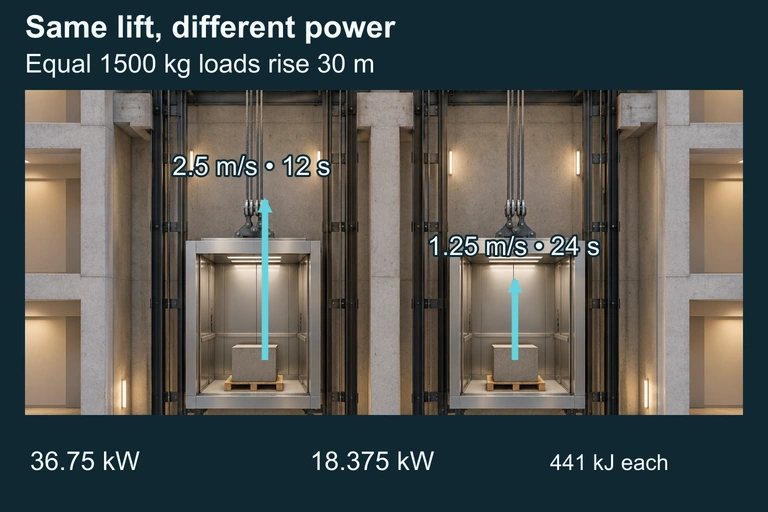
Power measures how fast energy is transferred or work is done. Two machines can do the same total work, but the one that does it faster delivers more power.
Why Power Matters
In real systems, we care not just about how much work is done, but how quickly. A small motor and a large engine can both lift a 500 kg load 10 m, but the engine does it in seconds while the motor takes minutes.
Average vs Instantaneous Power
The total work divided by the total time interval. Useful for overall performance.
The power at a specific moment. Found by taking the derivative of work with respect to time.
The Power Equations
Power and the Work-Energy Theorem
Since the net work equals the change in kinetic energy, we can also express power in terms of energy changes:
Work vs Power vs Energy
| Property | Work | Power | Energy |
|---|---|---|---|
| Definition | Force through displacement | Rate of doing work | Capacity to do work |
| Formula | \( W = \int \vec{F} \cdot d\vec{r} \) | \( P = \frac{dW}{dt} \) | \( K = \frac{1}{2}mv^2 \) |
| SI Unit | Joule (J) | Watt (W) | Joule (J) |
| Type | Scalar | Scalar | Scalar |
| Time dependence | Over an interval | At an instant or interval | At an instant (state) |
How to Apply Power Problems
Example 1: Lifting a Crate
A crane lifts a 200 kg crate vertically at a constant velocity of 3 m/s. Find the power delivered by the crane's tension.
Supplementary Physics C model
This illustration presents a separate Physics C model; compare its stated assumptions and values with the example already shown.
Example 2: Force at an Angle
A person pushes a box with a force of 150 N at \(30^\circ\) below horizontal in the direction of motion. The box moves horizontally at 4 m/s. Find the power delivered.
Example 3: Power from \( W(t) \)
The work done by a force on a particle is given by \( W(t) = 3t^3 - 2t^2 + 5t \) (in joules, with \( t \) in seconds). Find the instantaneous power at \( t = 2 \) s.
Power at Terminal Velocity
When a car reaches maximum speed on a flat road, the engine force exactly balances drag. All engine power goes to fighting resistive forces.
Visualizing Power vs Time
For the function \( P(t) = 9t^2 - 4t + 5 \), notice how power increases rapidly as \( t \) grows: a hallmark of accelerating systems.
Dimensional Analysis
Checking dimensions is critical on the AP exam. Power should always reduce to \( \frac{\text{kg} \cdot \text{m}^2}{\text{s}^3} \).
Common Mistakes
Power Formula Summary
| Formula | Expression | When to Use |
|---|---|---|
| Average power | \( \bar{P} = \frac{\Delta W}{\Delta t} \) | Total work and total time given |
| Instantaneous (calculus) | \( P = \frac{dW}{dt} \) | \( W(t) \) is a known function |
| Instantaneous (vectors) | \( P = \vec{F} \cdot \vec{v} \) | Force and velocity known at an instant |
| Scalar form | \( P = Fv\cos\theta \) | Magnitudes and angle given |
| Net power | \( P_{\text{net}} = \frac{dK}{dt} \) | Relating power to kinetic energy change |
Question 1 of 5
A 500 N force pulls an object horizontally. The object moves at a constant 8 m/s in the direction of the force. What is the power delivered?
Question 2 of 5
The work done on a particle is \( W(t) = 4t^3 + 2t \) (in joules). What is the instantaneous power at \( t = 3 \) s?
Question 3 of 5
A car engine delivers a maximum power of 150 kW. If the total resistive force at high speed is 3000 N, what is the car's maximum speed?
Question 4 of 5
A 60 N force acts on an object at \(60^\circ\) to its velocity. If the object's speed is 10 m/s, what power does this force deliver?
Question 5 of 5
A motor does 24,000 J of work lifting a load over 2 minutes. What is the average power output of the motor?