Potential
Energy
Explore the energy stored in configuration: from gravitational height to elastic springs, and the deep connection between conservative forces and energy conservation.
What is Potential Energy?
Potential energy is the energy stored in a system due to the relative positions or configurations of its parts. Unlike kinetic energy, which depends on motion, potential energy depends on where objects are relative to each other.
The General Definition
The change in potential energy is defined as the negative of the work done by the conservative force as the system moves from one configuration to another:
The negative sign is essential: when a conservative force does positive work (force and displacement in the same direction), potential energy decreases. When you lift a book, gravity does negative work, so \( U \) increases.
Why Potential Energy Matters
Gravitational Potential Energy
The reference point (\( h = 0 \)) is arbitrary: only changes in \( U \) are physically meaningful. Choose whatever reference makes the problem simplest.
Elastic Potential Energy
Since \( x^2 \) is always positive, elastic PE is always non-negative, and it's zero only at the equilibrium position. This is a direct consequence of integrating \( -\int (-kx)\,dx \).
Deriving \( U \) from \( F \)
The two key potential energies are derived directly from the definition \( \Delta U = -\int \vec{F}\cdot d\vec{r} \):
Recovering Force from \( U \)
The force points in the direction of decreasing potential energy. Wherever the \( U(x) \) curve slopes upward, the force pushes the object back; wherever it slopes downward, the force accelerates the object forward.
Conservative vs. Non-Conservative Forces
| Conservative | Non-Conservative | |
|---|---|---|
| Path dependence | Work is path-independent | Work is path-dependent |
| Closed-loop work | \( \oint \vec{F}\cdot d\vec{r} = 0 \) | \( \oint \vec{F}\cdot d\vec{r} \neq 0 \) |
| Potential energy | \( U \) can be defined | \( U \) cannot be defined |
| Examples | Gravity, spring, electric | Friction, air drag, tension |
| Energy effect | Converts between \( K \) and \( U \) | Removes mechanical energy as heat |
Conservation of Mechanical Energy
If non-conservative forces (like friction) also act, the generalized work-energy theorem becomes:
Reading \( U(x) \) Diagrams
How to Apply Energy Methods
Example 1: Falling Object
A \( 2\;\text{kg} \) ball is dropped from rest at height \( h = 10\;\text{m} \). Find its speed just before hitting the ground. (Ignore air resistance.)
Example 2: Spring Launch
A spring with \( k = 800\;\text{N/m} \) is compressed by \( x = 0.15\;\text{m} \). It launches a \( 0.5\;\text{kg} \) block on a frictionless surface. Find the block's speed after release.
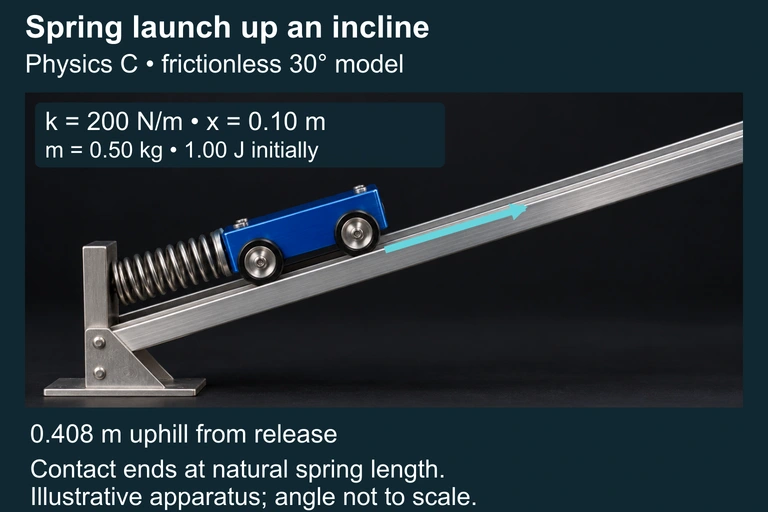
Supplementary Physics C model
This illustration presents a separate Physics C model; compare its stated assumptions and values with the example already shown.
A 0.50 kg block is placed against a spring (k = 200 N/m) compressed by 0.10 m at the base of a frictionless 30° incline. The spring is released. How far along the incline does the block travel before momentarily stopping? The system has elastic potential energy stored in the compressed spring and gravitational potential energy associated with the block's height on the incline. Because the surface is frictionless, there is no non-conservative work, so total mechanical energy is conserved: K_i + U_{s,i} + U_{g,i} = K_f + U_{s,f} + U_{g,f}.
Show answer and explanation
Step 1 — Identify the Energy Types: The system has elastic potential energy stored in the compressed spring and gravitational potential energy associated with the block's height on the incline. Because the surface is frictionless, there is no non-conservative work, so total mechanical energy is conserved: K_i + U_{s,i} + U_{g,i} = K_f + U_{s,f} + U_{g,f}. Step 2 — Choose Reference Points: Set U_g = 0 at the initial position of the block (bottom of the incline). Set U_s = 0 when the spring is at its natural length. The block starts from rest (K_i = 0) and momentarily stops at the top of its travel (K_f = 0). At the final position the spring is no longer in contact, so U_{s,f} = 0. Step 3 — Write the Conservation Equation: 0 + ½kx² + 0 = 0 + 0 + mgh. Here h is the height gained, which relates to the distance d along the incline by h = d sin 30°. So ½kx² = mgd sin 30°. Step 4 — Solve for d: d = kx² / (2mg sin 30°) = (200)(0.10)² / [2(0.50)(9.8)(0.50)] = (200)(0.01) / (4.9) = 2.0 / 4.9. d ≈ 0.41 m Step 5 — Verify Units & Reasonableness: Units: (N/m)(m²) / [(kg)(m/s²)] = N·m / N = m ✓. The block travels about 41 cm up the incline. Given a fairly stiff spring compressed 10 cm launching a light block on a modest incline, this result is physically reasonable.
Example 3: Combined Spring + Gravity
A \( 0.2\;\text{kg} \) ball sits atop a vertical spring (\( k = 500\;\text{N/m} \)), compressed \( 0.1\;\text{m} \). How high above the release point does the ball rise?
Common Mistakes
Question 1 of 5
A \( 3\;\text{kg} \) object falls from rest through a height of \( 5\;\text{m} \). What is its speed just before impact? (Use \( g = 10\;\text{m/s}^2 \)).
Question 2 of 5
A spring with \( k = 200\;\text{N/m} \) is compressed by \( 0.3\;\text{m} \). How much elastic potential energy is stored?
Question 3 of 5
If the potential energy function is \( U(x) = 4x^3 - 6x \), what is the force \( F(x) \)?
Question 4 of 5
On a \( U(x) \) diagram, a stable equilibrium point corresponds to:
Question 5 of 5
A block slides down a frictionless ramp of height \( h \) and then compresses a spring (constant \( k \)) at the bottom. What is the maximum compression \( x \)?