Newton's
Third Law
Every action has an equal and opposite reaction. Master the force pairs that govern all interactions in mechanics.
What Is a Force?
A force is a push or pull that one object exerts on another. Forces are vectors: they have both magnitude and direction. In Newtonian mechanics, forces always arise from interactions between two objects.
Forces Come in Pairs
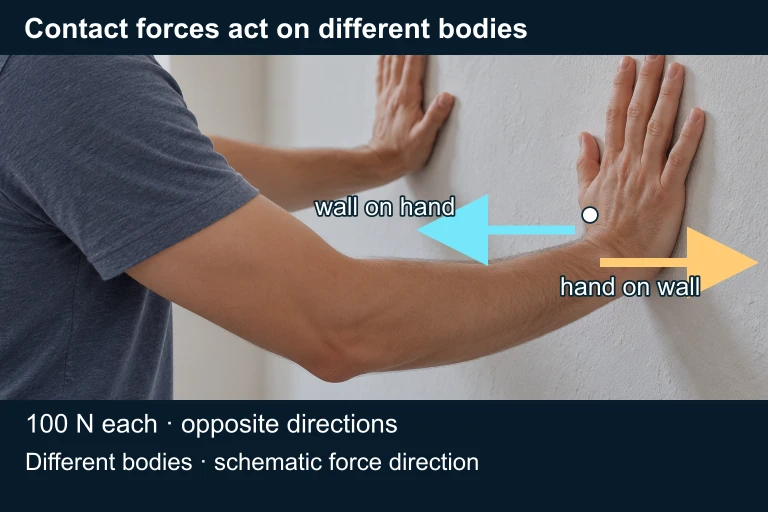
When object A pushes on object B, object B simultaneously pushes back on A. These two forces are called an action-reaction pair (or a Third-Law pair).
Why It Matters
Newton's Third Law is the foundation for understanding propulsion, collisions, and structural forces. Without it, we cannot correctly draw free-body diagrams or apply Newton's Second Law to multi-body systems.
The Formal Statement
Action-Reaction Diagram
Third-Law Pair vs. Balanced Forces
| Third-Law Pair | Balanced Forces | |
|---|---|---|
| Acts on | Two different objects | Same object |
| Force type | Same type (both gravitational, both normal, etc.) | Can be different types |
| Always equal? | Always, by law | Only when \( a = 0 \) |
| Cancel out? | Never (different objects) | Yes: \(\Sigma \vec{F} = 0\) |
| Example | Earth pulls you / you pull Earth | \(\vec{N}\) and \(\vec{W}\) on a book at rest |
Supplementary Physics C model
This illustration presents a separate Physics C model; compare its stated assumptions and values with the example already shown.
How to Identify a Pair
Example 1: Book on a Table
Example 2: Two Skaters Push Off
Example 3: Rope Tension
Connection to Momentum
Newton's Third Law is the reason momentum is conserved in isolated systems. If \(\vec{F}_{A \to B} = -\vec{F}_{B \to A}\) and both act for the same time \(\Delta t\), then:
This is the impulse-momentum theorem applied to each object. The Third Law guarantees that any momentum gained by one object is lost by the other.
Free-Body Diagrams and the Third Law
Application: Rocket Propulsion
Common Mistakes
Summary Checklist
| Property | Third-Law Pair |
|---|---|
| Number of objects | Always two |
| Magnitude | Equal: \(|\vec{F}_{A \to B}| = |\vec{F}_{B \to A}|\) |
| Direction | Opposite: \(\vec{F}_{A \to B} = -\vec{F}_{B \to A}\) |
| Force type | Same (gravitational ↔ gravitational, etc.) |
| Timing | Simultaneous: no delay |
| Net effect | Never cancel (different FBDs) |
| Consequence | Conservation of momentum |
Question 1 of 5
A \(1000 \text{ kg}\) car and a \(4000 \text{ kg}\) truck collide head-on. Which statement about the forces during the collision is correct?
Question 2 of 5
A book rests on a table. Which two forces form a Newton's Third-Law pair?
Question 3 of 5
Two ice skaters push off each other. Skater A has mass \(m\) and skater B has mass \(2m\). If skater A accelerates at \(a\), what is skater B's acceleration?
Question 4 of 5
A person stands in an elevator accelerating upward at \(2 \text{ m/s}^2\). The normal force on the person is greater than the person's weight. Is this a violation of Newton's Third Law?
Question 5 of 5
A horse pulls a cart forward. The horse claims: "By the Third Law, the cart pulls me backward with an equal force, so I can never accelerate." What is wrong with this argument?