Newton's Second Law
in Rotational Form
Explore how net torque drives angular acceleration, the rotational analog of \( \vec{F} = m\vec{a} \).
What Is Rotational Motion?
When an object spins about a fixed axis, every particle in the body traces a circular arc. Instead of describing each particle's linear motion, we use angular quantities that capture the rotation of the entire body in a single compact framework.
Torque: The Rotational Force
Torque measures the tendency of a force to cause rotation about an axis. It depends on how far from the axis the force is applied and at what angle.
Moment of Inertia: Rotational Mass
Just as mass resists changes in linear motion, the moment of inertia \( I \) resists changes in rotational motion. It depends on both the mass distribution and the chosen axis of rotation.
The Core Law: \( \sum\tau = I\alpha \)
Newton's Second Law for rotation states that the net torque on a rigid body about a fixed axis equals the product of its moment of inertia and its angular acceleration.
Formal Vector Statement
For a rigid body rotating about a fixed, symmetric axis, the full vector equation is:
Linear vs. Rotational Analogs
| Concept | Linear | Rotational |
|---|---|---|
| Cause of acceleration | Force \( F \) | Torque \( \tau \) |
| Resistance to acceleration | Mass \( m \) | Moment of inertia \( I \) |
| Acceleration | \( a \) (m/s²) | \( \alpha \) (rad/s²) |
| Newton's 2nd Law | \( \sum F = ma \) | \( \sum\tau = I\alpha \) |
| Velocity | \( v \) (m/s) | \( \omega \) (rad/s) |
| Momentum | \( p = mv \) | \( L = I\omega \) |
How to Apply the Law
Example 1: Simple Pulley
A uniform solid disk of mass \( M = 4 \) kg and radius \( R = 0.3 \) m serves as a frictionless pulley. A block of mass \( m = 2 \) kg hangs from a light string wrapped around the rim. Find the angular acceleration of the disk.
Example 2: Hinged Rod
A uniform thin rod of mass \( M = 3 \) kg and length \( L = 1.2 \) m is hinged at one end and released from horizontal. Find the initial angular acceleration.
Example 3: Two-Pulley Atwood
An Atwood machine uses a solid disk pulley (\( M = 6 \) kg, \( R = 0.2 \) m). Masses \( m_1 = 5 \) kg and \( m_2 = 3 \) kg hang from the string. Find \( \alpha \).
Supplementary Physics C model
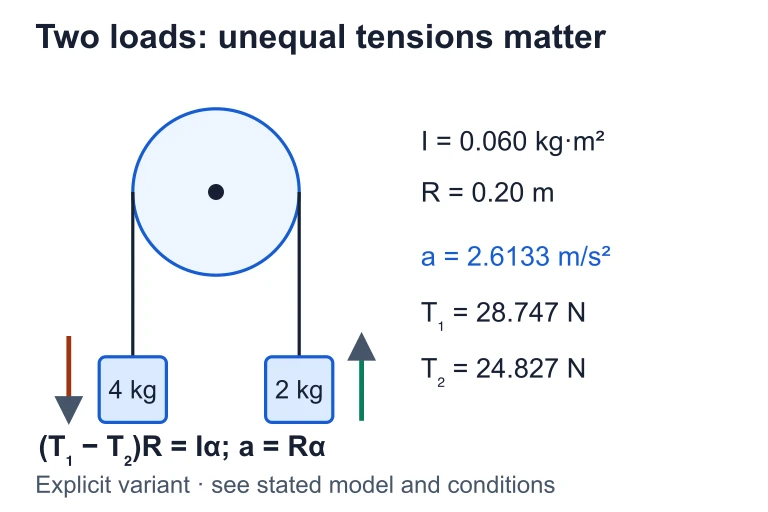
This illustration presents a separate Physics C model; compare its stated assumptions and values with the example already shown.
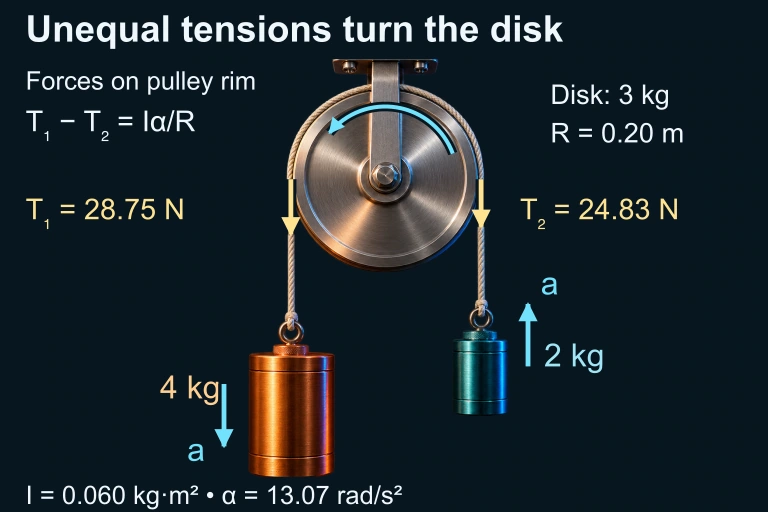
The classic Atwood machine with a massive pulley is a staple of AP Physics C: Mechanics because it simultaneously tests Newton's second law in both linear and rotational forms. Two blocks of mass m1 = 4.0 kg and m2 = 2.0 kg are connected by a massless string draped over a uniform solid disk pulley of mass M = 3.0 kg and radius R = 0.20 m. Find the angular acceleration of the pulley, the linear acceleration of the blocks, and the tension on each side of the string. Assume the string does not slip on the pulley. There are three objects: block 1 (4 kg, on the left, accelerates downward), block 2 (2 kg, on the right, accelerates upward), and the pulley (rotates counterclockwise). The string exerts different tensions T1 and T2 on each side because the pulley has mass. The no-slip condition links linear and angular quantities: a = Rα.
Show answer and explanation
Step 1 — Identify the system and draw free-body diagrams: There are three objects: block 1 (4 kg, on the left, accelerates downward), block 2 (2 kg, on the right, accelerates upward), and the pulley (rotates counterclockwise). The string exerts different tensions T1 and T2 on each side because the pulley has mass. The no-slip condition links linear and angular quantities: a = Rα. Step 2 — Write Newton's second law for each block: For block 1 (taking downward as positive): m1g − T1 = m1a. For block 2 (taking upward as positive): T2 − m2g = m2a. Step 3 — Write the rotational second law for the pulley: The net torque on the pulley comes from the two tensions acting at radius R. Taking counterclockwise as positive: T1R − T2R = Iα. For a uniform solid disk, I = ½MR². Using the no-slip condition α = a/R, this becomes (T1 − T2)R = ½MR²(a/R), which simplifies to T1 − T2 = ½Ma. Step 4 — Solve the system of three equations: Adding the three equations eliminates both tensions: m1g − m2g = (m1 + m2 + ½M)a. Substituting values: (4.0 − 2.0)(9.8) = (4.0 + 2.0 + 1.5)a → 19.6 = 7.5a → a = 2.61 m/s². a = 2.61 m/s² Step 5 — Find the angular acceleration: Using the no-slip condition: α = a/R = 2.61/0.20 = 13.1 rad/s². α = 13.1 rad/s² Step 6 — Find the tensions: From the block 1 equation: T1 = m1(g − a) = 4.0(9.8 − 2.61) = 28.8 N. From the block 2 equation: T2 = m2(g + a) = 2.0(9.8 + 2.61) = 24.8 N. Note that T1 > T2, as expected — the tension difference provides the net torque to accelerate the pulley. T₁ = 28.8 N, T₂ = 24.8 N
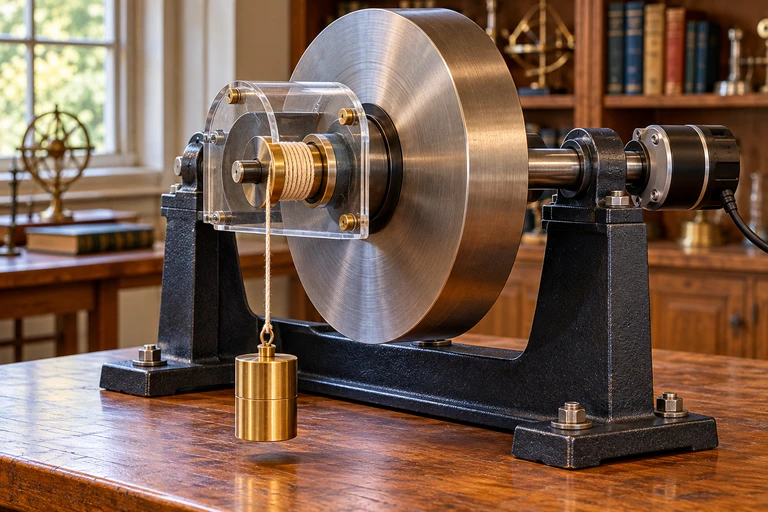
Measuring inertia through a revealed axle
For two loads linked over a massive pulley, unequal tensions supply the net pulley torque. With the heavier load labeled 1, combine the load equations with (T₁ − T₂)R = Iα and the no-slip condition a = Rα.Two loads and a massive pulley
For loads 4 kg and 2 kg, I = 0.060 kg·m² and R = 0.20 m, acceleration is about 2.6133 m/s². Tensions 28.747 N and 24.827 N satisfy (T₁ − T₂)R = Iα and a = Rα.Why the Axis Choice Matters
The moment of inertia \( I \) depends on the axis you choose. The parallel-axis theorem lets you shift from a center-of-mass axis to any parallel axis:
Rolling Without Slipping
When a round object rolls without slipping on a surface, the contact point has zero velocity. This gives the crucial constraint:
Connection to Rotational Energy
Newton's rotational second law is the dynamical approach: it gives accelerations. The energy approach provides an alternative, especially useful when forces are hard to track.
Common Mistakes to Avoid
Question 1 of 5
A net torque of 12 N·m is applied to a wheel with moment of inertia \( I = 4 \) kg·m². What is the angular acceleration?
Question 2 of 5
A uniform thin rod of mass \( M \) and length \( L \) is pivoted at one end. Its moment of inertia about that end is:
Question 3 of 5
A force of 10 N is applied perpendicular to a wrench at a distance of 0.25 m from the bolt. What is the torque on the bolt?
Question 4 of 5
In an Atwood machine with a massive pulley, the tension on the heavy side is \( T_1 \) and on the light side is \( T_2 \). Which statement is correct?
Question 5 of 5
A solid sphere and a hollow sphere of the same mass and radius roll down the same incline without slipping. Which reaches the bottom first?