01 / 20

Newton's Second Law
\( \vec{F} = m\vec{a} \)

Understand how net force, mass, and acceleration are connected: the cornerstone of classical mechanics.

AP Physics C: Mechanics

What is a Force?

A force is any interaction that, when unopposed, changes the motion of an object. Forces are vectors: they have both magnitude and direction. We measure force in newtons (N), where \( 1\;\text{N} = 1\;\text{kg} \cdot \text{m/s}^2 \).

Contact Forces
Push, pull, friction, tension, normal force: require physical contact.
Field Forces
Gravity, electromagnetic force: act at a distance through a field.

Mass vs. Weight

Mass \( m \)
Intrinsic property measuring resistance to acceleration (inertia). Scalar, measured in kg. Same everywhere in the universe.
Weight \( W \)
The gravitational force on an object: \( W = mg \). Vector, measured in N. Changes with the local value of \( g \).

Why Does This Law Matter?

Newton's Second Law is the equation of motion for classical mechanics. Given the forces on an object, it tells you exactly how that object will accelerate. This single relationship lets us:

1
Predict trajectories: from thrown baseballs to orbiting satellites.
2
Design structures: bridges, buildings, and vehicles must satisfy force-balance equations.
3
Solve for unknowns: if you know any two of \( \vec{F}_{\text{net}} \), \( m \), and \( \vec{a} \), you can find the third.

The Core Law

In component form for two dimensions:

\( x \)-direction
\( \sum F_x = m\,a_x \)
\( y \)-direction
\( \sum F_y = m\,a_y \)

A falling bead inside a transparent fluid column

One bead is immersed away from vessel walls below the free surface; circular magnifier depicts the same bead. Flow texture is uncalibrated; buoyancy/wall effects are excluded in the declared ideal model. Separate exact panel: A computed velocity curve rises from zero toward a dashed4.9m/s asymptote; downward-positive linear drag model is shown.A bead released from rest accelerates until upward drag balances its weight in the model. Linear and quadratic drag give different equations and approach curves, with coefficients and conditions specified separately.

Approaching terminal speed
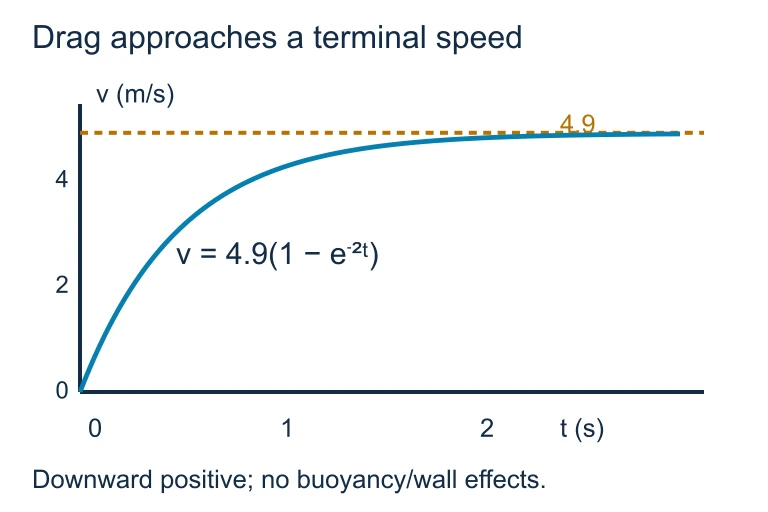
Approaching terminal speed. For downward motion from rest with linear drag and negligible buoyancy, v = 4.9(1 − e⁻²ᵗ) m/s. Acceleration decreases as speed approaches the terminal value 4.9 m/s.For downward motion from rest with linear drag and negligible buoyancy, v = 4.9(1 − e⁻²ᵗ) m/s. Acceleration decreases as speed approaches the terminal value 4.9 m/s.

The Free-Body Diagram

m W = mg N F f

First Law vs. Second Law

First Law (Inertia) Second Law (Dynamics)
Condition \( \vec{F}_{\text{net}} = 0 \) \( \vec{F}_{\text{net}} \neq 0 \)
Result Constant velocity (or rest) Acceleration \( \vec{a} = \vec{F}_{\text{net}} / m \)
Tells you What happens with no net force How much acceleration a net force produces
Special case? Yes: it is the \( \vec{a} = 0 \) case of the 2nd law General case

How to Apply the Law

1
Identify the system: Choose the object (or group of objects) you are analyzing.
2
Draw the free-body diagram: Sketch every external force on the object with correct directions.
3
Choose coordinate axes: Align one axis with the expected acceleration direction.
4
Resolve and sum forces: Write \( \sum F_x = m\,a_x \) and \( \sum F_y = m\,a_y \).
5
Solve: Use algebra to find the unknown(s) (acceleration, force, or mass).

Example 1: Horizontal Push

A 5 kg box on a frictionless surface is pushed with a horizontal force of 20 N. Find the acceleration.

5 kg 20 N a = ?

Example 2: Adding Friction

The same 5 kg box is now pushed with 20 N on a surface with kinetic friction \( f_k = 5\;\text{N} \). Find the acceleration.

5 kg 20 N 5 N

Example 3: Inclined Plane

A 10 kg block slides down a frictionless \( 30^\circ \) incline. Find the acceleration down the slope.

30° 10 kg mg sin θ mg N

The General Form

In AP Physics C, Newton's Second Law is often written in its more general momentum form:

When mass is constant, \( \frac{d\vec{p}}{dt} = m\frac{d\vec{v}}{dt} = m\vec{a} \), recovering the familiar form. But when mass changes (like a rocket burning fuel), you need the full derivative.

Connected Objects

When two objects are connected by a massless, inextensible string over a massless, frictionless pulley, they share the same magnitude of acceleration.

m₁ m₂ friction T m₂g T

Supplementary Physics C model

This illustration presents a separate Physics C model; compare its stated assumptions and values with the example already shown.

The Atwood machine is a classic system consisting of two masses connected by a light, inextensible string draped over an ideal (massless, frictionless) pulley. It elegantly demonstrates Newton's Second Law applied to a two-body system with a constraint. Suppose mass m₁ = 5.0 kg and mass m₂ = 3.0 kg are connected in this arrangement. Find the acceleration of the system and the tension in the string. Isolate each mass. For m₁ (heavier, accelerates downward): weight m₁g acts downward, tension T acts upward. For m₂ (lighter, accelerates upward): weight m₂g acts downward, tension T acts upward. The string is inextensible and massless, so the magnitude of tension is the same throughout and both masses have the same magnitude of acceleration a.

Show answer and explanation

Step 1 — Draw Free-Body Diagrams: Isolate each mass. For m₁ (heavier, accelerates downward): weight m₁g acts downward, tension T acts upward. For m₂ (lighter, accelerates upward): weight m₂g acts downward, tension T acts upward. The string is inextensible and massless, so the magnitude of tension is the same throughout and both masses have the same magnitude of acceleration a. Step 2 — Choose Sign Convention & Write ΣF = ma: Define positive as the direction of m₁'s motion (downward for m₁, upward for m₂). For m₁: m₁g − T = m₁a. For m₂: T − m₂g = m₂a. These are two equations with two unknowns (a and T). Step 3 — Solve for Acceleration: Add the two equations to eliminate T: m₁g − m₂g = (m₁ + m₂)a. Therefore a = (m₁ − m₂)g / (m₁ + m₂). Substituting: a = (5.0 − 3.0)(9.8) / (5.0 + 3.0) = (2.0)(9.8) / 8.0. a = 2.45 m/s² Step 4 — Solve for Tension: Substitute a back into the equation for m₂: T = m₂(g + a) = 3.0(9.8 + 2.45) = 3.0 × 12.25. T = 36.75 N Step 5 — Check Limiting Cases: If m₁ = m₂, then a = 0 and T = mg, consistent with static equilibrium. If m₂ = 0, then a = g and T = 0, consistent with free fall. Our answer falls between these limits (a = 2.45 m/s² < g and T = 36.75 N, which lies between m₂g = 29.4 N and m₁g = 49.0 N), so the result is physically reasonable.
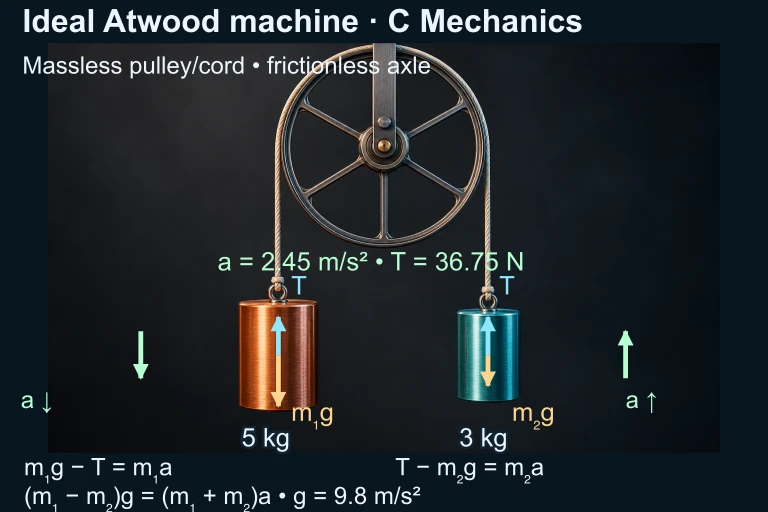
C Mechanics:5kg and3kg

Graphical Interpretation

For a fixed mass, force and acceleration are linearly proportional. The graph of \( F \) vs. \( a \) is a straight line through the origin with slope \( m \).

a F 0 Large m Small m slope = m

Common Mistakes

✕ Using total force, not net force
You must sum all forces vectorially. A single applied force is not \( F_{\text{net}} \) unless it is the only force present.
✕ Forgetting to decompose
On inclines, you must resolve gravity into components parallel and perpendicular to the surface.
✕ Mixing up mass and weight
Mass is in kg, weight is in N. Plugging weight into \( F = ma \) where \( m \) belongs gives the wrong answer.

Summary Table

Quantity Symbol Unit Type
Net force \( \vec{F}_{\text{net}} \) N (newton) Vector
Mass \( m \) kg Scalar
Acceleration \( \vec{a} \) m/s\(^2\) Vector
Momentum \( \vec{p} = m\vec{v} \) kg·m/s Vector
Weight \( W = mg \) N Vector (downward)

Question 1 of 5

A 4 kg object experiences a net force of 12 N. What is its acceleration?

Question 2 of 5

A 2 kg block is pushed with 10 N to the right while friction exerts 4 N to the left. What is the acceleration?

Question 3 of 5

A 5 kg block sits on a frictionless incline at \( 37^\circ \). What is the component of gravitational force along the incline? (Use \( g = 10\;\text{m/s}^2 \), \( \sin 37^\circ \approx 0.6 \))

Question 4 of 5

If the net force on an object is doubled while its mass remains constant, the acceleration:

Question 5 of 5

Newton's Second Law in its most general form is written as: