Motion of
Orbiting Satellites
Explore how gravitational force governs circular orbits, derive orbital velocity and period, and connect Kepler's laws to Newtonian mechanics.
What Is a Circular Orbit?
An orbiting satellite is in uniform circular motion: it moves at constant speed along a circular path around a central body. The only force acting on it is gravity, which provides the centripetal acceleration needed to curve its trajectory.
Gravity as the Centripetal Force
For a satellite of mass \( m \) orbiting a central body of mass \( M \) at radius \( r \), gravity is the only force. Newton's Second Law for circular motion gives:
The satellite mass \( m \) cancels from both sides, meaning orbital motion is independent of satellite mass. This is a direct consequence of the equivalence of gravitational and inertial mass.
Key Orbital Quantities
Deriving Orbital Velocity
Deriving Orbital Period
The satellite travels one circumference \( 2\pi r \) in one period \( T \):
Kepler's Third Law: \( T^2 \propto r^3 \)
LEO vs Geosynchronous Orbits
| LEO | GEO | |
|---|---|---|
| Altitude | 160 – 2000 km | ~35,786 km |
| Orbital speed | ~7.8 km/s | ~3.1 km/s |
| Period | ~90 min | ~24 hr |
| Use case | ISS, imaging | Comms, weather |
Gravitational Field Strength in Orbit
The gravitational field strength at orbital radius \( r \) is:
For an object in orbit at radius \( r \), we can also write orbital speed as \( v = \sqrt{g(r) \cdot r} \). Notice that \( g \) decreases with altitude: at the ISS (~400 km up), \( g \approx 8.7 \; \text{m/s}^2 \), not zero!
Energy of an Orbiting Satellite
Energy vs Orbital Radius
Supplementary Physics C model
This illustration presents a separate Physics C model; compare its stated assumptions and values with the example already shown.
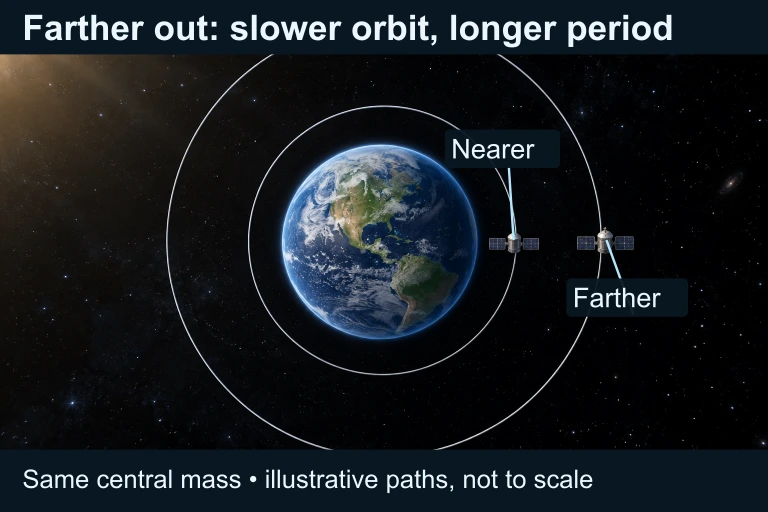
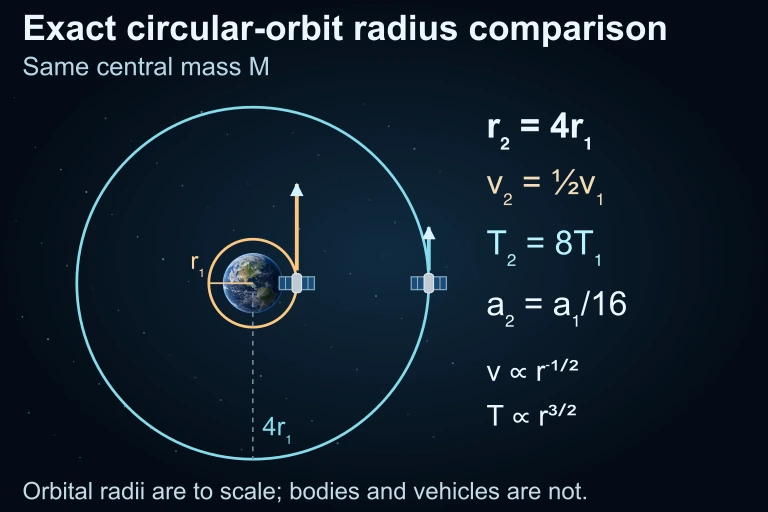
Two short burns and a long coast between orbits
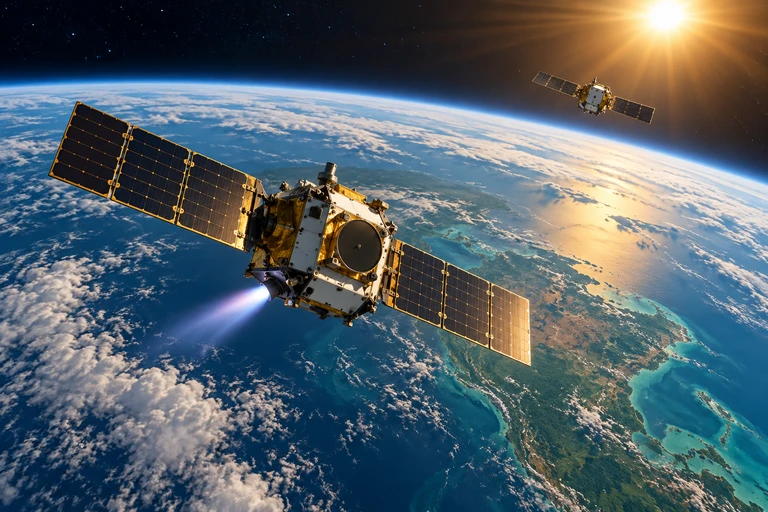 An outward two-burn transfer follows an ellipse between circular orbits. Ideal gravitational coasting conserves energy and angular momentum; the burns change both.
Two short burns and a long coast between orbits
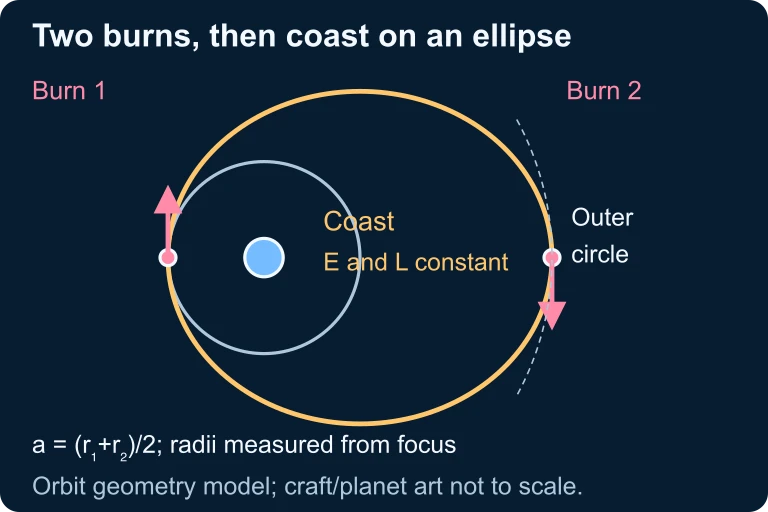 An outward two-burn transfer follows an ellipse between circular orbits. Ideal gravitational coasting conserves energy and angular momentum; the burns change both.
Energy across circular orbit states
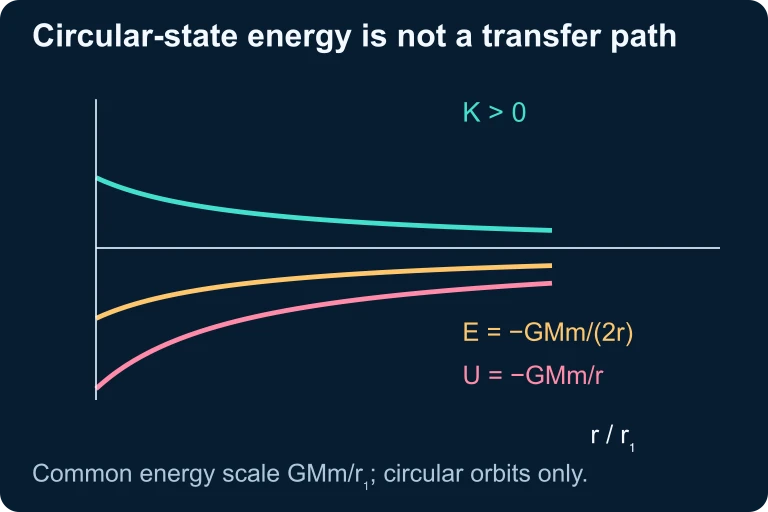 For circular orbits, K = GMm/(2r), U = −GMm/r and E = −GMm/(2r). These are different circular states, each with its own angular momentum; the curves are not a transfer trajectory.
How to Solve Orbital Problems
Example 1: ISS Orbital Speed
The ISS orbits at an altitude of 408 km above Earth's surface. Find its orbital speed. (\( R_E = 6.371 \times 10^6 \) m, \( M_E = 5.972 \times 10^{24} \) kg)
Example 2: Geosynchronous Orbit Radius
A geosynchronous satellite has \( T = 24 \) hr \( = 86{,}400 \) s. Find the orbital radius.
Example 3: Determining a Planet's Mass
A moon orbits a planet at \( r = 2.0 \times 10^8 \) m with a period of \( T = 1.5 \times 10^6 \) s. Find the planet's mass.
Common Mistakes
Summary of Key Equations
| Quantity | Equation | Depends On |
|---|---|---|
| Orbital Speed | \( v = \sqrt{GM/r} \) | \( M, r \) |
| Orbital Period | \( T = 2\pi\sqrt{r^3/(GM)} \) | \( M, r \) |
| Kinetic Energy | \( K = GMm/(2r) \) | \( M, m, r \) |
| Potential Energy | \( U = -GMm/r \) | \( M, m, r \) |
| Total Energy | \( E = -GMm/(2r) \) | \( M, m, r \) |
| Central Mass | \( M = 4\pi^2 r^3/(GT^2) \) | \( r, T \) |
Question 1 of 4
A satellite orbits Earth in a circular orbit of radius \( r \). If the orbit radius is doubled to \( 2r \), how does the orbital speed change?
Question 2 of 4
Two satellites orbit the same planet: Satellite A at radius \( r \) and Satellite B at radius \( 4r \). What is the ratio \( T_B / T_A \)?
Question 3 of 4
An astronaut in the ISS feels "weightless." This is because:
Question 4 of 4
A satellite's total mechanical energy in a circular orbit of radius \( r \) is \( E \). If it moves to an orbit of radius \( 2r \), its new total energy is: