Motion in Two or
Three Dimensions
Master position, velocity, and acceleration vectors in multiple dimensions: from projectile motion to circular paths and beyond.
What Is Multi-Dimensional Motion?
In one dimension, motion is described by a single coordinate. In two or three dimensions, we need a vector for every kinematic quantity: position, velocity, and acceleration each have independent components along each axis.
The Independence Principle
The most powerful idea in multi-dimensional kinematics: each component of motion is independent. The \(x\)-component equations know nothing about the \(y\)-component, and vice versa.
This means you can solve two separate 1D problems and combine the results. Time \(t\) is the link between the components.
Vector Kinematics in the Plane
Core Kinematic Equations in Vector Form
Projectile Motion
Uniform Circular Motion
Tangential vs Centripetal Acceleration
| Tangential \(a_t\) | Centripetal \(a_c\) | |
|---|---|---|
| Direction | Along the velocity (\(\vec{v}\)) | Toward center of curvature |
| Changes | Speed (magnitude of \(\vec{v}\)) | Direction of \(\vec{v}\) |
| Formula | \(a_t = \frac{d|\vec{v}|}{dt}\) | \(a_c = \frac{v^2}{r}\) |
| Zero when | Speed is constant | Path is a straight line (\(r \to \infty\)) |
| Total | \(\vec{a} = \vec{a}_t + \vec{a}_c\), \(|\vec{a}| = \sqrt{a_t^2 + a_c^2}\) | |
Acceleration follows the local bend
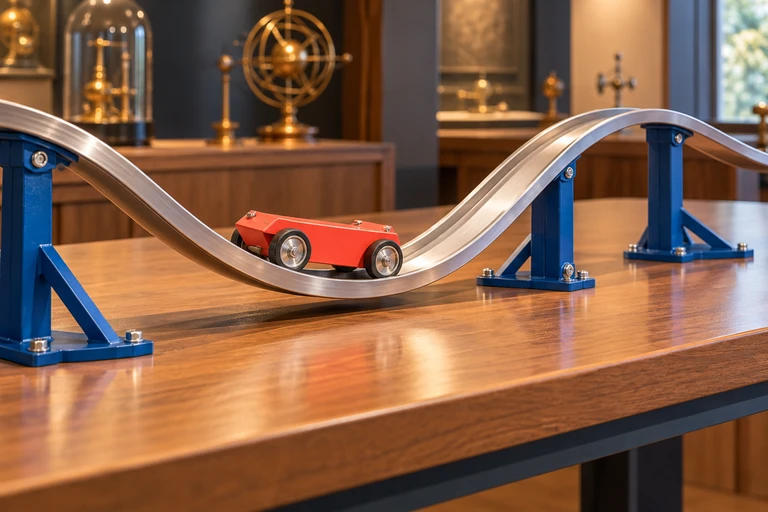 Velocity follows the local tangent to the path. Normal acceleration points toward the center of curvature, while tangential acceleration changes the speed.
Normal and tangential acceleration
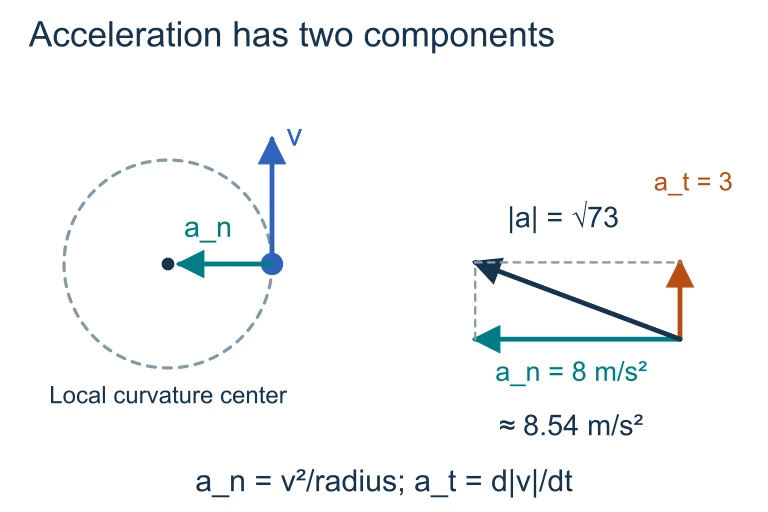 Velocity follows the local tangent to the path. Normal acceleration points toward the center of curvature, while tangential acceleration changes the speed.
Relative Motion in 2D
When two reference frames move relative to each other, velocities add as vectors. If frame B moves with velocity \(\vec{v}_{BA}\) relative to frame A:
This is essential for problems like a boat crossing a river, a plane in wind, or any problem where the "ground frame" differs from the object's immediate frame.
How to Solve 2D Problems
Example 1: Projectile Launch
A ball is launched at \(v_0 = 20 \text{ m/s}\) at \(\theta = 30^\circ\) above horizontal from ground level. Find the range and maximum height.
Example 2: Cliff Launch
A stone is thrown horizontally at \(v_0 = 15 \text{ m/s}\) from a cliff \(h = 45 \text{ m}\) high. Find the speed and angle of impact.
Example 3: Non-Uniform Circular Motion
A car travels around a curve of radius \(r = 50 \text{ m}\). At the instant its speed is \(v = 20 \text{ m/s}\) and increasing at \(3 \text{ m/s}^2\), find the magnitude of total acceleration.
Common Mistakes
Summary of 2D Motion Types
| Projectile | Uniform Circular | Non-Uniform Circular | |
|---|---|---|---|
| \(a_t\) (Tangential) | Non-zero (except at peak) | 0 | Non-zero |
| \(a_c\) (Centripetal) | Non-zero | Constant magnitude | Changes magnitude |
| Speed | Changes | Constant | Changes |
| Path | Parabola | Circle | Circle |
| Key formula | \(R = \frac{v_0^2 \sin 2\theta}{g}\) | \(a_c = \frac{v^2}{r}\) | \(|\vec{a}| = \sqrt{a_t^2 + a_c^2}\) |
Question 1 of 5
A projectile is launched at \(45^\circ\) with initial speed \(v_0\). What is its speed at the highest point?
Question 2 of 5
In uniform circular motion, the acceleration vector is directed:
Question 3 of 5
A ball is thrown horizontally from a height \(h\). Ignoring air resistance, how does the horizontal distance traveled depend on \(h\)?
Question 4 of 5
A car rounds a bend of radius \(r\) at speed \(v\). If the speed doubles, the centripetal acceleration becomes:
Question 5 of 5
A boat heads due north at \(5 \text{ m/s}\) relative to the water. The river flows east at \(3 \text{ m/s}\). What is the boat's speed relative to the ground?