01 / 21

Kinetic & Static
Friction

Master the forces that resist motion: understand when objects stay put, when they slide, and how to calculate friction using \( f = \mu N \).

AP Physics C: Mechanics

What Is Friction?

Friction is a contact force that acts parallel to the surfaces in contact and opposes relative motion (or the tendency of motion) between them. It arises from microscopic interactions between surface irregularities.

Static Friction
Prevents an object from starting to move. It adjusts to match the applied force up to a maximum.
Kinetic Friction
Acts on an object that is already sliding. It has a constant magnitude for a given pair of surfaces.

Forces on a Sliding Block

\(m\) \(mg\) \(N\) \(F\) \(f\)

Why Does Friction Matter?

Friction is essential to nearly every mechanical system. Without it, cars could not accelerate, you could not walk, and objects on inclines would always slide. In AP Physics C, friction problems appear in Newton's second law applications, inclined plane problems, and circular motion.

Traction
Tires grip the road via static friction, allowing acceleration and braking.
Walking
Your foot pushes backward; static friction pushes you forward.
Braking
Kinetic friction converts kinetic energy to thermal energy when sliding.

The Friction Model

Friction vs. Applied Force

Applied Force Friction \(\mu_s N\) \(\mu_k N\) Static \(f = F_{\text{app}}\) Kinetic \(f = \mu_k N\) Slides

Determining the Normal Force

The normal force \( N \) is not always equal to \( mg \). You must analyze forces perpendicular to the surface. Common scenarios:

1
Flat surface, no extra vertical forces: \( N = mg \)
2
Inclined plane (angle \( \theta \)): \( N = mg\cos\theta \)
3
Applied force with vertical component: \( N = mg - F\sin\theta \) (pushing up) or \( N = mg + F\sin\theta \) (pushing down)

Static vs. Kinetic: Key Differences

Property Static \( f_s \) Kinetic \( f_k \)
Object moving? No Yes (sliding)
Magnitude Variable: \( 0 \leq f_s \leq \mu_s N \) Constant: \( f_k = \mu_k N \)
Coefficient \( \mu_s \) (larger) \( \mu_k \) (smaller)
Direction Opposes tendency of motion Opposes actual motion
Equation type Inequality \( \leq \) Equality \( = \)

Step-by-Step Problem Solving

1
Draw a free-body diagram. Identify all forces on the object, including weight, normal, applied, and friction.
2
Choose a coordinate system. Align one axis parallel and one perpendicular to the surface.
3
Find the normal force. Apply \( \sum F_\perp = 0 \) to solve for \( N \).
4
Determine friction type. Is the object stationary or moving? Use \( f_s \leq \mu_s N \) or \( f_k = \mu_k N \).
5
Apply Newton's second law along the parallel axis: \( \sum F_\parallel = ma \). Solve for the unknown.

Example 1: Flat Surface

A \(10 \text{ kg}\) box sits on a flat surface. The coefficients of friction are \( \mu_s = 0.5 \) and \( \mu_k = 0.3 \). A horizontal force of \(40 \text{ N}\) is applied. Does the box move? If so, what is its acceleration?

Example 2: Inclined Plane

\(\theta\) \(m\) \(mg\) \(N\) \(f\) Components: \(mg\sin\theta\) (down slope) \(N = mg\cos\theta\)

Supplementary Physics C model

This illustration presents a separate Physics C model; compare its stated assumptions and values with the example already shown.

A 5.0 kg block is placed on a 30° incline. The coefficient of kinetic friction between the block and the surface is μₖ = 0.20. The block is sliding down the incline. Find the acceleration of the block down the incline. Orient the x-axis along the incline (positive down the slope) and the y-axis perpendicular to the surface (positive away from the surface). The forces are: weight mg downward, normal force N perpendicular to the surface, and kinetic friction fₖ up the incline (opposing the sliding direction).

Show answer and explanation

Step 1 — Draw the Free-Body Diagram & Choose Coordinates: Orient the x-axis along the incline (positive down the slope) and the y-axis perpendicular to the surface (positive away from the surface). The forces are: weight mg downward, normal force N perpendicular to the surface, and kinetic friction fₖ up the incline (opposing the sliding direction). Step 2 — Apply Newton's Second Law Perpendicular to the Incline: In the y-direction there is no acceleration, so ΣF_y = N − mg cos θ = 0, giving N = mg cos θ = (5.0)(9.8) cos 30° = (49)(0.866). N = 42.4 N Step 3 — Calculate the Kinetic Friction Force: With the block sliding, fₖ = μₖ N = (0.20)(42.4 N). fₖ = 8.49 N Step 4 — Apply Newton's Second Law Along the Incline: ΣF_x = mg sin θ − fₖ = ma. Substituting: (5.0)(9.8) sin 30° − 8.49 = (5.0) a, so 24.5 − 8.49 = 5.0 a, which gives 16.01 = 5.0 a. a = 3.2 m/s² down the incline Step 5 — Verify & Interpret: Without friction the acceleration would be g sin 30° = 4.9 m/s². Friction reduces this to 3.2 m/s², a decrease of about 35%. The result is positive (down the slope), confirming our assumed direction was correct.
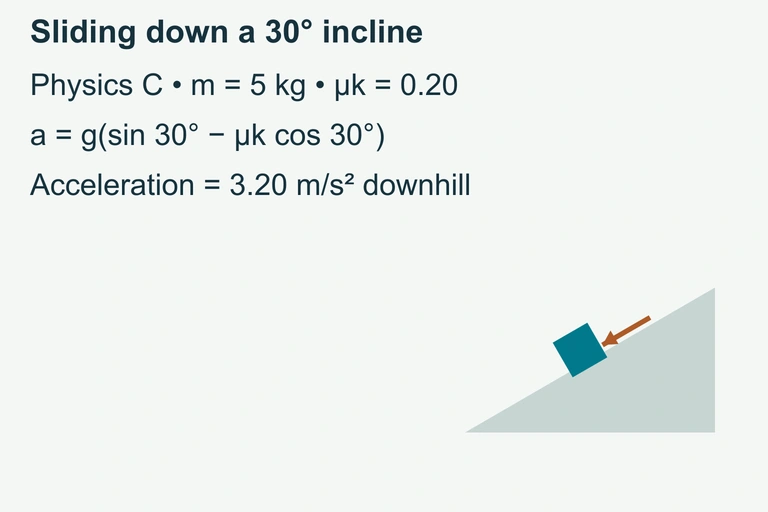
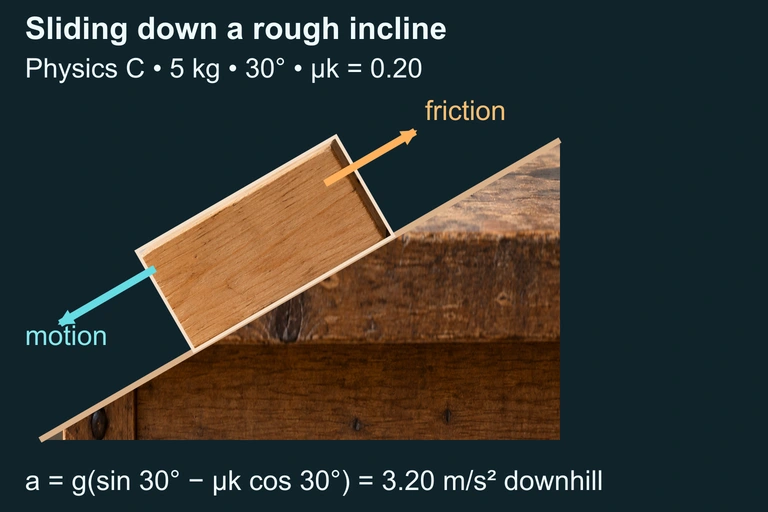
Sliding down a 30° incline; a separate idealized course-specific preset.
Sliding block • Physics C; exact schematic, not a measured apparatus.

Example 3: Finding \( \mu_s \)

A block is placed on a board. The board is slowly tilted. The block begins to slide when the angle reaches \( \theta = 35^\circ \). What is \( \mu_s \)?

Force at an Angle

\(m\) \(F\) \(\theta\) Components of F: \(F\cos\theta\) (horizontal) \(F\sin\theta\) (vertical, up)

Connected Systems with Friction

When two objects are connected (e.g., by a string over a pulley), friction on one object affects the entire system's acceleration. The strategy:

1
Draw separate FBDs for each object, including tension and friction on each.
2
Write Newton's second law for each object individually.
3
Use the constraint that both objects share the same magnitude of acceleration \( |a| \).
4
Add the equations to eliminate tension and solve for \( a \).

Common Mistakes

✕ Assuming \( N = mg \)
The normal force equals \( mg \) only on a flat surface with no vertical applied forces. On inclines or with angled pushes, you must solve for \( N \).
✕ Using \( \mu_s \) for moving objects
Once the object is sliding, switch to \( \mu_k \). Static friction only applies when the object is at rest relative to the surface.
✕ Treating \( f_s = \mu_s N \) as an equality
Static friction is an inequality. It only equals \( \mu_s N \) at the threshold of motion. Below that, \( f_s \) matches the applied force.

Summary of Key Formulas

Scenario Normal Force \( N \) Friction \( f \)
Flat, horizontal \( F \) \( mg \) \( \mu N \)
Incline angle \( \theta \) \( mg\cos\theta \) \( \mu mg\cos\theta \)
Pull at angle \( \theta \) up \( mg - F\sin\theta \) \( \mu(mg - F\sin\theta) \)
Push at angle \( \theta \) down \( mg + F\sin\theta \) \( \mu(mg + F\sin\theta) \)
At critical angle \( \theta_c \) \( mg\cos\theta_c \) \( mg\sin\theta_c \)

Question 1 of 5

A \(20 \text{ kg}\) crate on a flat floor has \( \mu_s = 0.4 \) and \( \mu_k = 0.25 \). A horizontal force of \(70 \text{ N}\) is applied. What is the friction force on the crate?

Question 2 of 5

A block slides down a \( 40^\circ \) incline with \( \mu_k = 0.3 \). What is its acceleration? (Use \( g = 9.8 \text{ m/s}^2 \))

Question 3 of 5

A block begins to slide on a board when the board is tilted to \( 28^\circ \). What is \( \mu_s \)?

Question 4 of 5

A \(15 \text{ kg}\) box is pulled across a floor by a rope at \( 30^\circ \) above horizontal with a force of \(80 \text{ N}\). If \( \mu_k = 0.2 \), what is the kinetic friction force?

Question 5 of 5

Which statement about friction is always true?