Gravitational
Force
Explore Newton's Law of Universal Gravitation, understand how mass and distance govern the attractive force between objects, and solve AP-level problems.
What is Gravity?
Gravity is a fundamental force of nature that attracts any two objects with mass toward each other. It is always attractive, never repulsive, and acts over infinite range: even at enormous distances, its effect never truly reaches zero.
Key Quantities
Why Gravity Matters
Gravitational force governs motion at every scale: from an apple falling from a tree to planets orbiting stars and galaxies clustering together. In AP Physics C, you need to:
Newton's Law of Universal Gravitation
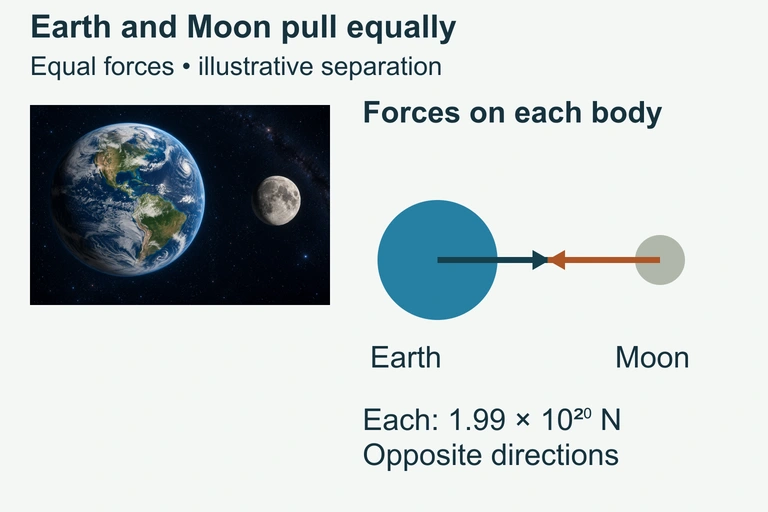
The force is attractive, directed along the line joining the centers. Both masses experience equal and opposite forces.
Supplementary Physics C model
This illustration presents a separate Physics C model; compare its stated assumptions and values with the example already shown.
The Inverse-Square Law
Gravitational force decreases with the square of the distance. If you double the separation, the force drops to one-quarter its original value.
Vector Form
Here \( \hat{r}_{12} \) is the unit vector pointing from \( m_1 \) to \( m_2 \). The negative sign ensures the force on \( m_2 \) points toward \( m_1 \): gravity is always attractive.
Gravitational Force vs Weight
| Gravitational Force | Weight | |
|---|---|---|
| Formula | \( F = \frac{Gm_1m_2}{r^2} \) | \( W = mg \) |
| Applies to | Any two masses, any distance | Object near a planet's surface |
| Varies with | Both masses and distance | Location (different \( g \)) |
| Key Insight | General law of nature | Special case when \( r \approx R_{\text{planet}} \) |
Gravitational Field \( \vec{g} \)
The gravitational field at a point in space is the force per unit mass that a test mass would experience there. It points radially inward toward the source mass \( M \).
A transparent planet with an ideal tunnel
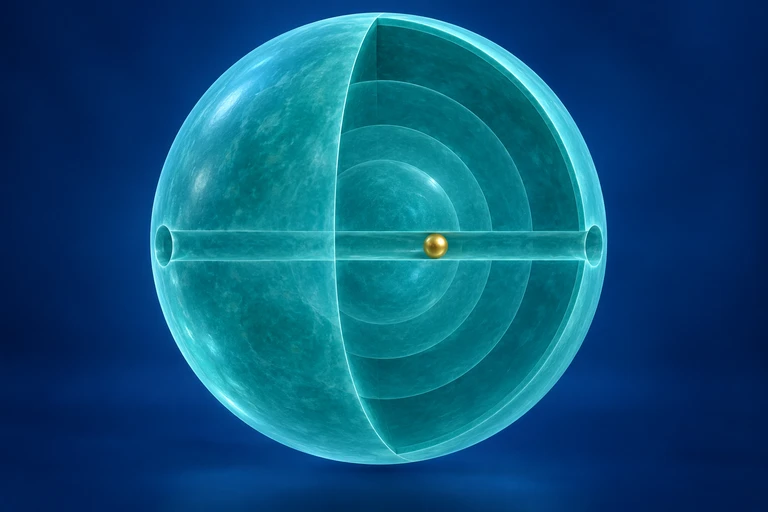 For a uniform-density sphere, the enclosed mass varies as r³ and the interior gravitational field varies linearly with radius. The field is zero at the center and joins continuously to the exterior inverse-square field.
Uniform solid sphere gravitational field
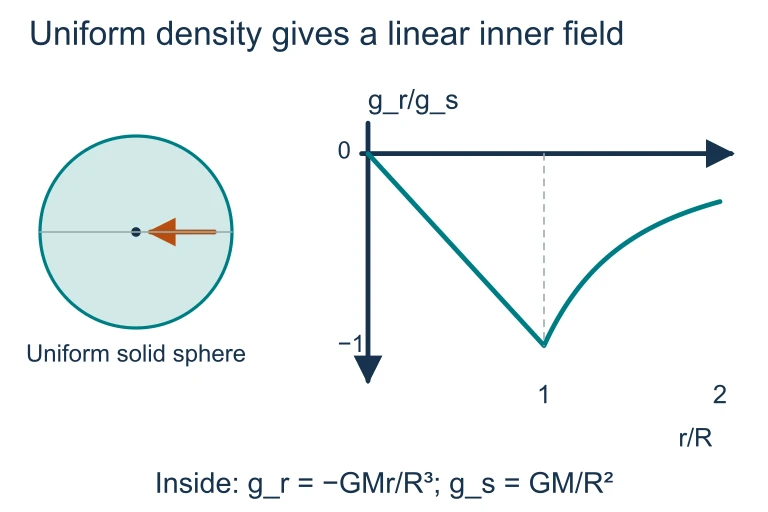 For a uniform-density sphere, the enclosed mass varies as r³ and the interior gravitational field varies linearly with radius. The field is zero at the center and joins continuously to the exterior inverse-square field.
Gravitational field of a thin shell
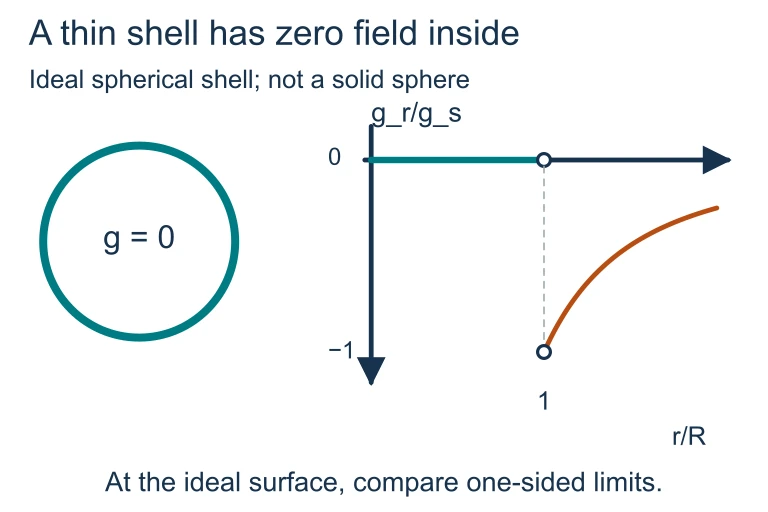 A uniform thin spherical shell has zero gravitational field everywhere inside. Outside, its field equals that of a point mass at its center; the ideal shell surface has distinct inner and outer limits.
Superposition Principle
When multiple masses are present, the total gravitational force on any object is the vector sum of the individual forces from each other mass:
This means you must compute each pairwise force independently, then add them as vectors (using components).
How to Apply the Law
Example 1: Two Masses
Two spheres of mass \( m_1 = 5.0 \; \text{kg} \) and \( m_2 = 8.0 \; \text{kg} \) are separated by \( r = 0.50 \; \text{m} \). Find the gravitational force between them.
Example 2: Surface Gravity
Derive the acceleration due to gravity at Earth's surface. Use \( M_E = 5.97 \times 10^{24} \; \text{kg} \), \( R_E = 6.37 \times 10^{6} \; \text{m} \).
Example 3: Altitude Effect
A satellite orbits at altitude \( h = R_E \) above Earth's surface (i.e., \( r = 2R_E \) from Earth's center). What is \( g \) at that altitude?
Doubling the distance from Earth's center reduces gravitational acceleration to one-quarter of the surface value: the inverse-square law in action.
Gravitational Potential Energy
Common Mistakes
Key Formulas Summary
| Quantity | Formula | Units |
|---|---|---|
| Gravitational Force | \( F = \frac{Gm_1m_2}{r^2} \) | N |
| Gravitational Field | \( g = \frac{GM}{r^2} \) | \(\text{m/s}^2\) or \(\text{N/kg}\) |
| Potential Energy | \( U = -\frac{Gm_1m_2}{r} \) | J |
| Escape Velocity | \( v_e = \sqrt{\frac{2GM}{R}} \) | \(\text{m/s}\) |
| Orbital Speed | \( v = \sqrt{\frac{GM}{r}} \) | \(\text{m/s}\) |
Question 1 of 5
If the distance between two masses is tripled, by what factor does the gravitational force change?
Question 2 of 5
What is the gravitational acceleration at a distance of \( 3R_E \) from Earth's center?
Question 3 of 5
Two identical masses are separated by distance \( d \). If one mass is doubled and the separation is halved, what happens to the force?
Question 4 of 5
The gravitational potential energy of two masses is \( U = -\frac{Gm_1m_2}{r} \). As the masses move closer together, what happens to \( U \)?
Question 5 of 5
A planet has twice Earth's mass and twice Earth's radius. What is the surface gravitational acceleration on this planet?