Frequency & Period
of Simple Harmonic Motion
Master the timing of oscillations: how \( T \) and \( f \) describe the rhythmic motion of springs, pendulums, and waves.
What is Simple Harmonic Motion?
Simple Harmonic Motion (SHM) is periodic motion in which a restoring force is directly proportional to the displacement from equilibrium and acts in the opposite direction:
Examples include a mass on a spring, the bob of a simple pendulum (for small angles), and many molecular vibrations. Two quantities completely describe the timing of SHM: period and frequency.
Visualizing an Oscillation Cycle
Defining Period and Frequency
Introducing Angular Frequency \( \omega \)
While \( f \) counts cycles per second, the angular frequency \( \omega \) measures radians per second. Since one full cycle is \( 2\pi \) radians:
\( \omega \) appears naturally in the position equation for SHM:
Here, \( A \) is the amplitude, \( \omega \) is the angular frequency, and \( \phi \) is the phase constant.
Mass-Spring: \( T \) and \( f \)
The spring has mass too
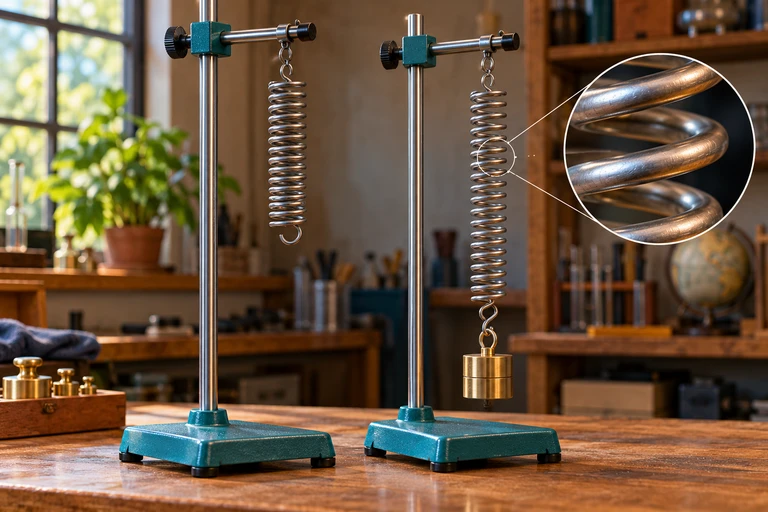 A spring has distributed mass as well as stiffness. An effective-mass model can include its contribution to the oscillator’s inertia.
A nonzero intercept can mean added inertia
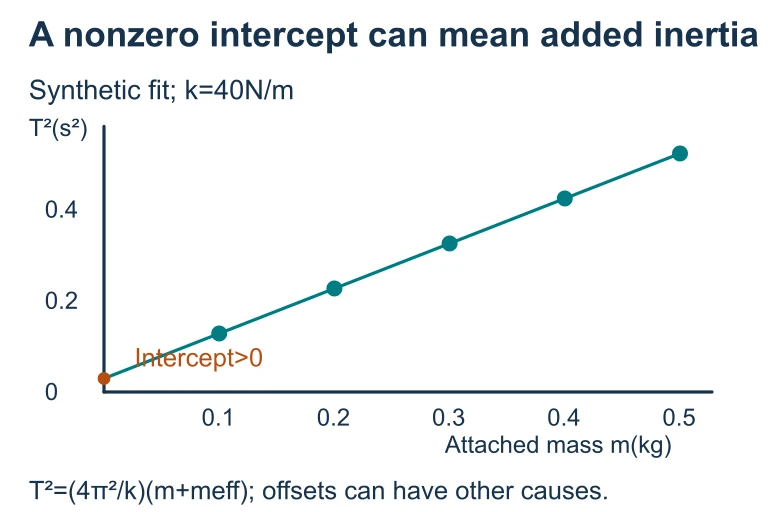 A spring has distributed mass as well as stiffness. An effective-mass model can include its contribution to the oscillator’s inertia.
Simple Pendulum: \( T \) and \( f \)
Spring vs Pendulum: What Matters?
| Property | Mass-Spring | Simple Pendulum |
|---|---|---|
| Period Formula | \( 2\pi\sqrt{m/k} \) | \( 2\pi\sqrt{L/g} \) |
| Depends on mass? | Yes | No |
| Depends on amplitude? | No | No (small angle) |
| Key parameter | Spring constant \( k \) | Length \( L \) |
| Effect of \( g \)? | None | Yes: larger \( g \) \(\to\) shorter \( T \) |
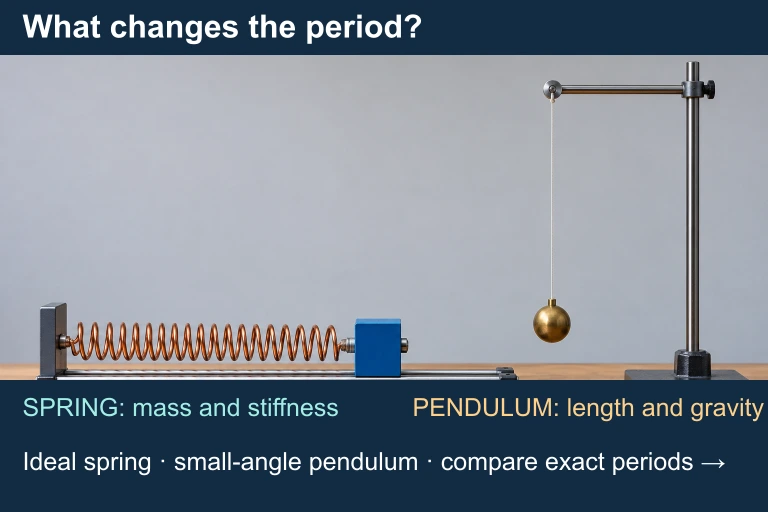
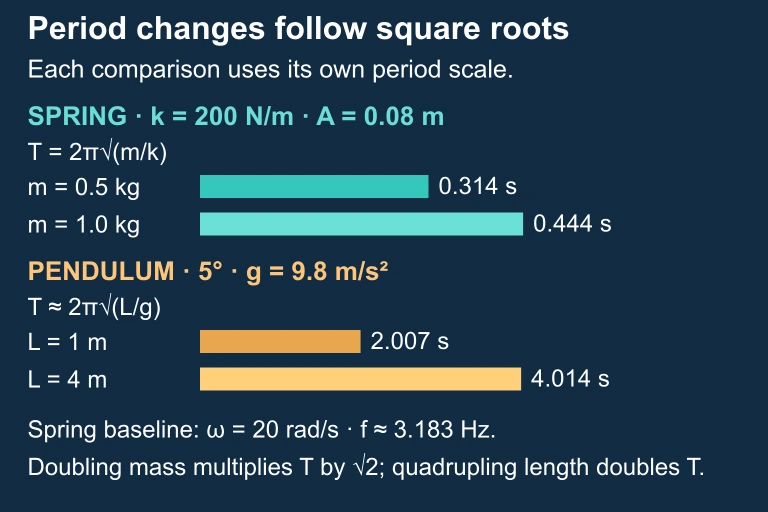
Supplementary Physics C model
This illustration presents a separate Physics C model; compare its stated assumptions and values with the example already shown.
Why is \( \omega = \sqrt{k/m} \)?
A transparent planet with an ideal tunnel
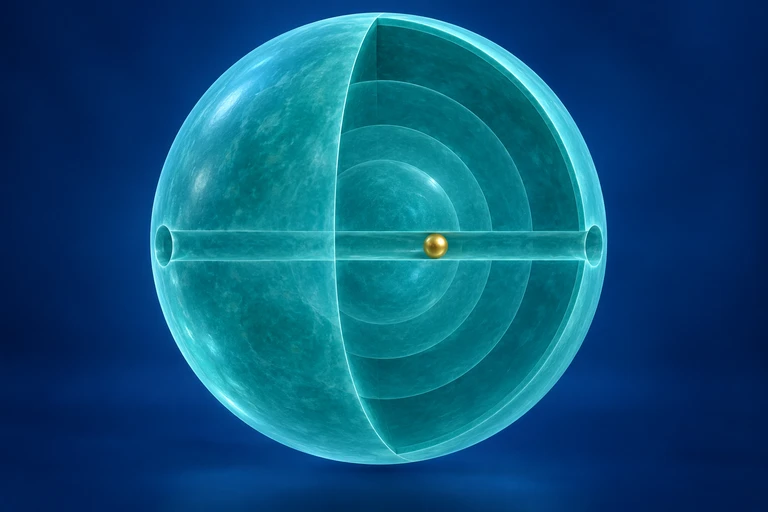 Along a narrow diameter tunnel through a uniform-density, nonrotating sphere, gravity provides a restoring acceleration x″ = −(GM/R³)x. The resulting period is 2π√(R³/GM).
Ideal tunnel oscillation
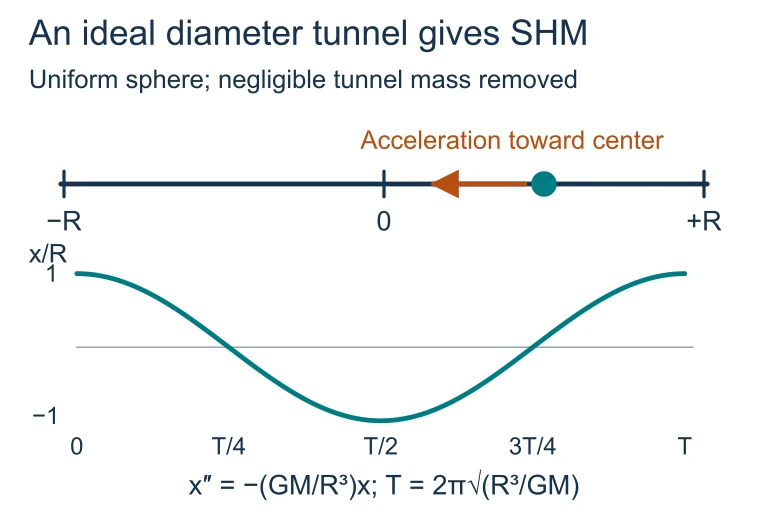 Along a narrow diameter tunnel through a uniform-density, nonrotating sphere, gravity provides a restoring acceleration x″ = −(GM/R³)x. The resulting period is 2π√(R³/GM).
How to Solve for \( T \) and \( f \)
Example 1: Mass on a Spring
A \( 0.50 \) kg block is attached to a spring with \( k = 200 \) N/m. Find the period, frequency, and angular frequency.
Example 2: Simple Pendulum
A pendulum of length \( L = 0.80 \) m swings on Earth (\( g = 9.8 \text{ m/s}^2 \)). Find \( T \) and \( f \).
Example 3: Finding the Spring Constant
A \( 2.0 \) kg mass oscillates on a spring with a frequency of \( f = 4.0 \) Hz. What is the spring constant \( k \)?
What Happens When You Double a Parameter?
| Change | Effect on \( T \) | Why? |
|---|---|---|
| Double \( m \) (spring) | \( T \) increases by \( \sqrt{2} \) | \( T \propto \sqrt{m} \) |
| Double \( k \) (spring) | \( T \) decreases by \( \sqrt{2} \) | \( T \propto 1/\sqrt{k} \) |
| Double \( L \) (pendulum) | \( T \) increases by \( \sqrt{2} \) | \( T \propto \sqrt{L} \) |
| Double \( A \) (either) | No change! | \( T \) is independent of \( A \) |
| Quadruple \( k \) | \( T \) is halved | \( \sqrt{4} = 2 \) |
Common Mistakes to Avoid
Question 1 of 5
A mass-spring system has \( m = 0.25 \) kg and \( k = 100 \) N/m. What is the period of oscillation?
Question 2 of 5
If the length of a simple pendulum is quadrupled, by what factor does the period change?
Question 3 of 5
A block oscillates on a spring with \( f = 5.0 \) Hz. What is the angular frequency \( \omega \)?
Question 4 of 5
A spring-mass system oscillates with \( T = 0.50 \) s. If the amplitude is doubled while everything else stays the same, the new period is:
Question 5 of 5
A pendulum has \( T = 2.0 \) s on Earth (\( g = 9.8 \text{ m/s}^2 \)). What is the length of the pendulum?