Energy of
Simple Harmonic Oscillators
Explore how kinetic energy and potential energy transform back and forth in oscillating systems, while total mechanical energy remains constant.
What is Simple Harmonic Motion?
Simple harmonic motion (SHM) occurs when a restoring force is directly proportional to displacement and directed toward the equilibrium position. The position as a function of time is:
Classic examples include a mass on a spring and a simple pendulum (for small angles). In each case, energy continuously converts between kinetic and potential forms.
Two Forms of Energy in SHM
Maximum at equilibrium where speed is greatest, zero at the turning points.
Maximum at the turning points (maximum displacement), zero at equilibrium.
Visualizing the Energy Exchange
Core Energy Equations
Since \( \omega^2 = k/m \), the total energy depends only on the spring constant \(k\) and the amplitude \(A\): it does not depend on mass alone or on the current position.
Energy vs. Time
Watching a damped oscillator lose its spiral
 In the zero-damping spring model, kinetic and potential energies vary with position and time while total mechanical energy stays constant.
Undamped energy exchange
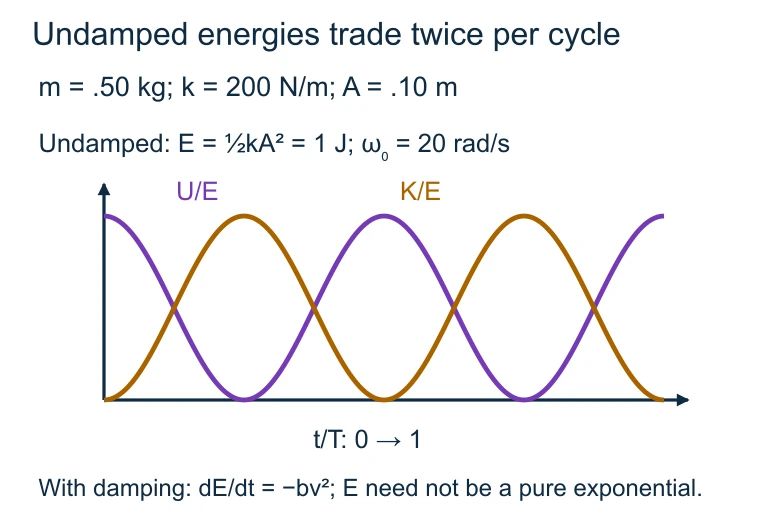 For m = 0.50 kg, k = 200 N/m and A = 0.10 m, total energy is 1 J and angular frequency is 20 rad/s. Kinetic and potential energies exchange at twice the displacement frequency.
Kinetic vs. Potential Energy
| Kinetic Energy \(K\) | Potential Energy \(U\) | |
|---|---|---|
| Formula | \(\tfrac{1}{2}mv^2\) | \(\tfrac{1}{2}kx^2\) |
| Maximum at | Equilibrium (\(x = 0\)) | Turning points (\(x = \pm A\)) |
| Zero at | Turning points | Equilibrium |
| Depends on | Mass & velocity | Spring constant & displacement |
| Oscillation freq. | \(2\omega\) | \(2\omega\) |
Deriving Total Energy
Finding Velocity from Energy
Energy conservation gives us a powerful way to find speed at any position without solving the full equation of motion:
How to Solve SHM Energy Problems
Example 1: Speed at a Position
A 0.5 kg block on a spring (\(k = 200\) N/m) oscillates with amplitude \(A = 0.1\) m. Find the speed when \(x = 0.06\) m.
Example 2: Finding Amplitude
A 2.0 kg mass on a spring (\(k = 50\) N/m) passes through equilibrium at \(v = 3.0\) m/s. What is the amplitude of oscillation?
Example 3: Energy Ratio
At what fraction of the amplitude is the kinetic energy equal to twice the potential energy?
The Potential Energy Well
Common Mistakes to Avoid
Summary of SHM Energy
| Quantity | Expression | Key Feature |
|---|---|---|
| Total Energy | \(\tfrac{1}{2}kA^2\) | Constant throughout motion |
| Kinetic Energy | \(\tfrac{1}{2}k(A^2 - x^2)\) | Max at \(x = 0\) |
| Potential Energy | \(\tfrac{1}{2}kx^2\) | Max at \(x = \pm A\) |
| Max Speed | \(\omega A = A\sqrt{k/m}\) | Occurs at equilibrium |
| \(K = U\) position | \(x = \pm A/\sqrt{2}\) | Each energy = \(E/2\) |
Question 1 of 5
A mass-spring system oscillates with amplitude \(A\). If the amplitude is tripled, what happens to the total mechanical energy?
Question 2 of 5
At what displacement does the kinetic energy equal the potential energy in a simple harmonic oscillator with amplitude \(A\)?
Question 3 of 5
A block on a spring (\(k = 100\) N/m) has total energy \(E = 2.0\) J. When the block is at \(x = 0.15\) m, what is its kinetic energy?
Question 4 of 5
A 0.4 kg mass oscillates on a spring with \( \omega = 10 \) rad/s and amplitude \( A = 0.2 \) m. What is the maximum speed?
Question 5 of 5
In SHM, the potential and kinetic energies each oscillate at frequency \(f_E\). How does \(f_E\) compare to the frequency \(f\) of the oscillator's motion?