01 / 21

Elastic & Inelastic
Collisions

Master the physics of momentum conservation and kinetic energy in collisions: from perfectly elastic bounces to perfectly inelastic stick-togethers.

AP Physics C: Mechanics

What Is a Collision?

A collision is a short-duration interaction between two or more objects in which internal forces dominate over external forces. During the collision interval, we treat the system as isolated, meaning the net external force is approximately zero.

What distinguishes collision types is whether kinetic energy is also conserved. That single criterion separates elastic from inelastic collisions.

Momentum Is Always Conserved

For any isolated system of two objects, the total momentum before the collision equals the total momentum after:

Before \(m_1\) \(v_{1i}\) \(m_2\) \(v_{2i}\) After \(m_1\) \(v_{1f}\) \(m_2\) \(v_{2f}\)

This equation holds for every collision type: elastic, inelastic, and perfectly inelastic. It is the starting point for every collision problem.

The Role of Kinetic Energy

While momentum is always conserved, kinetic energy may or may not be. The total kinetic energy of the system is:

Elastic
\( K_i = K_f \). Kinetic energy is fully conserved. Objects bounce apart.
Inelastic
\( K_i > K_f \). Some kinetic energy is converted to heat, sound, or deformation.
Perfectly Inelastic
\( K_f \) is minimized. Objects stick together and move as one mass.

Elastic Collision Equations

In an elastic collision, we have two conservation laws, giving us two equations for two unknowns (\( v_{1f} \) and \( v_{2f} \)):

1
Momentum: \( m_1 v_{1i} + m_2 v_{2i} = m_1 v_{1f} + m_2 v_{2f} \)
2
Kinetic energy: \( \frac{1}{2}m_1 v_{1i}^2 + \frac{1}{2}m_2 v_{2i}^2 = \frac{1}{2}m_1 v_{1f}^2 + \frac{1}{2}m_2 v_{2f}^2 \)

Perfectly Inelastic Collisions

When objects stick together after the collision, they share a common final velocity \( v_f \). Momentum conservation alone is sufficient:

Before \(m_1\) \(v_{1i}\) \(m_2\) at rest → After \(m_1\!+\!m_2\) \(v_f\)

This type of collision loses the maximum amount of kinetic energy. The lost energy goes into deformation, heat, and sound.

Elastic vs. Inelastic: Key Distinction

Property Elastic Inelastic Perfectly Inelastic
Momentum Conserved Conserved Conserved
Kinetic Energy Conserved Not conserved Max loss
Objects after Bounce apart Separate (deformed) Stick together
Equations needed 2 (\(p\) + \(K\)) 1 (\(p\)) + info 1 (\(p\) only)
Real example Billiard balls Car fender-bender Catching a ball

Energy Lost in a Perfectly Inelastic Collision

We can compute exactly how much kinetic energy is lost. If object 2 is initially at rest:

This can also be expressed as a fraction of the initial kinetic energy:

Notice: when \( m_2 \gg m_1 \), nearly all kinetic energy is lost. When \( m_1 \gg m_2 \), very little is lost: the heavy object barely slows down.

Special Cases in Elastic Collisions

Equal Masses
When \( m_1 = m_2 \) and \( v_{2i} = 0 \): object 1 stops, object 2 moves with \( v_{1i} \). They exchange velocities.
Heavy Hits Light
When \( m_1 \gg m_2 \): object 1 barely changes speed. Object 2 flies off at nearly \( 2v_{1i} \).
Light Hits Heavy
When \( m_1 \ll m_2 \): object 1 bounces back at nearly \( -v_{1i} \). Object 2 barely moves.

Coefficient of Restitution

The coefficient of restitution \( e \) quantifies how "bouncy" a collision is. It relates the relative velocities before and after:

1
\( e = 1 \): Perfectly elastic. Relative speed of separation equals relative speed of approach.
2
\( 0 < e < 1 \): Inelastic. Some kinetic energy is lost; objects separate but slower.
3
\( e = 0 \): Perfectly inelastic. Objects stick together; relative speed of separation is zero.

How to Solve Collision Problems

1
Identify the collision type. Do the objects stick together (perfectly inelastic)? Does the problem state elastic? If neither, assume general inelastic.
2
Choose a coordinate system. Define positive direction (usually the initial velocity direction of the heavier object).
3
Write momentum conservation: \( m_1 v_{1i} + m_2 v_{2i} = m_1 v_{1f} + m_2 v_{2f} \)
4
If elastic, add energy conservation (or use the velocity exchange formula). If perfectly inelastic, set \( v_{1f} = v_{2f} = v_f \).
5
Solve algebraically for the unknowns. Check: does the sign of each velocity make physical sense?

Example 1: Elastic Head-On Collision

A \(3\,\text{kg}\) cart moving at \(4\,\text{m/s}\) to the right collides elastically with a \(1\,\text{kg}\) cart at rest. Find the final velocities.

\(3\,\text{kg}\) \(4\,\text{m/s}\) \(1\,\text{kg}\) at rest

Check:
Momentum: \(p_i = 3(4) = 12\,\text{kg}\cdot\text{m/s}\). \(p_f = 3(2) + 1(6) = 12\,\text{kg}\cdot\text{m/s}\). ✓
Kinetic Energy: \(K_i = \frac{1}{2}(3)(4^2) = 24\,\text{J}\). \(K_f = \frac{1}{2}(3)(2^2) + \frac{1}{2}(1)(6^2) = 6 + 18 = 24\,\text{J}\). ✓

Supplementary Physics C model

This illustration presents a separate Physics C model; compare its stated assumptions and values with the example already shown.

A 3.0 kg cart moving at 4.0 m/s to the right collides elastically with a 1.0 kg cart initially at rest on a frictionless track. Find the final velocities of both carts and verify that kinetic energy is conserved. m₁ = 3.0 kg, v₁ᵢ = +4.0 m/s (rightward positive), m₂ = 1.0 kg, v₂ᵢ = 0 m/s. The collision is elastic, so both momentum and kinetic energy are conserved.

Show answer and explanation

Step 1 — Identify Given Values: m₁ = 3.0 kg, v₁ᵢ = +4.0 m/s (rightward positive), m₂ = 1.0 kg, v₂ᵢ = 0 m/s. The collision is elastic, so both momentum and kinetic energy are conserved. Step 2 — Apply Momentum Conservation: m₁v₁ᵢ + m₂v₂ᵢ = m₁v₁f + m₂v₂f. Substituting: (3.0)(4.0) + (1.0)(0) = 3.0·v₁f + 1.0·v₂f, which gives 12 = 3v₁f + v₂f. This is Equation (1). Equation (1): 3v₁f + v₂f = 12 Step 3 — Apply Relative Velocity Condition: For an elastic collision: v₁ᵢ − v₂ᵢ = −(v₁f − v₂f). Substituting: 4.0 − 0 = −(v₁f − v₂f), so v₂f − v₁f = 4.0. This is Equation (2). Using this linear equation rather than the quadratic KE equation greatly simplifies the algebra. Equation (2): v₂f − v₁f = 4.0 Step 4 — Solve the System: From Equation (2): v₂f = v₁f + 4.0. Substitute into Equation (1): 3v₁f + (v₁f + 4.0) = 12 → 4v₁f = 8.0 → v₁f = 2.0 m/s. Then v₂f = 2.0 + 4.0 = 6.0 m/s. Both velocities are positive, meaning both carts move to the right after the collision—but m₂ moves faster, so they separate. v₁f = +2.0 m/s, v₂f = +6.0 m/s Step 5 — Verify Kinetic Energy Conservation: KE_initial = ½(3.0)(4.0)² + ½(1.0)(0)² = 24.0 J. KE_final = ½(3.0)(2.0)² + ½(1.0)(6.0)² = 6.0 + 18.0 = 24.0 J. Since KE_initial = KE_final = 24.0 J, kinetic energy is indeed conserved, confirming the collision is elastic. KE_initial = KE_final = 24.0 J ✓ Step 6 — Cross-Check with Closed-Form Equations: Using the derived formulas: v₁f = [(m₁ − m₂)/(m₁ + m₂)]v₁ᵢ = [(3 − 1)/(3 + 1)](4.0) = (2/4)(4.0) = 2.0 m/s. v₂f = [2m₁/(m₁ + m₂)]v₁ᵢ = [2(3)/(4)](4.0) = (6/4)(4.0) = 6.0 m/s. Both match, providing a valuable sanity check on the algebraic solution. Confirmed: v₁f = 2.0 m/s, v₂f = 6.0 m/s
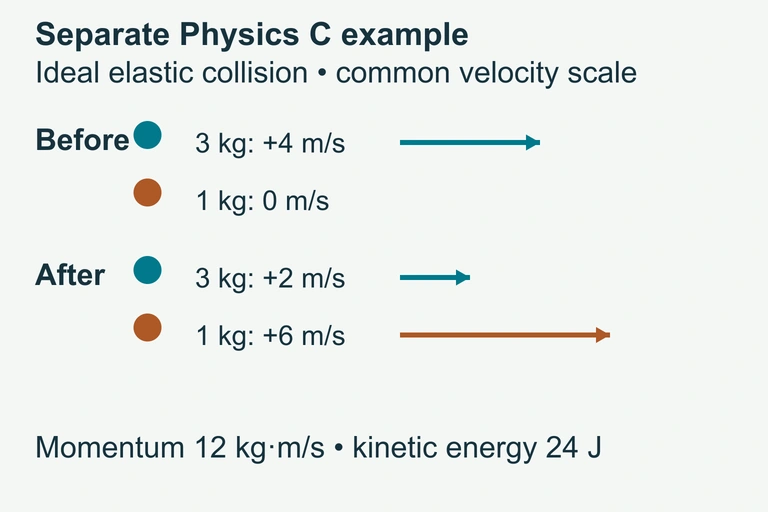
Separate idealized Physics C elastic collision example.

Example 2: Perfectly Inelastic

A \(5\,\text{kg}\) block moving at \(6\,\text{m/s}\) collides with and sticks to a \(3\,\text{kg}\) block moving at \(2\,\text{m/s}\) in the same direction. Find \( v_f \) and the energy lost.

Example 3: Perfectly Inelastic (Opposite Directions)

A \(2\,\text{kg}\) ball moving at \(+5\,\text{m/s}\) collides head-on and perfectly inelastically with a \(4\,\text{kg}\) ball moving at \(-3\,\text{m/s}\). Find the final velocity.

\(2\,\text{kg}\) \(+5\,\text{m/s}\) \(4\,\text{kg}\) \(-3\,\text{m/s}\)

Common Mistakes

Ignoring Signs
Velocity is a vector. Objects moving left or opposite to your positive direction must have negative velocity values.
Assuming KE Is Conserved
Kinetic energy is conserved only in elastic collisions. For inelastic problems, do not set \( K_i = K_f \).
Using Energy for Velocity
The energy equation uses \( v^2 \), which loses sign info. Always use momentum (linear in \( v \)) first.

Summary: Collision Formulas

Formula Elastic Perfectly Inelastic
Conservation Law \( p \) and \( K \) \( p \) only
\( v_{1f} \) \( \frac{m_1 - m_2}{m_1 + m_2}v_{1i} + \frac{2m_2}{m_1+m_2}v_{2i} \) \( \frac{m_1 v_{1i} + m_2 v_{2i}}{m_1+m_2} \)
\( v_{2f} \) \( \frac{2m_1}{m_1+m_2}v_{1i} + \frac{m_2 - m_1}{m_1+m_2}v_{2i} \)
Energy Lost 0 \( \frac{1}{2}\frac{m_1 m_2}{m_1+m_2}v_{rel}^2 \)
Restitution \( e \) 1 0

Question 1 of 5

Two identical objects collide elastically. Object A is initially moving at \(v\) and object B is at rest. What are their final velocities?

Question 2 of 5

A \(4\,\text{kg}\) object at \(3\,\text{m/s}\) collides with and sticks to a \(2\,\text{kg}\) object at rest. What is the final velocity?

Question 3 of 5

Which quantity is always conserved in any collision between two objects in an isolated system?

Question 4 of 5

In a perfectly inelastic collision, a \(1\,\text{kg}\) ball at \(10\,\text{m/s}\) strikes a \(4\,\text{kg}\) ball at rest. What fraction of the initial kinetic energy is lost?

Question 5 of 5

A collision has a coefficient of restitution \(e = 0.6\). What type of collision is this?