01 / 21

Simple Harmonic
Motion (SHM)

Master the physics of oscillation: from restoring forces to sinusoidal displacement, understand the foundation of periodic motion.

AP Physics C: Mechanics

What Is Oscillation?

An oscillation is any repetitive back-and-forth motion around a central position. When you pull a mass on a spring and release it, the mass moves back and forth: that is oscillation.

Eq. +A −A T (period)

Defining Simple Harmonic Motion

Simple Harmonic Motion occurs when the net force on an object is directly proportional to its displacement from equilibrium and always directed toward the equilibrium position:

This leads to the differential equation: \( m\ddot{x} = -kx \), or equivalently \( \ddot{x} + \omega^2 x = 0 \), where \( \omega = \sqrt{k/m} \).

The Restoring Force

m F x < 0 (compressed) x = 0 m F x > 0 (stretched)

Supplementary Physics C model

This illustration presents a separate Physics C model; compare its stated assumptions and values with the example already shown.
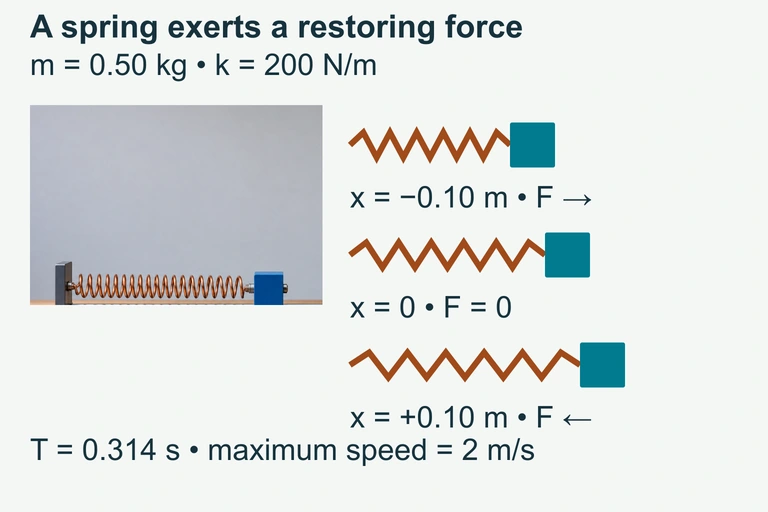
A spring exerts a restoring force. For m = 0.50 kg and k = 200 N/m, displacement −0.10 m gives rightward force, zero displacement gives zero force, and +0.10 m gives leftward force. T = 0.314 s and maximum speed is 2 m/s.

The SHM Differential Equation

Starting from Newton's second law with the restoring force:

1
Newton's 2nd Law: \( F = ma = m\ddot{x} \)
2
Set equal to restoring force: \( m\ddot{x} = -kx \)
3
Rearrange: \( \ddot{x} + \frac{k}{m}x = 0 \)
4
Define \( \omega^2 = \frac{k}{m} \), giving the SHM equation: \( \ddot{x} + \omega^2 x = 0 \)

The spring has mass too

Two hanging-spring setups and a coil close-up accompany a syntheticT²-versus-mass fit with a positive intercept.Measure displacement from equilibrium. For a linear restoring force, acceleration is proportional to that displacement and points in the opposite direction.

Displacement from loaded equilibrium
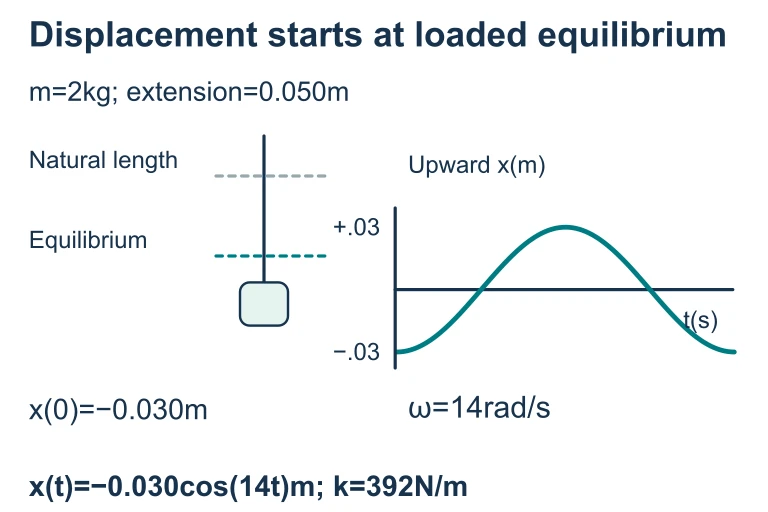
Displacement from loaded equilibrium. A 2 kg mass stretches the spring 0.050 m, giving k = 392 N/m and ω = 14 rad/s. With upward displacement measured from equilibrium and x(0) = −0.030 m, x(t) = −0.030 cos(14t) m.A 2 kg mass stretches the spring 0.050 m, giving k = 392 N/m and ω = 14 rad/s. With upward displacement measured from equilibrium and x(0) = −0.030 m, x(t) = −0.030 cos(14t) m.

Key Parameters of SHM

Amplitude \( A \)
Maximum displacement from equilibrium. Measured in meters.
Period \( T \)
Time for one full oscillation. \( T = \frac{2\pi}{\omega} \)
Frequency \( f \)
Oscillations per second. \( f = \frac{1}{T} = \frac{\omega}{2\pi} \)
Angular Freq \( \omega \)
Rate of angle change in radians/s. \( \omega = 2\pi f = \sqrt{k/m} \)
Phase \( \phi \)
Determines initial position and direction at \( t = 0 \).

Position, Velocity, Acceleration

\(x\)
Position: \( x(t) = A\cos(\omega t + \phi) \)
\(v\)
Velocity: \( v(t) = \frac{dx}{dt} = -A\omega\sin(\omega t + \phi) \)
\(a\)
Acceleration: \( a(t) = \frac{d^2x}{dt^2} = -A\omega^2\cos(\omega t + \phi) = -\omega^2 x \)

Graphs of \( x \), \( v \), and \( a \)

x(t) t v(t) a(t)
\(v\) leads \(x\) by \(90^\circ\)
\(a\) is \(180^\circ\) out of phase with \(x\)

SHM vs Periodic vs Oscillatory

Property Oscillatory Periodic SHM
Back-and-forth motion ✓ Not necessarily ✓
Repeats after fixed time Not necessarily ✓ ✓
Sinusoidal displacement Not necessarily Not necessarily ✓
\( F \propto -x \) Not necessarily Not necessarily ✓
Example Ball bouncing Uniform circular motion Mass on spring

Watching a damped oscillator lose its spiral

A spring cart on a rail connected to a cutaway fluid dashpot with a visible piston assembly.With linear damping, the phase trajectory contracts and mechanical energy decreases at the rate −bv². The undamped comparison has constant total mechanical energy.

Damping contracts the phase trajectory
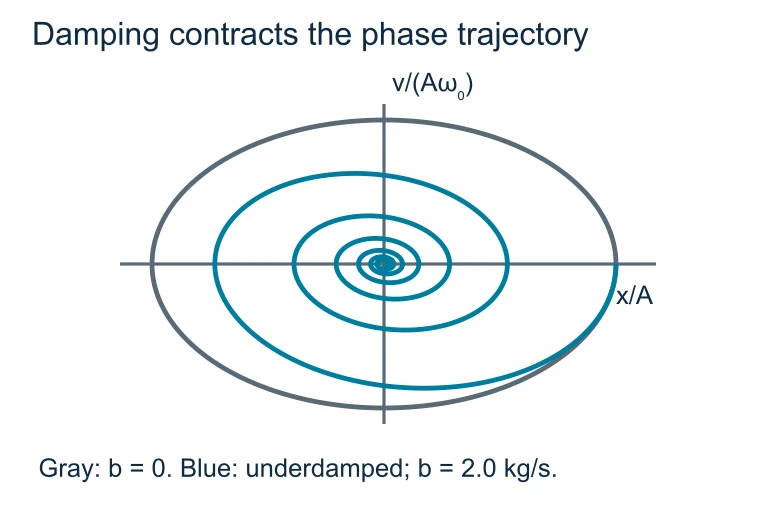
Damping contracts the phase trajectory. With linear damping, the phase trajectory contracts and mechanical energy decreases at the rate −bv². The undamped comparison has constant total mechanical energy.With linear damping, the phase trajectory contracts and mechanical energy decreases at the rate −bv². The undamped comparison has constant total mechanical energy.

Energy in SHM

Kinetic Energy
\( K = \frac{1}{2}mv^2 = \frac{1}{2}m\omega^2 A^2\sin^2(\omega t + \phi) \)
Potential Energy
\( U = \frac{1}{2}kx^2 = \frac{1}{2}kA^2\cos^2(\omega t + \phi) \)
t E E K U

Common SHM Systems

Mass-Spring
\( T = 2\pi\sqrt{\frac{m}{k}} \)
Restoring force: Hooke's Law \( F = -kx \)
Simple Pendulum
\( T = 2\pi\sqrt{\frac{L}{g}} \)
SHM only for small angles: \( \sin\theta \approx \theta \)
Physical Pendulum
\( T = 2\pi\sqrt{\frac{I}{mgd}} \)
Depends on moment of inertia \( I \) and pivot distance \( d \)

How to Identify SHM

1
Find the equilibrium position: Where is the net force zero?
2
Displace the object by a small amount \( x \) from equilibrium.
3
Write the net force as a function of displacement. Is it \( F_{\text{net}} = -(\text{constant}) \cdot x \)?
4
If yes: the system undergoes SHM with \( \omega = \sqrt{\frac{\text{constant}}{m}} \).
5
If no: the motion may be oscillatory but is not SHM.

Example 1: Mass-Spring System

A 0.5 kg mass is attached to a spring with \( k = 200 \) N/m. It is displaced 0.1 m from equilibrium and released from rest. Find the angular frequency, period, and maximum velocity.

1
Angular frequency: \( \omega = \sqrt{\frac{k}{m}} = \sqrt{\frac{200}{0.5}} = \sqrt{400} = 20 \) rad/s
2
Period: \( T = \frac{2\pi}{\omega} = \frac{2\pi}{20} = \frac{\pi}{10} \approx 0.314 \) s
3
Maximum velocity: \( v_{\max} = A\omega = (0.1)(20) = 2.0 \) m/s

Example 2: Identifying \( \omega \) from \( x(t) \)

A particle moves according to \( x(t) = 0.04\cos(5\pi t + \frac{\pi}{3}) \) meters. Find the amplitude, frequency, period, and maximum acceleration.

1
Amplitude: \( A = 0.04 \) m (coefficient of cosine)
2
Angular frequency: \( \omega = 5\pi \) rad/s, so \( f = \frac{\omega}{2\pi} = \frac{5\pi}{2\pi} = 2.5 \) Hz
3
Period: \( T = \frac{1}{f} = \frac{1}{2.5} = 0.4 \) s
4
Max acceleration: \( a_{\max} = A\omega^2 = (0.04)(5\pi)^2 = (0.04)(25\pi^2) \approx 9.87 \) m/s\(^2\)

Example 3: Energy Conservation

A 2.0 kg mass on a spring (\( k = 50 \) N/m, \( A = 0.2 \) m) passes through a point where \( x = 0.1 \) m. Find the speed at that point.

1
Total energy: \( E = \frac{1}{2}kA^2 = \frac{1}{2}(50)(0.2)^2 = 1.0 \) J
2
PE at \( x = 0.1 \): \( U = \frac{1}{2}(50)(0.1)^2 = 0.25 \) J
3
KE: \( K = E - U = 1.0 - 0.25 = 0.75 \) J
4
Speed: From \( K = \frac{1}{2}mv^2 \), we have \( v = \sqrt{\frac{2K}{m}} = \sqrt{\frac{2(0.75)}{2.0}} = \sqrt{0.75} \approx 0.866 \) m/s.

Common Mistakes

✕ Confusing \( \omega \) with \( f \)
\( \omega = 2\pi f \). Angular frequency is in rad/s, frequency is in Hz. Mixing these up changes answers by a factor of \( 2\pi \).
✕ Amplitude affects period
For SHM, the period is independent of amplitude. Doubling \( A \) does not change \( T \).
✕ Wrong sign on acceleration
\( a = -\omega^2 x \), not \( +\omega^2 x \). The negative sign is essential: it makes the force restoring.

Question 1 of 5

Which condition defines simple harmonic motion?

Question 2 of 5

A mass-spring system has \( k = 100 \) N/m and \( m = 0.25 \) kg. What is the period of oscillation?

Question 3 of 5

In SHM, when is the speed of the object at its maximum?

Question 4 of 5

A particle undergoes SHM with \( A = 0.06 \) m and \( \omega = 10 \) rad/s. What is the maximum acceleration?

Question 5 of 5

If the amplitude of a mass-spring system is doubled, what happens to the total mechanical energy?