01 / 21

Conservation of
Energy

Master the principle that energy cannot be created or destroyed: from kinetic and potential energy to the work-energy theorem and real-world applications.

AP Physics C: Mechanics

What Is Energy?

Energy is a scalar quantity that represents the capacity of a system to do work. In mechanics, we focus on two fundamental forms:

Kinetic Energy
Energy of motion: \( K = \frac{1}{2}mv^2 \). Depends on mass and the square of velocity.
Potential Energy
Stored energy due to position or configuration: \( U_g = mgh \) for gravity, \( U_s = \frac{1}{2}kx^2 \) for springs.

The Work-Energy Theorem

The net work done on an object equals the change in its kinetic energy. This is the bridge between forces and energy:

Work done by a variable force along a path is computed with a line integral:

When only conservative forces do work, we can define potential energy and unlock the conservation law.

Conservative vs Non-Conservative Forces

Whether a force is conservative determines if we can use energy conservation directly.

Conservative
Work is path-independent: depends only on start and end positions. Work around any closed loop is zero. Examples: gravity, spring force, electrostatic force.
Non-Conservative
Work is path-dependent: depends on the trajectory taken. Energy is converted to thermal or other forms. Examples: friction, air resistance, applied pushes.

The Conservation of Energy Law

When non-conservative forces (like friction) also act, energy is still conserved globally, but mechanical energy changes:

Here \( W_{\text{nc}} \) is the work done by all non-conservative forces. For friction, \( W_{\text{nc}} < 0 \), so the system loses mechanical energy.

Visualizing Energy: Bar Charts

Energy bar charts show how kinetic and potential energy trade off while total energy stays constant (no friction).

Top of Hill Midway Bottom K U K U K U E total

Potential Energy and Force

For a conservative force in one dimension, the force is the negative derivative of the potential energy function:

In three dimensions, the force is the negative gradient of the potential energy:

This means the force always points in the direction of decreasing potential energy: objects naturally "roll downhill" on a \( U(x) \) curve.

Potential Energy Diagrams

x U(x) E Stable Unstable Stable Unstable TP
Stable Equilibrium
Local minimum of \( U(x) \). If displaced, the restoring force pushes the object back.
Unstable Equilibrium
Local maximum of \( U(x) \). Any small displacement causes the object to accelerate away.
Turning Points
Where \( E = U(x) \), so \( K = 0 \). The object reverses direction here.

Energy vs Momentum

Both are conserved quantities, but they describe different aspects of motion and obey different rules.

Energy Momentum
Type Scalar Vector
Formula \( K = \frac{1}{2}mv^2 \) \( \vec{p} = m\vec{v} \)
Conserved when No non-conservative work No net external force
Changed by Net work \( W_{\text{net}} \) Impulse \( \vec{J} = \vec{F}\Delta t \)
In collisions Conserved only if elastic Always conserved

How to Apply the Method

1
Define the system. Identify the object(s) and what forces act: gravity, springs, friction, applied forces.
2
Choose two states. Pick the initial state (i) and final state (f) for which you know or want quantities.
3
Set the reference point. Choose where \( U = 0 \) (typically ground level for gravity, natural length for springs).
4
Write the energy equation. \( K_i + U_i + W_{\text{nc}} = K_f + U_f \). If no friction/applied work, set \( W_{\text{nc}} = 0 \).
5
Substitute and solve. Plug in known values and solve for the unknown (speed, height, spring compression, etc.).

Example 1: Frictionless Slide

A child of mass \( m = 30 \) kg starts from rest at the top of a \( h = 5 \) m frictionless slide. Find the speed at the bottom.

h i f v

Example 2: Spring Launch

A block of mass \( m = 0.5 \) kg is pushed against a spring (\( k = 200 \) N/m) compressed by \( x = 0.3 \) m. After release, the block slides up a frictionless ramp. How high does it go?

h = ? f x = 0.3 m

Example 3: With Friction

A 2 kg block slides down a \( h = 3 \) m ramp with friction coefficient \( \mu_k = 0.2 \). The ramp is inclined at 30°. Find the speed at the bottom.

Supplementary Physics C model

This illustration presents a separate Physics C model; compare its stated assumptions and values with the example already shown.

A cart of mass m = 500 kg starts from rest at the top of a frictionless hill of height h₁ = 40 m. It descends and then travels along a rough horizontal surface of length L = 100 m where the coefficient of kinetic friction is μk = 0.10. It then ascends a second frictionless hill. Find the maximum height h₂ the cart reaches on the second hill. The system consists of the cart and the Earth. Relevant energy forms are gravitational potential energy U = mgh and kinetic energy K = ½mv². Friction acts on the horizontal stretch as a non-conservative force. On the frictionless hills, only gravity (conservative) does work.

Show answer and explanation

Step 1 — Identify the System and Energy Types: The system consists of the cart and the Earth. Relevant energy forms are gravitational potential energy U = mgh and kinetic energy K = ½mv². Friction acts on the horizontal stretch as a non-conservative force. On the frictionless hills, only gravity (conservative) does work. Step 2 — Write the General Energy Equation: Using Ki + Ui + Wnc = Kf + Uf. The initial state is the cart at rest at height h₁; the final state is the cart at rest at maximum height h₂ on the second hill. Step 3 — Evaluate Initial and Final Energies: Ki = 0 (starts from rest), Ui = mgh₁. Kf = 0 (momentarily at rest at peak), Uf = mgh₂. The equation becomes: mgh₁ + Wnc = mgh₂. Step 4 — Calculate Non-Conservative Work: On the horizontal surface, friction does negative work: Wfriction = −fk × L = −μkmgL = −(0.10)(500)(9.8)(100) = −49,000 J. Wnc = −49,000 J Step 5 — Solve for h₂: Substituting: mgh₁ + Wnc = mgh₂ → h₂ = h₁ + Wnc/(mg) = 40 + (−49,000)/((500)(9.8)) = 40 − 10 = 30 m. h₂ = 30 m Step 6 — Verify and Interpret: The cart loses 10 m worth of gravitational PE to friction, which converts 49 kJ of mechanical energy into thermal energy. Notice that we never needed to find the cart's speed at the bottom of the first hill—energy methods let us connect the initial and final states directly, which is precisely why conservation of energy is so powerful.
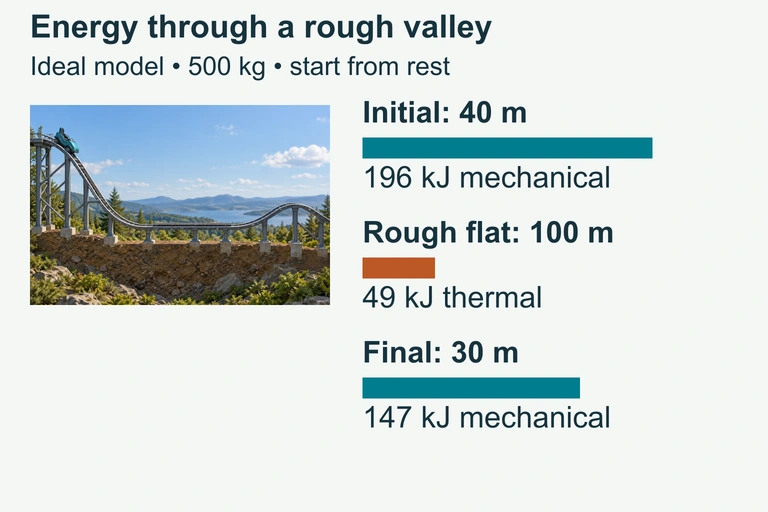
AP Physics C model: a 500 kg car begins at rest at 40 m, loses 49 kJ on a 100 m rough horizontal section with μ_k = 0.10, and reaches a 30 m turning height. This is a separate model from the AP Physics 1 two-hill example.

Energy and Power

Power is the rate at which energy is transferred or work is done. It connects energy conservation to time-dependent problems.

Average Power
\( P_{\text{avg}} = \frac{W}{\Delta t} = \frac{\Delta E}{\Delta t} \)
Instantaneous Power
\( P = \frac{dW}{dt} = \vec{F} \cdot \vec{v} \)

Common Mistakes

✕ Forgetting Reference Point
Not choosing a consistent \( U = 0 \) reference. If you set ground level as zero for one state, you must use the same reference for all states.
✕ Sign of \( W_{\text{nc}} \)
Friction always does negative work. Students sometimes add friction energy instead of subtracting it, getting speeds that are too high.
✕ Using Energy When Forces Are Needed
Energy conservation gives speeds, not accelerations. If the problem asks for force or acceleration at a point, use Newton's second law or \( F = -dU/dx \).

Summary of Key Formulas

Concept Formula When to Use
Kinetic Energy \( K = \frac{1}{2}mv^2 \) Object in motion
Gravitational PE \( U_g = mgh \) Near Earth's surface
Spring PE \( U_s = \frac{1}{2}kx^2 \) Compressed/stretched spring
Conservation \( K_i + U_i = K_f + U_f \) Only conservative forces
With Friction \( K_i + U_i + W_{\text{nc}} = K_f + U_f \) Non-conservative forces present
Force from PE \( F = -\frac{dU}{dx} \) Finding force from PE curve
Power \( P = \vec{F} \cdot \vec{v} \) Rate of energy transfer

Question 1 of 5

A ball is dropped from a height of 20 m (no air resistance). What is its speed just before hitting the ground?

Question 2 of 5

A spring with \( k = 500 \) N/m is compressed by 0.2 m. How much elastic potential energy is stored?

Question 3 of 5

A block slides down a rough incline and arrives at the bottom slower than on a frictionless incline. Which statement best explains why?

Question 4 of 5

At a point where \( U(x) \) has a local minimum, a particle in equilibrium is displaced slightly. What happens?

Question 5 of 5

A car engine delivers 60 kW of power. If the car moves at a constant 30 m/s against a resistive force, what is the magnitude of that resistive force?