Conservation of
Angular Momentum
Explore how rotating systems conserve angular momentum when no external torques act: from spinning figure skaters to collapsing stars.
What Is Angular Momentum?
Angular momentum is the rotational analog of linear momentum. Just as a moving object has linear momentum \( p = mv \), a spinning or orbiting object has angular momentum that quantifies how much "rotational motion" it carries.
Direction via the Right-Hand Rule
Why Does It Matter?
Conservation of angular momentum is one of the fundamental conservation laws in physics, arising from rotational symmetry of space (Noether's theorem). It governs phenomena across every scale:
The Conservation Law
This is the rotational analog of Newton's second law in impulse form. Recall that:
Torque as the Rate of Change of \( \vec{L} \)
Linear vs Angular Momentum
| Linear | Angular | |
|---|---|---|
| Quantity | \( \vec{p} = m\vec{v} \) | \( \vec{L} = I\vec{\omega} \) |
| Inertia term | Mass \( m \) | Moment of inertia \( I \) |
| Agent of change | Force \( \vec{F} \) | Torque \( \vec{\tau} \) |
| Conservation condition | \( \vec{F}_{\text{ext}} = 0 \) | \( \vec{\tau}_{\text{ext}} = 0 \) |
| Can change independently? | \( m \) is constant | \( I \) can change |
When Is \( \vec{L} \) Conserved?
How to Apply the Conservation Law
Example 1: Figure Skater
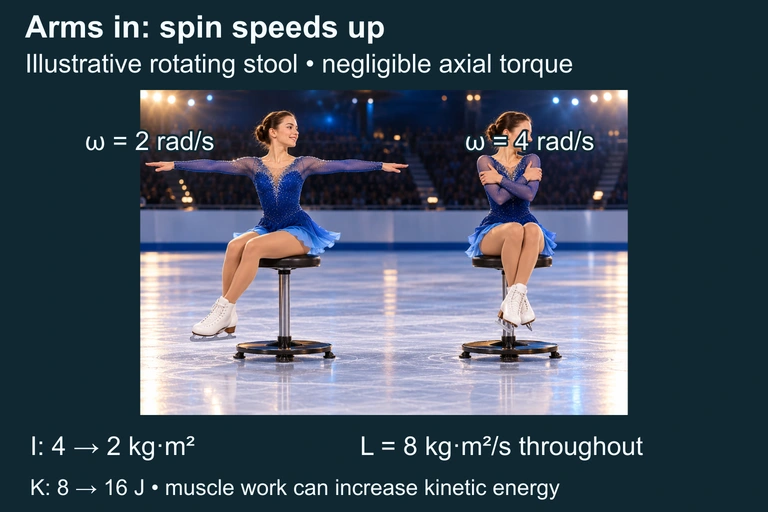
Supplementary Physics C model
This illustration presents a separate Physics C model; compare its stated assumptions and values with the example already shown.
A figure skater is spinning with arms extended. She then pulls her arms close to her body. Which of the following correctly describes the changes in her angular velocity ω, moment of inertia I, and rotational kinetic energy KE? A. ω increases, I decreases, KE stays the same B. ω increases, I decreases, KE increases C. ω increases, I decreases, KE decreases D. ω stays the same, I decreases, KE decreases
Show answer and explanation
The correct answer is B. By pulling her arms in, the skater reduces her moment of inertia I. Since angular momentum L = Iω is conserved (no external torque from the ice about the vertical axis), ω must increase. The rotational kinetic energy KE = ½Iω² = L²/(2I) increases because I decreases while L is constant—the internal muscular work done to pull the arms inward is the source of this additional kinetic energy. Choice A is wrong because KE does not stay the same; the relationship KE = L²/(2I) shows that decreasing I increases KE. Choice C is wrong because KE increases, not decreases. Choice D is wrong because ω must increase to keep L constant when I decreases.
Example 2: Merry-Go-Round
A uniform disk (merry-go-round) of mass \( M = 200 \;\text{kg} \) and radius \( R = 2.0 \;\text{m} \) spins at \( \omega_i = 3.0 \;\text{rad/s} \). A child of mass \( m = 40 \;\text{kg} \) jumps onto the rim. Find \( \omega_f \).
Example 3: Satellite in Orbit
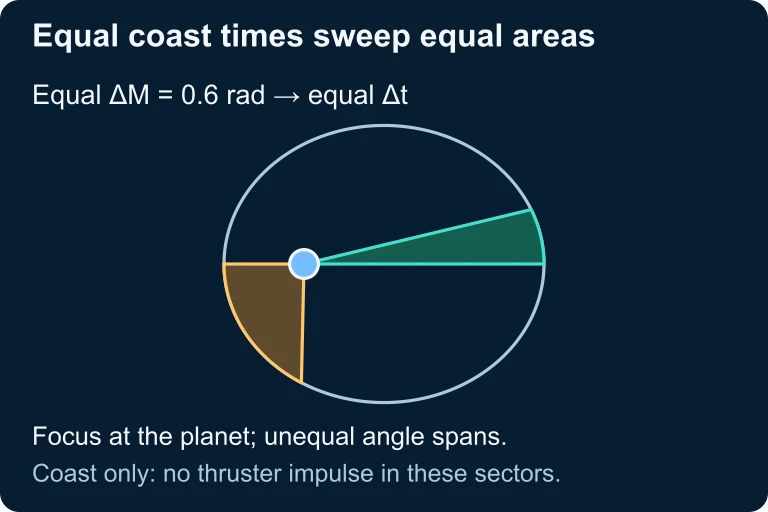
Two short burns and a long coast between orbits

Equal time intervals during ideal gravitational coasting sweep equal areas about the planet at the ellipse’s focus. Angular speed changes along the orbit while angular momentum remains constant.Equal areas during coasting
Equal changes of mean anomaly, ΔM = 0.6 rad, correspond to equal coast times and equal swept areas about the occupied focus. The angular span is larger near periapsis.\( L \) Conserved ≠ \( K \) Conserved
When a system's moment of inertia changes, angular momentum is conserved but rotational kinetic energy changes. Internal forces do work to speed up or slow down the rotation.
Collisions and Angular Momentum
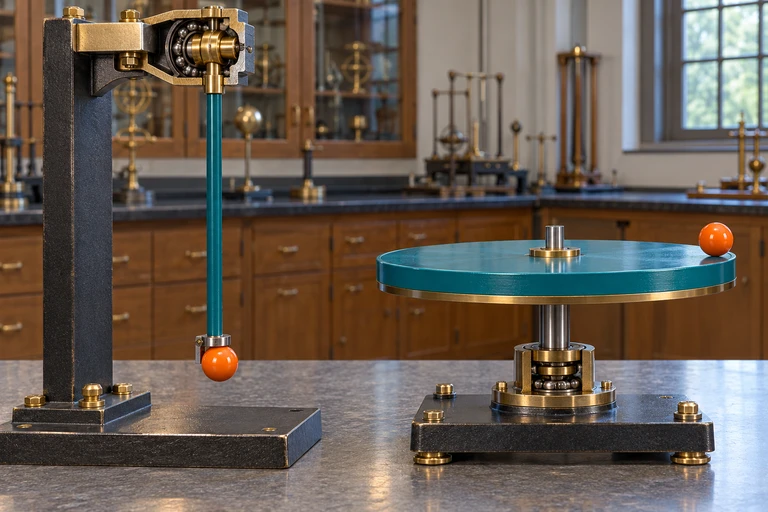
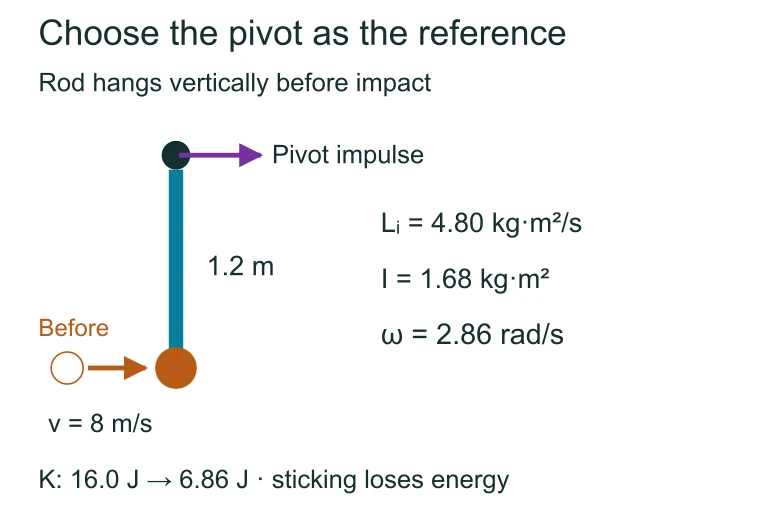
In rotational collisions (e.g., a ball striking a rod, or two disks coupling together), angular momentum about the pivot is conserved when external angular impulse about that pivot is negligible. Internal collision forces alone do not establish conservation.
An impact caught by a pivot
During a short impact, choose the pivot as the angular-momentum reference. Its support force has zero lever arm about that pivot; angular momentum can be conserved even though linear momentum and kinetic energy are not.An impact caught by a pivot
During a short impact, choose the pivot as the angular-momentum reference. Its support force has zero lever arm about that pivot; angular momentum can be conserved even though linear momentum and kinetic energy are not.Common Mistakes
Summary of Key Relationships
| Scenario | \( L \) conserved? | \( K \) conserved? |
|---|---|---|
| Skater pulls arms in | Yes | No (increases) |
| Planet in orbit (central force) | Yes | No (exchanges with PE) |
| Inelastic rotational collision | Yes | No (decreases) |
| Elastic rotational collision | Yes | Yes |
| External torque applied | No | Depends |
Question 1 of 5
A spinning figure skater reduces her moment of inertia to one-third of its original value. By what factor does her angular velocity change?
Question 2 of 5
A disk spinning at \( \omega_i = 6.0 \;\text{rad/s} \) with \( I = 2.0 \;\text{kg}\cdot\text{m}^2 \) collides and sticks to an identical stationary disk (same \( I \)). What is \( \omega_f \)?
Question 3 of 5
A satellite in an elliptical orbit moves from aphelion (far point) to perihelion (close point). Compared to aphelion, at perihelion the satellite has:
Question 4 of 5
When a diver tucks mid-air to spin faster, what happens to her rotational kinetic energy?
Question 5 of 5
A particle moves in a straight line at constant velocity past a point P. What can be said about its angular momentum about P?