01 / 21

Connecting Linear and Rotational Motion

Bridge the gap between translational kinematics and rotational dynamics by mastering the relationships between \(v\), \(\omega\), \(a\), and \(\alpha\).

AP Physics C: Mechanics

Why Connect the Two?

Every spinning object also has points that translate. A car's tire rotates, yet the car moves forward. A ball rolling down a ramp converts gravitational PE into both translational and rotational KE. Without linking these two worlds, you cannot solve real problems.

Key Definitions

\(\theta\) : Angular Position
Angle (in radians) swept from a reference line. Analogous to position \(x\).
\(\omega\) : Angular Velocity
\(\omega = \frac{d\theta}{dt}\). Rate of rotation, analogous to linear velocity \(v\).
\(\alpha\) : Angular Acceleration
\(\alpha = \frac{d\omega}{dt}\). Rate of change of \(\omega\), analogous to linear acceleration \(a\).

The Radius Bridge

\(r\) \(v = r\omega\) \(\omega\) \(a_c = v^2/r = r\omega^2\) Key Relations \(s = r\theta\) \(v = r\omega\) \(a_t = r\alpha\) \(a_c = r\omega^2\) \(a = \sqrt{a_t^2 + a_c^2}\)

The Core Equations

1
Arc length: \(s = r\theta\). Angle in radians times the radius gives the linear distance along the arc.
2
Tangential velocity: \(v_t = r\omega\). Differentiate the arc-length relation with respect to time.
3
Tangential acceleration: \(a_t = r\alpha\). Differentiate again. This component is tangent to the circle.
4
Centripetal acceleration: \(a_c = \frac{v_t^2}{r} = r\omega^2\). Always points inward toward the axis.

Rolling Without Slipping

\(R\) \(\omega\) \(v_{\text{cm}}\) \(v = 0\) (contact) \(v_{\text{top}} = 2v_{\text{cm}}\) No-slip constraint \(v_{\text{cm}} = R\omega\) \(a_{\text{cm}} = R\alpha\)

A cylinder skids, spins up, and finally rolls
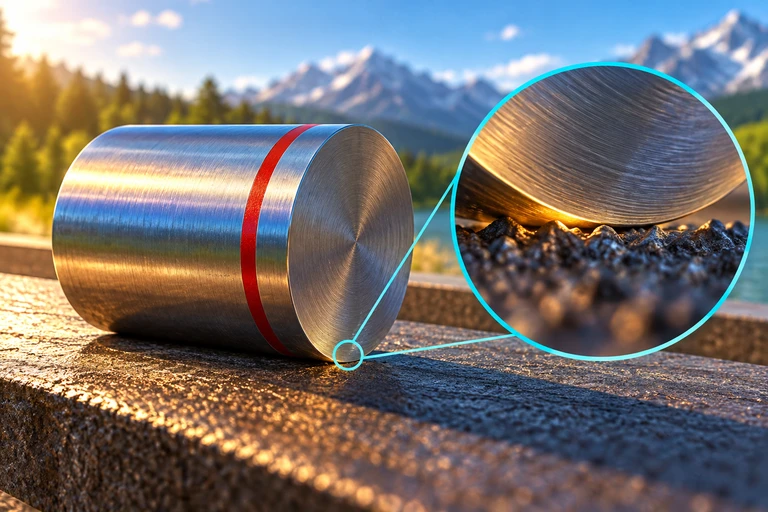
A launched metal cylinder on a track with a prominent colored band and a magnified rubbing contact region.Kinetic friction slows the center of mass and increases the spin of an initially nonspinning solid cylinder. Slipping ends when v = Rω; one-third of the initial mechanical energy has been dissipated in this model.

Kinetic friction brings translation and spin together
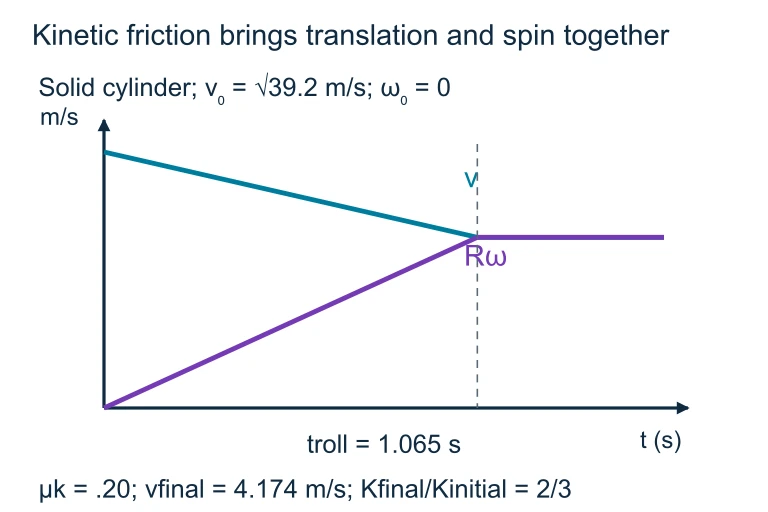
Kinetic friction brings translation and spin together. Kinetic friction slows the center of mass and increases the spin of an initially nonspinning solid cylinder. Slipping ends when v = Rω; one-third of the initial mechanical energy has been dissipated in this model.Kinetic friction slows the center of mass and increases the spin of an initially nonspinning solid cylinder. Slipping ends when v = Rω; one-third of the initial mechanical energy has been dissipated in this model.

Spin-up states have computed positions and rotations
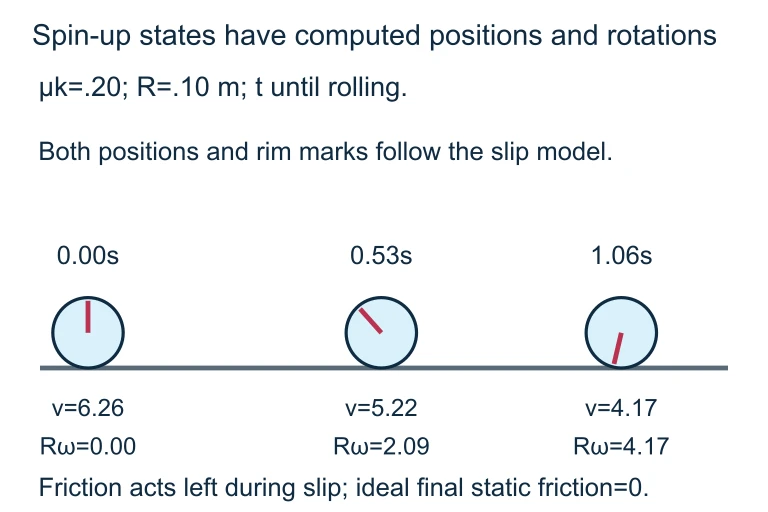
Spin-up states have computed positions and rotations. Kinetic friction slows the center of mass and increases the spin of an initially nonspinning solid cylinder. Slipping ends when v = Rω; one-third of the initial mechanical energy has been dissipated in this model.Kinetic friction slows the center of mass and increases the spin of an initially nonspinning solid cylinder. Slipping ends when v = Rω; one-third of the initial mechanical energy has been dissipated in this model.

Kinetic Energy of Rolling Objects

A rolling object has two contributions to its kinetic energy: translational and rotational. The total is:

Solid Sphere
\(I = \frac{2}{5}mR^2\), so \(K = \frac{7}{10}mv^2\)
Solid Cylinder
\(I = \frac{1}{2}mR^2\), so \(K = \frac{3}{4}mv^2\)
Hollow Sphere
\(I = \frac{2}{3}mR^2\), so \(K = \frac{5}{6}mv^2\)

Linear vs. Rotational Analogs

Concept Linear Rotational Link
Position \(x\) \(\theta\) \(s = r\theta\)
Velocity \(v\) \(\omega\) \(v = r\omega\)
Acceleration \(a\) \(\alpha\) \(a_t = r\alpha\)
Inertia \(m\) \(I\) \(I = \sum m_i r_i^2\)
Force / Torque \(F\) \(\tau\) \(\tau = rF\sin\theta\)
Kinetic Energy \(\frac{1}{2}mv^2\) \(\frac{1}{2}I\omega^2\) Add both
Momentum \(p = mv\) \(L = I\omega\) \(\vec{L} = \vec{r} \times \vec{p}\)

\(a_t\) vs. \(a_c\): Two Accelerations

Tangential \(a_t\)
Tangent to the circular path. Changes speed of the point. Present only when \(\alpha \neq 0\).

\(a_t = r\alpha\)
Centripetal \(a_c\)
Points radially inward. Changes direction of velocity. Present whenever \(\omega \neq 0\).

\(a_c = r\omega^2 = \frac{v^2}{r}\)

Supplementary Physics C model

This illustration presents a separate Physics C model; compare its stated assumptions and values with the example already shown.
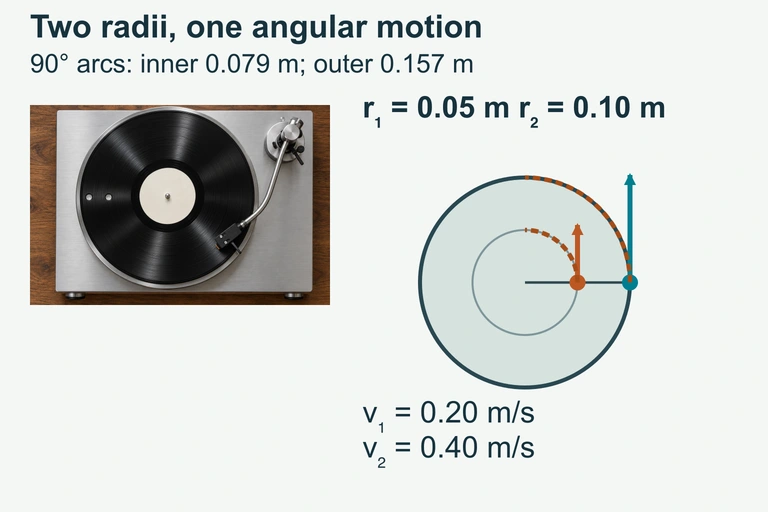
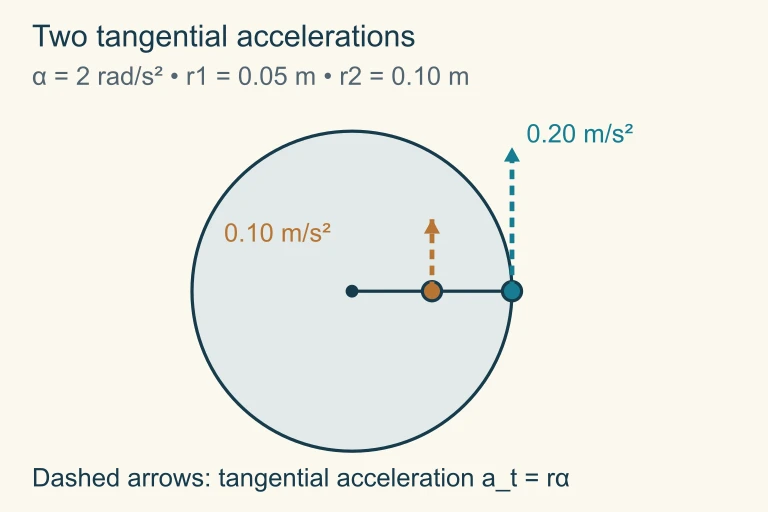
At the illustrated instant, ω = 4 rad/s. Points at radii 0.05 m and 0.10 m move at 0.20 m/s and 0.40 m/s. A shared 90° rotation traces arcs of 0.0785 m and 0.1571 m. The required companion adds the instantaneous tangential accelerations.
At the instant shown, ω = 4 rad/s and α = 2 rad/s². Both points share angular motion; v = rω and a_t = rα, so the outer point has twice the speed and twice the tangential acceleration. The 90° arc lengths are 0.0785 m and 0.1571 m.

How to Apply These Relations

1
Identify the axis of rotation and the radius \(r\) from the axis to the point of interest.
2
Check the constraint: Is the object rolling without slipping? If yes, use \(v_{\text{cm}} = R\omega\) and \(a_{\text{cm}} = R\alpha\).
3
Write Newton's second law in linear form (\(\sum F = ma\)) and rotational form (\(\sum \tau = I\alpha\)) simultaneously.
4
Substitute the constraint to eliminate either \(a\) or \(\alpha\), then solve the coupled system.
5
For energy methods: Include both \(\frac{1}{2}mv^2\) and \(\frac{1}{2}I\omega^2\) in kinetic energy. Use the constraint to write everything in terms of one variable.

Example 1: Spinning Wheel

A wheel of radius \(r = 0.30\) m spins at \(\omega = 20\) rad/s and accelerates uniformly at \(\alpha = 4.0\) rad/s². Find the tangential speed, tangential acceleration, and centripetal acceleration of a point on the rim.

1
Tangential speed: \(v_t = r\omega = (0.30)(20) = \) \(6.0\) m/s
2
Tangential acceleration: \(a_t = r\alpha = (0.30)(4.0) = \) \(1.2\) m/s²
3
Centripetal acceleration: \(a_c = r\omega^2 = (0.30)(20)^2 = \) \(120\) m/s²

Example 2: Sphere on a Ramp

\(h\) \(\theta\) \(v_{\text{cm}}\) \(\omega\) Energy Conservation \(mgh = \tfrac{1}{2}mv^2 + \tfrac{1}{2}I\omega^2\) \(v = \sqrt{10gh/7}\)

A solid sphere (\(I = \frac{2}{5}mR^2\)) rolls without slipping from height \(h\). Using energy conservation and \(v = R\omega\):

Example 3: Atwood with a Pulley

\(R\) \(M\) \(m\) \(a\) \(a\) \(\alpha\) Equations \(Mg - T_1 = Ma\) \(T_2 - mg = ma\) \((T_1-T_2)R = I\alpha\) \(a = R\alpha\)

Angular Momentum Connection

For a particle, the angular momentum about a point is the cross product of position and linear momentum:

Newton's 2nd (Linear)
\(\vec{F}_{\text{net}} = \frac{d\vec{p}}{dt}\)
Newton's 2nd (Rotational)
\(\vec{\tau}_{\text{net}} = \frac{d\vec{L}}{dt}\)

Common Mistakes

✕ Forgetting Rotational KE
Using only \(\frac{1}{2}mv^2\) for a rolling object. You must add \(\frac{1}{2}I\omega^2\) or the total energy budget is wrong.
✕ Equal Tensions on a Massive Pulley
Assuming \(T_1 = T_2\) when the pulley has mass. The net torque \((T_1 - T_2)R = I\alpha\) requires different tensions.
✕ Using Degrees in \(s = r\theta\)
All rotational equations require \(\theta\) in radians. Degrees will give answers off by a factor of \(\frac{\pi}{180}\).

Summary of Connections

Relation Equation When to Use
Arc length \(s = r\theta\) Convert angle to distance
Tangential speed \(v_t = r\omega\) Speed of a point on a rotating body
Tangential accel. \(a_t = r\alpha\) Speeding up or slowing rotation
Centripetal accel. \(a_c = r\omega^2\) Any circular motion
Rolling constraint \(v_{\text{cm}} = R\omega\) No-slip rolling
Total KE \(\frac{1}{2}mv^2 + \frac{1}{2}I\omega^2\) Energy conservation with rolling
Angular momentum \(L = I\omega\) or \(\vec{r}\times m\vec{v}\) Torque and conservation problems

Question 1 of 5

A wheel of radius \(0.50\) m rotates at \(\omega = 10\) rad/s. What is the tangential speed of a point on the rim?

Question 2 of 5

A solid cylinder and a hollow cylinder of the same mass and radius roll from rest down the same incline without slipping. Which reaches the bottom first?

Question 3 of 5

A disk rotates at \(\omega = 6.0\) rad/s and has angular acceleration \(\alpha = 2.0\) rad/s². For a point at \(r = 0.40\) m, what is the magnitude of the total acceleration?

Question 4 of 5

A solid sphere of mass \(m\) rolls without slipping at speed \(v\). What fraction of its total kinetic energy is rotational?

Question 5 of 5

In an Atwood machine with a massive pulley (moment of inertia \(I\), radius \(R\)), the string does not slip on the pulley. Which statement is true about the tensions \(T_1\) and \(T_2\) on the two sides?