01 / 20

Circular
Motion

Master uniform circular motion, centripetal acceleration, and the forces that keep objects on curved paths: essential tools for AP Physics C: Mechanics.

AP Physics C: Mechanics

What Is Circular Motion?

An object travels in a circle of radius \( r \) at some speed. Even if the speed is constant, the velocity is always changing because its direction changes continuously.

\(v\) \(v\) \(v\) \(r\)

Key Quantities in Circular Motion

Period \( T \)
Time for one full revolution. Measured in seconds.
Frequency \( f \)
Revolutions per second: \( f = 1/T \). Unit: Hz.
Angular Velocity \( \omega \)
\( \omega = 2\pi f = 2\pi / T \). Unit: rad/s.

Why Does Velocity Change?

Velocity is a vector: it has both magnitude and direction. In uniform circular motion the speed (magnitude) stays the same, but the direction rotates continuously. A changing velocity means there must be an acceleration.

\(v_1\) \(v_2\) Velocity change: \(v_1\) \(v_2\) \(\Delta v\) \(\Delta v\) points toward center

Centripetal Acceleration

For an object moving at speed \( v \) along a circle of radius \( r \), the magnitude of the centripetal acceleration is:

\(v\) \(a_c\) \(r\) Direction: Always toward the center

Centripetal Force: Newton's Second Law

By Newton's second law, a net force must cause the centripetal acceleration:

Centripetal force is not a new type of force. It is the net radial force provided by real forces: tension, gravity, friction, normal force, or any combination directed toward the center.

String/rope
Tension provides \( F_c \) for a ball on a string.
Road curve
Static friction provides \( F_c \) for a car turning.
Orbit
Gravity provides \( F_c \) for a satellite.

Centripetal vs Centrifugal

Centripetal Centrifugal
Direction Toward center Away from center
Reference frame Inertial (lab frame) Non-inertial (rotating frame)
Real force? Yes No (fictitious / pseudo)
AP Physics C usage Always use this Avoid unless stated

Non-Uniform Circular Motion

When the speed changes along the circular path, there is an additional tangential acceleration \( a_t \) alongside the centripetal component:

\(a_c\) \(a_t\) \(\vec{a}\) Total acceleration: \(|\vec{a}|\) shown in formula Radial: \(a_c = v^2/r\) Tangential: \(a_t = dv/dt\) Net: \(|a| = \sqrt{a_c^2 + a_t^2}\)

How to Solve Circular Motion Problems

1
Draw a free-body diagram at the point of interest, choosing a radial axis (toward center = positive).
2
Identify all real forces acting on the object: gravity, tension, normal, friction, etc.
3
Apply Newton's second law radially: \( \sum F_{\text{radial}} = \dfrac{mv^2}{r} \).
4
If non-uniform, also apply \( \sum F_{\text{tangential}} = m\,a_t \) along the tangent.
5
Solve for the unknown. Check units and sign (positive = toward center).

Example 1: Ball on a String

A 0.50 kg ball moves in a horizontal circle of radius 0.80 m at a constant speed of 4.0 m/s. Find the tension in the string (ignore gravity for the horizontal plane).

\(T\) \(v\) center Given: m = 0.50 kg r = 0.80 m v = 4.0 m/s

Example 2: Banked Curve

A car rounds a frictionless banked curve of radius \( r = 50\,\text{m} \) banked at angle \( \theta = 30° \). Find the speed at which the car can travel without sliding.

\(mg\) \(N\) \(N \sin\theta\) \(\theta\) Radial equation: \(N \sin\theta = mv^2/r\) Vertical equation: \(N \cos\theta = mg\) Divide: \(\tan\theta = v^2/(rg)\) \(v = \sqrt{rg \tan\theta}\) \(= \sqrt{50 \cdot 9.8 \cdot \tan30^\circ} \approx 16.8\,\text{m/s}\)

Supplementary Physics C model

This illustration presents a separate Physics C model; compare its stated assumptions and values with the example already shown.
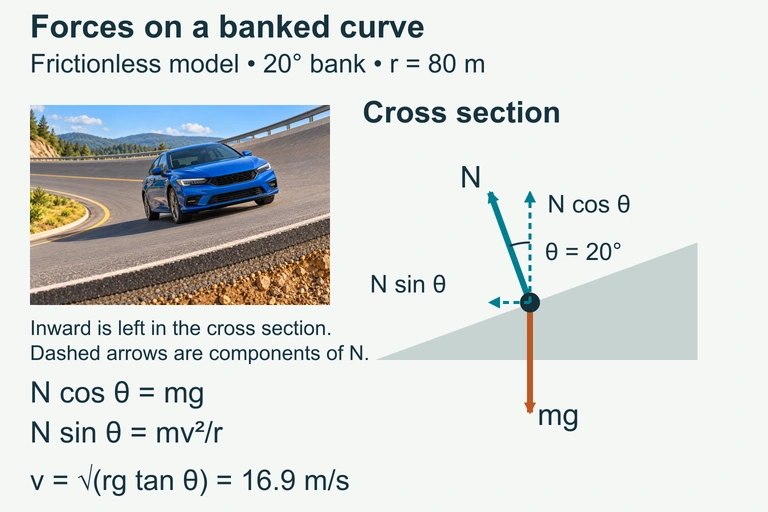
On a frictionless 20° bank of radius 80 m, the normal force has upward component N cos θ = mg and inward component N sin θ = mv²/r. Dashed arrows are components of N, not additional forces. The ideal speed is 16.9 m/s.

Banked-turn normal and friction direction
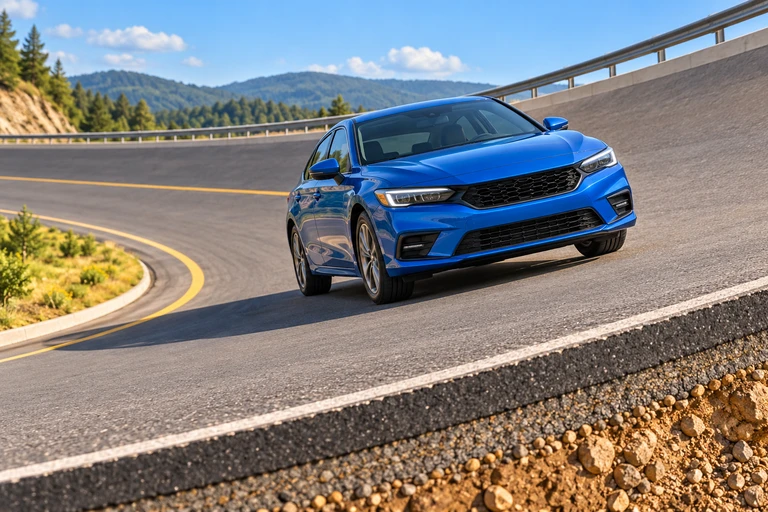
One blue car rests on a banked curve with the outer edge raised; exact cross-sections show normal force, weight and speed-dependent friction directions.On a banked turn, static friction points up the bank below the friction-free design speed and down the bank above it. Its magnitude adjusts up to the limiting value μsN.

Friction on a banked turn
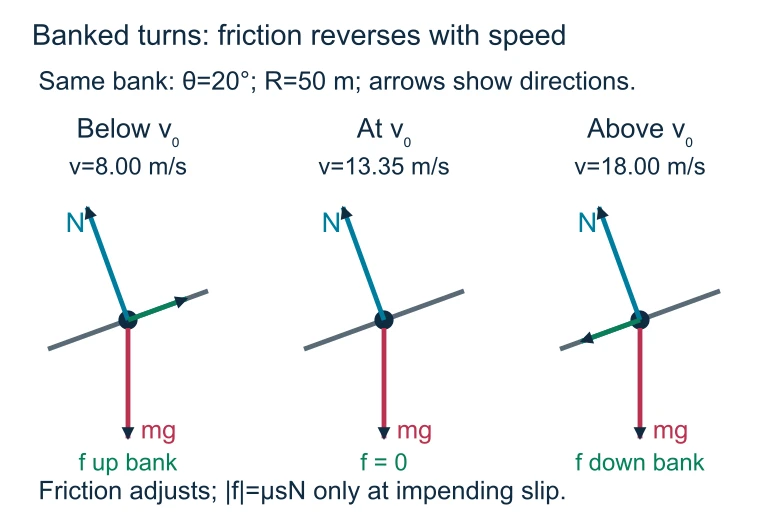
Friction on a banked turn. For a 20° bank and a 50 m radius, the friction-free design speed is about 13.35 m/s. The shown 8 m/s case needs friction up the bank and the 18 m/s case needs friction down the bank.For a 20° bank and a 50 m radius, the friction-free design speed is about 13.35 m/s. The shown 8 m/s case needs friction up the bank and the 18 m/s case needs friction down the bank.

Resolving banked-turn forces
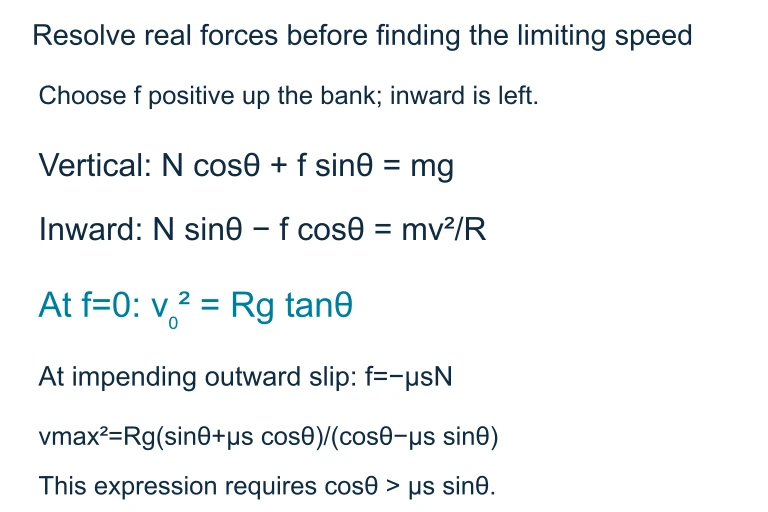
Resolving banked-turn forces. Taking friction positive up the bank gives N cosθ + f sinθ = mg and N sinθ − f cosθ = mv²/R. At impending outward slip, substitute f = −μsN; the displayed maximum-speed expression requires cosθ > μs sinθ.Taking friction positive up the bank gives N cosθ + f sinθ = mg and N sinθ − f cosθ = mv²/R. At impending outward slip, substitute f = −μsN; the displayed maximum-speed expression requires cosθ > μs sinθ.

Example 3: Vertical Loop

A ball of mass \( m \) moves in a vertical circle of radius \( r \) on a string. Write the radial equation at the top and bottom of the loop.

Top \(T\) \(mg\) Bottom \(T\) \(mg\) At the top: \(T + mg = mv_{\text{top}}^2/r\) (both forces toward center) At the bottom: \(T - mg = mv_{\text{bot}}^2/r\) (T toward center, mg away) \(\therefore T\) is greatest at the bottom and least at the top.

Acceleration follows the local bend

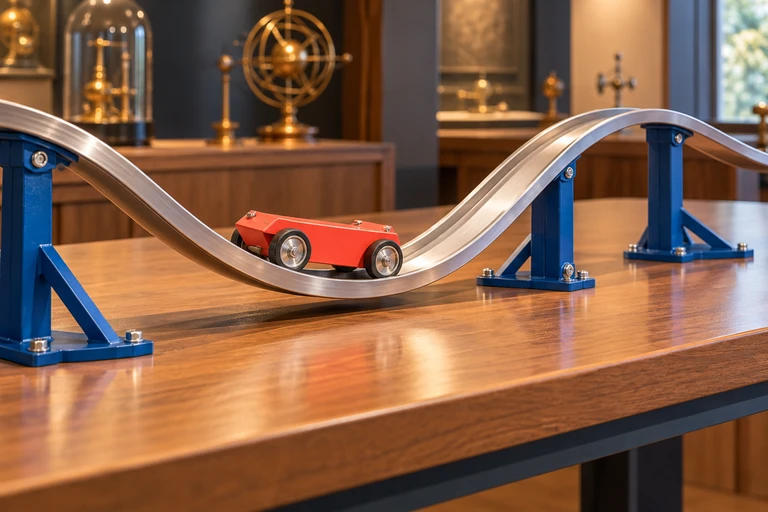
A red wheeled cart rests on the low curved part of a smooth metal track, supported by blue stands over a laboratory bench.For a car inside a vertical circular track, gravity and the normal force can both point toward the center at the top. Contact requires a nonnegative normal force, giving v ≥ √(gr).

Vertical-circle contact condition
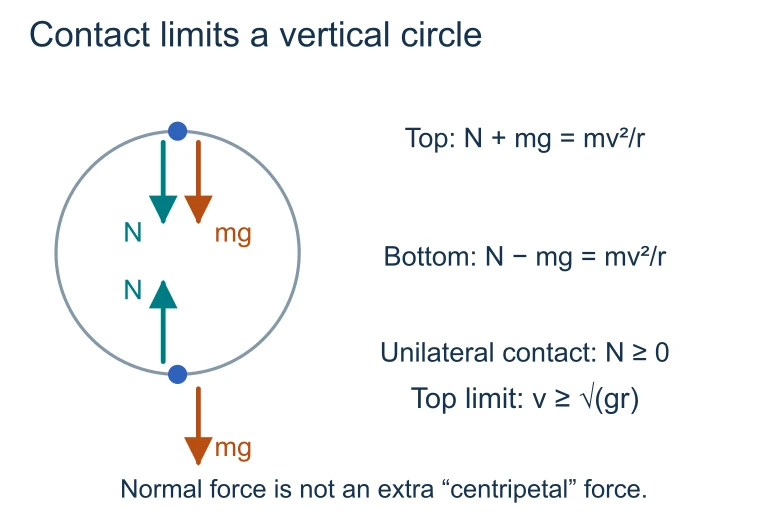
Vertical-circle contact condition. For a car inside a vertical circular track, gravity and the normal force can both point toward the center at the top. Contact requires a nonnegative normal force, giving v ≥ √(gr).For a car inside a vertical circular track, gravity and the normal force can both point toward the center at the top. Contact requires a nonnegative normal force, giving v ≥ √(gr).

Example 4: Conical Pendulum

A mass hangs from a string of length \( L \) and swings in a horizontal circle, making angle \( \theta \) with the vertical. The radius of the circle is \( r = L\sin\theta \).

pivot \(r = L \sin\theta\) \(\theta\) \(T\) \(mg\) Vertical: \(T \cos\theta = mg\) Radial: \(T \sin\theta = mv^2/r\) Period: \(T = 2\pi\sqrt{\frac{L \cos\theta}{g}}\)

Common Mistakes

✕ Adding a "centrifugal force"
In an inertial frame there is no outward force. Only real forces (tension, gravity, normal, friction) go on the FBD.
✕ Setting \( F_c = \) a single force
Centripetal force is the net radial force, not one specific force. Multiple forces can contribute.
✕ Forgetting direction at top vs bottom
At the top of a loop, gravity helps provide centripetal force. At the bottom, gravity opposes it. Signs matter.

Key Formulas Summary

Quantity Formula Units
Speed \( v = \omega r = \dfrac{2\pi r}{T} \) m/s
Centripetal acceleration \( a_c = \dfrac{v^2}{r} = \omega^2 r \) m/s²
Centripetal force \( F_c = \dfrac{mv^2}{r} = m\omega^2 r \) N
Period \( T = \dfrac{2\pi r}{v} = \dfrac{2\pi}{\omega} \) s
Banked curve (no friction) \( v = \sqrt{rg\tan\theta} \) m/s
Min. speed at loop top \( v_{\min} = \sqrt{gr} \) m/s

Question 1 of 5

A car travels around a flat circular track of radius \( r \) at constant speed \( v \). If the speed is doubled, by what factor does the required friction force change?

Question 2 of 5

In uniform circular motion, the acceleration vector points:

Question 3 of 5

A ball on a string moves in a vertical circle of radius \( r \). At the top of the loop, the minimum speed for the string to remain taut is:

Question 4 of 5

A \( 1500\,\text{kg} \) car rounds a frictionless banked curve of radius \( 80\,\text{m} \) at \( 20\,\text{m/s} \). What is the banking angle \( \theta \)?

Question 5 of 5

An object moves in a circle and its speed is increasing. The net acceleration vector: