01 / 21

Change in Momentum
and Impulse

Explore how forces acting over time change an object's momentum, and master the impulse-momentum theorem for AP Physics C.

AP Physics C: Mechanics

What is Momentum?

Momentum is a vector quantity that measures the "quantity of motion" an object possesses. It depends on both how massive the object is and how fast it is moving.

Units
\(\text{kg} \cdot \text{m/s}\)
Type
Vector: same direction as \(\vec{v}\)
Symbol
\(\vec{p}\) (lowercase p)

Change in Momentum: \(\Delta\vec{p}\)

When a force acts on an object, its velocity changes, and so does its momentum. The change in momentum is the difference between final and initial momentum vectors.

\(m\) \(v_i\) → \(m\) \(v_f\) Before After \(\Delta p\)

What is Impulse?

Impulse is the effect of a force acting over a time interval. It tells you how much the force "pushes" on an object in total, accounting for both magnitude and duration.

Units
\(\text{N} \cdot \text{s} = \text{kg} \cdot \text{m/s}\)
Type
Vector: same direction as net \(\vec{F}\)

Why Does This Matter?

The impulse-momentum connection is everywhere: from car safety design (extending collision time to reduce peak force) to rocket propulsion (continuous thrust changing momentum) to sports (a baseball bat's contact time).

Safety
Airbags increase \(\Delta t\), reducing \(F\) on passengers for the same \(\Delta p\).
Rockets
Thrust \(\vec{F}(t)\) integrated over burn time gives total impulse.
Sports
"Follow through" extends \(\Delta t\) and maximizes \(\Delta p\) delivered to the ball.

The Impulse-Momentum Theorem

Newton's Second Law directly connects impulse to change in momentum. Starting from \(\vec{F} = m\vec{a} = m \dfrac{d\vec{v}}{dt}\), we integrate both sides over time.

Derivation from \(\vec{F} = m\vec{a}\)

1
Start with Newton's Second Law: \(\vec{F}_{\text{net}} = \dfrac{d\vec{p}}{dt}\)
2
Multiply both sides by \(dt\): \(\vec{F}_{\text{net}}\,dt = d\vec{p}\)
3
Integrate over the time interval: \(\displaystyle \int_{t_i}^{t_f}\vec{F}_{\text{net}}\,dt = \int_{\vec{p}_i}^{\vec{p}_f} d\vec{p}\)
4
Result: \(\vec{J} = \vec{p}_f - \vec{p}_i = \Delta\vec{p}\)

Impulse as Area Under the \(F\text{-}t\) Curve

Since \(\vec{J} = \int \vec{F}\,dt\), the impulse equals the area under the force-vs-time graph. This is critical for variable forces.

\(t\) (s) \(F\) (N) \(t_i\) \(t_f\) Area = \(J = \Delta p\) \(F(t)\)

Supplementary Physics C model

This illustration presents a separate Physics C model; compare its stated assumptions and values with the example already shown.

Let us work through a problem that requires integration of a time-dependent force, a standard AP Physics C skill. This example illustrates the full mathematical procedure from force function to final velocity. Mass m = 2.0 kg, initial velocity v_i = 0 m/s, force function F(t) = 600t − 100t² (in SI units), and the time interval is t = 0 to t = 4.0 s. The motion is one-dimensional, so we work with scalar equations along the direction of F.

Show answer and explanation

Step 1 — Identify Given Values: Mass m = 2.0 kg, initial velocity v_i = 0 m/s, force function F(t) = 600t − 100t² (in SI units), and the time interval is t = 0 to t = 4.0 s. The motion is one-dimensional, so we work with scalar equations along the direction of F. Step 2 — Compute the Impulse via Integration: J = ∫₀⁴ (600t − 100t²) dt = [300t² − (100/3)t³] evaluated from 0 to 4. Substituting: J = 300(16) − (100/3)(64) = 4800 − 6400/3 = 4800 − 2133.3 = 2666.7 N·s. J ≈ 2667 N·s Step 3 — Apply the Impulse–Momentum Theorem: By the impulse–momentum theorem, J = Δp = mv_f − mv_i. Since v_i = 0: v_f = J / m = 2666.7 / 2.0 = 1333.3 m/s. v_f ≈ 1333 m/s Step 4 — Calculate the Average Force: F_avg = J / Δt = 2666.7 N·s / 4.0 s = 666.7 N. This is the constant force that, if applied for 4.0 s, would produce the same impulse and therefore the same momentum change. F_avg ≈ 667 N Step 5 — Reasonableness Check: The force function F(t) = 600t − 100t² equals zero at t = 0 and t = 6 s, reaching a maximum of F(3) = 900 N at t = 3 s. Our average of 667 N is below the peak but above zero, which is consistent. The impulse is positive, yielding a positive final velocity in the direction of the applied force—also consistent.
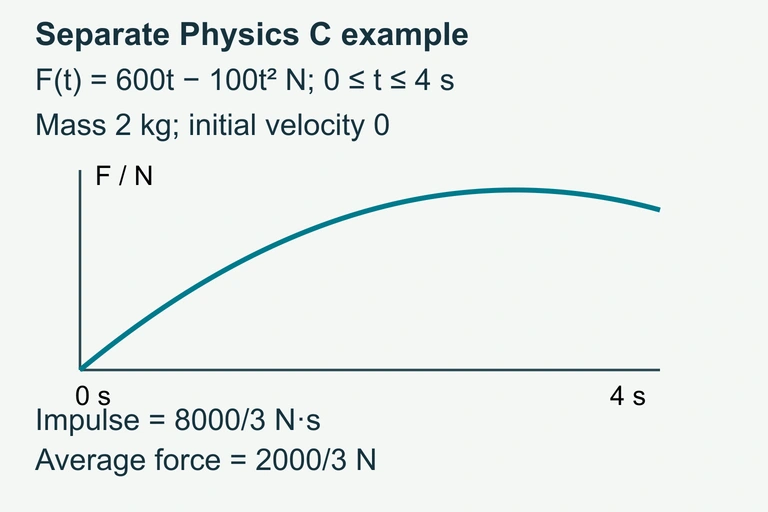
Separate idealized Physics C example: impulse is the force–time integral. With mass 2 kg starting from rest, the model implies a final speed of 4000/3 m/s.

Impulse vs. Momentum

Students often confuse impulse and momentum. They have the same units, but describe different things. Understanding the distinction is essential.

Momentum \(\vec{p}\) Impulse \(\vec{J}\)
What it is State of motion at an instant Effect of a force over time
Formula \(m\vec{v}\) \(\int \vec{F}\,dt\)
Type Property of an object Process (transfer of momentum)
Analogy Bank balance Deposit or withdrawal
Units \(\text{kg}\cdot\text{m/s}\) \(\text{N}\cdot\text{s} = \text{kg}\cdot\text{m/s}\)

How to Apply the Theorem

1
Define your system and identify the object whose momentum changes.
2
Choose a coordinate system and assign positive/negative directions. Momentum is a vector!
3
Identify initial and final states: find \(\vec{p}_i = m\vec{v}_i\) and \(\vec{p}_f = m\vec{v}_f\).
4
Compute \(\Delta\vec{p} = \vec{p}_f - \vec{p}_i\). Watch the signs carefully: direction reversal means a large change.
5
Relate to impulse: \(\vec{J} = \Delta\vec{p}\). Use \(\vec{J} = \vec{F}\,\Delta t\) (constant force) or \(\vec{J} = \int \vec{F}\,dt\) (variable force).

Example 1: Constant Force

A 2 kg ball moving at 5 m/s to the right is hit by a bat, reversing its direction to 3 m/s to the left. The contact time is 0.01 s. Find the average force on the ball.

Example 2: Variable Force

A 0.5 kg object at rest is acted on by a force \(F(t) = 6t - t^2\) (in N) from \(t = 0\) to \(t = 4\) s. Find the final velocity.

Example 3: Bouncing Ball (Direction Change)

A 0.15 kg ball strikes a wall at 20 m/s and rebounds at 18 m/s. Find \(\Delta p\).

20 m/s 18 m/s Before After Wall

Reading Impulse from a Graph

Given a triangular \(F\text{-}t\) graph: the force rises linearly from 0 to 600 N over 0.004 s, then drops back to 0 over another 0.004 s. Find the impulse.

\(t\) (s) \(F\) (N) 0 0.004 0.008 600 Area = \(J\)

Common Mistakes

✕ Ignoring Direction
Using \(|\Delta p| = m|v_f| - m|v_i|\) instead of properly accounting for vector signs. A ball reversing direction has a much larger \(|\Delta p|\) than you would get by subtracting speeds.
✕ Confusing \(p\) and \(J\)
Saying "the impulse is 10 kg·m/s" when you mean "the momentum is 10 kg·m/s." Impulse is a transfer; momentum is a state.
✕ Using \(F\Delta t\) for Variable Forces
Applying \(J = F\Delta t\) when the force is not constant. You must integrate: \(J = \int F(t)\,dt\), or find the area under the \(F\text{-}t\) graph.

Summary of Key Relationships

Quantity Formula When to Use
Momentum \(\vec{p} = m\vec{v}\) State at a single instant
Change in momentum \(\Delta\vec{p} = m\vec{v}_f - m\vec{v}_i\) Between two known velocities
Impulse (constant \(F\)) \(\vec{J} = \vec{F}\,\Delta t\) Constant force, known duration
Impulse (variable \(F\)) \(\vec{J} = \int \vec{F}\,dt\) Force varies with time
Impulse-Momentum Theorem \(\vec{J} = \Delta\vec{p}\) Connects force to velocity change

Question 1 of 5

A 3 kg object moving at 4 m/s comes to rest. What is the magnitude of its change in momentum?

Question 2 of 5

A constant force of 50 N acts on a stationary 10 kg block for 0.2 s. What is the final speed of the block?

Question 3 of 5

A ball of mass 0.2 kg strikes a wall at 10 m/s and bounces back at 10 m/s. What is the impulse delivered to the ball?

Question 4 of 5

A force \(F(t) = 12t\) (in N) acts on a 4 kg object initially at rest, from \(t = 0\) to \(t = 3 \;\text{s}\). What is the final velocity?

Question 5 of 5

An airbag increases the time of a collision from 0.005 s to 0.05 s. If the change in momentum is the same, how does the average force compare?