Angular Momentum
& Angular Impulse
Master the rotational analogues of linear momentum and impulse: from \(\vec{L} = I\vec{\omega}\) to the angular impulse-momentum theorem.
What Is Angular Momentum?
Angular momentum is the rotational analogue of linear momentum. Just as \(\vec{p} = m\vec{v}\) describes how hard it is to stop a moving object in a straight line, angular momentum \(\vec{L}\) describes how hard it is to stop a rotating object.
For a point particle, we use the cross-product definition: \(\vec{L} = \vec{r} \times \vec{p}\), where \(\vec{r}\) is the position vector from the axis and \(\vec{p}\) is the linear momentum.
Visualizing \(\vec{L} = \vec{r} \times \vec{p}\)
Why Angular Momentum Matters
Introducing Angular Impulse
Just as a force applied over time changes linear momentum (\(\vec{J} = \Delta\vec{p}\)), a torque applied over time changes angular momentum. This change is called angular impulse.
For a constant torque, this simplifies to: \(\vec{J}_{\text{ang}} = \vec{\tau}\,\Delta t\).
The Angular Impulse-Momentum Theorem
\(\vec{\tau}_{\text{net}} = \dfrac{d\vec{L}}{dt}\): The Foundation
Linear vs Angular Analogues
| Concept | Linear | Angular |
|---|---|---|
| Inertia | \(m\) | \(I\) |
| Velocity | \(\vec{v}\) | \(\vec{\omega}\) |
| Momentum | \(\vec{p} = m\vec{v}\) | \(\vec{L} = I\vec{\omega}\) |
| Force / Torque | \(\vec{F}\) | \(\vec{\tau} = \vec{r} \times \vec{F}\) |
| Impulse | \(\vec{J} = \int \vec{F}\,dt\) | \(\vec{J}_{\text{ang}} = \int \vec{\tau}\,dt\) |
| Newton's 2nd | \(\vec{F} = \dfrac{d\vec{p}}{dt}\) | \(\vec{\tau} = \dfrac{d\vec{L}}{dt}\) |
Conservation of Angular Momentum
When the net external torque on a system is zero, total angular momentum is conserved:
How to Solve Problems
Example 1: Spinning Disk
A uniform disk of mass \(M = 4\,\text{kg}\) and radius \(R = 0.5\,\text{m}\) spins at \(\omega_i = 10\,\text{rad/s}\). A constant braking torque of \(\tau = -2\,\text{N}\cdot\text{m}\) is applied for \(\Delta t = 1.5\,\text{s}\). Find the final angular velocity.
Example 2: Skater Conservation
A figure skater with arms extended has \(I_i = 4.0\,\text{kg}\cdot\text{m}^2\) and spins at \(\omega_i = 2\,\text{rev/s}\). She pulls her arms in so \(I_f = 1.6\,\text{kg}\cdot\text{m}^2\). Find \(\omega_f\).
Example 3: Particle on a Turntable
A \(0.2\,\text{kg}\) ball is dropped vertically onto a frictionless turntable (disk: \(M=2\,\text{kg}\), \(R=0.3\,\text{m}\)) spinning at \(\omega_i = 6\,\text{rad/s}\). The ball lands at distance \(r = 0.2\,\text{m}\) from the center and sticks. Find the new \(\omega\).
Supplementary Physics C model
This illustration presents a separate Physics C model; compare its stated assumptions and values with the example already shown.
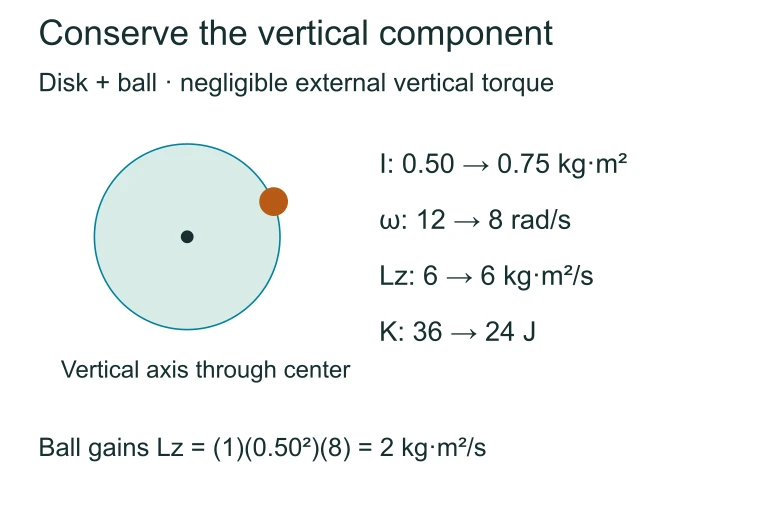
A uniform disk of mass M = 4.0 kg and radius R = 0.50 m is spinning freely at ωi = 12 rad/s about a vertical axis through its center. A small ball of mass m = 1.0 kg is dropped vertically onto the rim of the disk and sticks. Find (a) the final angular velocity, (b) the angular impulse delivered to the ball by friction during the collision, and (c) the fraction of kinetic energy lost. Take the system as the disk + ball. The only external vertical-axis torques come from the support bearing (frictionless) and gravity, both of which act through the rotation axis and produce zero torque. Therefore, angular momentum about the vertical axis is conserved: Li = Lf.
Show answer and explanation
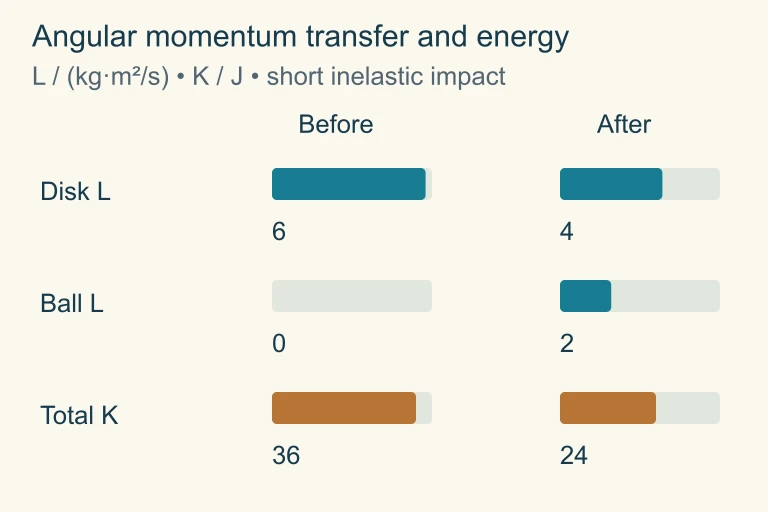
Step 1 — Identify the System and Conservation Law: Take the system as the disk + ball. The only external vertical-axis torques come from the support bearing (frictionless) and gravity, both of which act through the rotation axis and produce zero torque. Therefore, angular momentum about the vertical axis is conserved: Li = Lf. Step 2 — Compute Initial Angular Momentum: The disk is a uniform solid disk: Idisk = ½MR² = ½(4.0)(0.50)² = 0.50 kg·m². The ball starts with zero angular momentum (dropped vertically onto the rim). Therefore, Li = Idiskωi = (0.50)(12) = 6.0 kg·m²/s. Li = 6.0 kg·m²/s Step 3 — Compute Final Moment of Inertia: After the ball sticks at the rim, it acts as a point mass at distance R from the axis. Its contribution to the moment of inertia is Iball = mR² = (1.0)(0.50)² = 0.25 kg·m². The total final moment of inertia is If = Idisk + Iball = 0.50 + 0.25 = 0.75 kg·m². If = 0.75 kg·m² Step 4 — Solve for Final Angular Velocity (Part a): Conservation of angular momentum gives Idiskωi = Ifωf, so ωf = Li / If = 6.0 / 0.75 = 8.0 rad/s. ωf = 8.0 rad/s Step 5 — Angular Impulse on the Ball (Part b): The angular impulse on the ball equals the change in the ball's angular momentum. Initially, the ball has Lball,i = 0. After the collision, Lball,f = Iballωf = (0.25)(8.0) = 2.0 kg·m²/s. Therefore Jball = ΔLball = 2.0 − 0 = 2.0 kg·m²/s. This angular impulse is delivered by the friction between the ball and the disk rim. Jball = 2.0 kg·m²/s Step 6 — Fraction of Kinetic Energy Lost (Part c): KEi = ½Idiskωi² = ½(0.50)(12)² = 36 J. KEf = ½Ifωf² = ½(0.75)(8.0)² = 24 J. Fraction lost = (36 − 24)/36 = 12/36 = 1/3 ≈ 33%. This energy is converted to heat by the friction that brings the ball up to speed. Fraction lost = 1/3 ≈ 33%
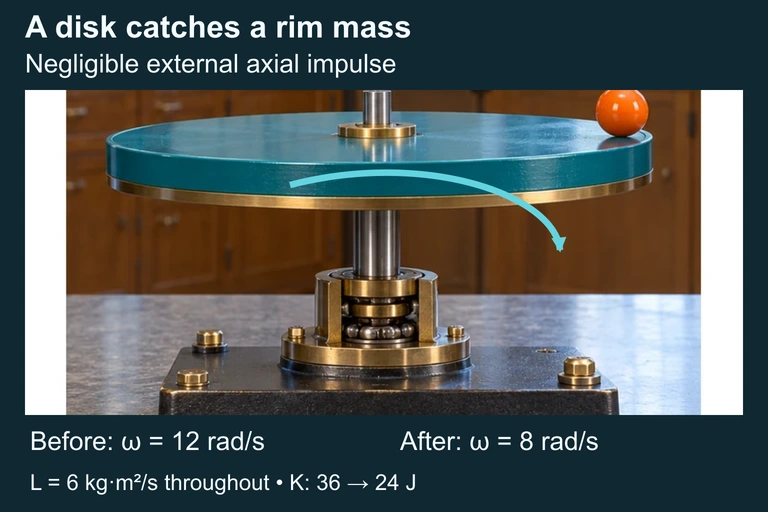
An impact caught by a pivot
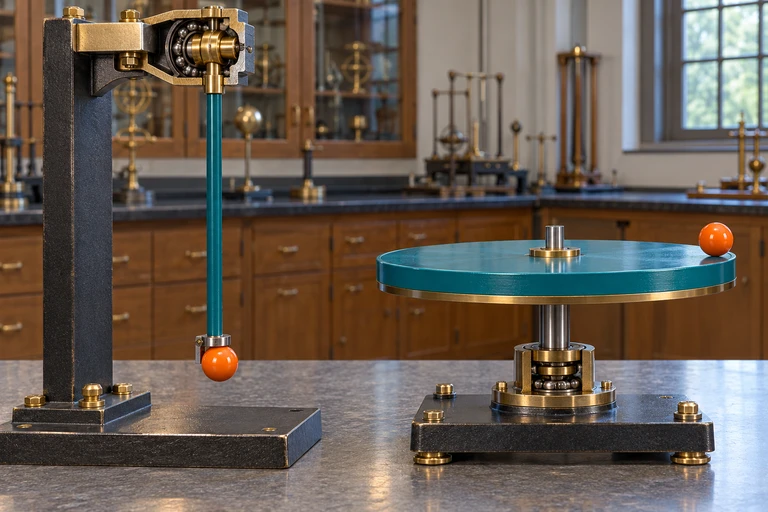
During the brief interaction between the particle and turntable, negligible external torque about the axle makes their total angular momentum constant. Their combined rotational inertia sets the final angular speed.A mass landing on a turntable
A vertical landing changes the combined inertia from 0.50 to 0.75 kg·m² and angular speed from 12 to 8 rad/s. Axial angular momentum stays 6 kg·m²/s while kinetic energy falls from 36 to 24 J.\(\vec{L}\) for a Point Particle
Common Mistakes to Avoid
Summary of Key Equations
| Equation | When to Use |
|---|---|
| \(\vec{L} = I\vec{\omega}\) | Rigid body about fixed axis |
| \(\vec{L} = \vec{r} \times \vec{p}\) | Point particle about a point |
| \(\vec{\tau} = \dfrac{d\vec{L}}{dt}\) | Newton's 2nd for rotation (always true) |
| \(\int \vec{\tau}\,dt = \Delta\vec{L}\) | Angular impulse: torque acts over time |
| \(I_i\omega_i = I_f\omega_f\) | Conservation: no net external torque |
| \(L = rmv\sin\theta\) | Magnitude for point particle |
Question 1 of 5
A disk with \(I = 0.4\,\text{kg}\cdot\text{m}^2\) rotates at \(\omega = 12\,\text{rad/s}\). What is the magnitude of its angular momentum?
Question 2 of 5
A constant torque of \(6\,\text{N}\cdot\text{m}\) acts on a wheel for \(3\,\text{s}\). What is the angular impulse delivered?
Question 3 of 5
A merry-go-round (\(I = 200\,\text{kg}\cdot\text{m}^2\)) spins at \(1.5\,\text{rad/s}\). A child (\(30\,\text{kg}\)) jumps on at the rim (\(r = 2\,\text{m}\)). What is the new angular velocity?
Question 4 of 5
A \(0.5\,\text{kg}\) ball moves at \(4\,\text{m/s}\) along a straight line that passes \(3\,\text{m}\) from point P. What is \(|\vec{L}|\) about P?
Question 5 of 5
A skater with \(I_i = 3.6\,\text{kg}\cdot\text{m}^2\) spins at \(2\,\text{rev/s}\). She pulls her arms in to \(I_f = 1.2\,\text{kg}\cdot\text{m}^2\). What happens to her rotational kinetic energy?