
SECTION 1
Historical Context & Motivation
The concept of work arose from a centuries-long quest to quantify how forces produce changes in the state of motion of objects and, more broadly, how energy is transferred between systems. Before a formal definition existed, engineers and natural philosophers grappled with practical questions about machines — levers, pulleys, and inclined planes — and sought a single quantity that would capture the "useful effect" of a force applied over a distance. The development of work as a rigorous physical concept required contributions from mathematicians, physicists, and engineers across several generations, culminating in the powerful framework of energy methods that underpins modern mechanics.
1687 • Newton's Principia Published
1807 • Young Coins 'Energy'
1829 • Coriolis Defines Work
1843 • Joule's Mechanical Equivalent of Heat
1850s • The Work-Energy Theorem Matures
The central question that motivated these developments was deceptively simple: if a force acts on an object as it moves, how much energy has been transferred to or from that object? Newton's second law tells us about instantaneous acceleration, but it does not directly tell us about the cumulative effect of a force along an entire path. The concept of work fills this gap, providing the bridge between force and displacement on one side and energy transfer on the other — a bridge that is essential for solving a vast range of problems more elegantly than force-by-force analysis allows.
SECTION 2
Core Principles & Definitions
At its core, work is the mechanism by which a force transfers energy to or from an object as the object undergoes a displacement. Unlike force and displacement, which are vectors, work is a scalar quantity — it has magnitude and sign but no direction. A positive value of work means the force transfers energy into the object's motion (or potential energy), while a negative value means the force removes energy from it. The sign of work depends entirely on the angle between the force vector and the displacement vector, a fact that leads to several important conceptual consequences explored below.
Definition via the Dot Product
Work by Variable Forces
Sign Conventions
Units
Net Work and the Work-Energy Theorem
KEY TAKEAWAY
SECTION 3
Visual Explanation — Force, Displacement, and the Dot Product
The diagram above captures the essential geometry of work for a constant force. The displacement vector d points along the direction of motion, while the force F may act at any angle θ relative to that direction. By resolving F into components parallel and perpendicular to d, you can see that the parallel component F cos θ is the sole contributor to energy transfer. The perpendicular component changes the direction of motion (as a centripetal force does, for example) but does not change the object's speed or kinetic energy. This geometric insight is why work is naturally expressed as a dot product — the dot product automatically extracts the component of one vector along the direction of another.
SECTION 4
Mathematical Framework
Constant Force
WORK BY A CONSTANT FORCE
F = magnitude of the force (N), d = magnitude of the displacement (m), θ = angle between F and d. Result is in joules (J).
When the force is constant in both magnitude and direction along the entire displacement, the calculation reduces to simple scalar multiplication. In Cartesian components, if F = (Fx, Fy) and d = (dx, dy), then W = Fxdx + Fydy. This component form is often more convenient on the AP exam than the angle form.
Variable Force — The Line Integral
WORK BY A VARIABLE FORCE
The integral is evaluated along the actual path of the object from the initial position to the final position. For one-dimensional motion along x: W = ∫ F(x) dx from xi to xf.
This is the general definition used in AP Physics C. The line integral sums infinitesimal contributions F · dr along the path. In one dimension, this simplifies to a standard definite integral. A classic example is the spring force F(x) = −kx, for which the work done by the spring as the object moves from xi to xf is W = −½k(xf² − xi²). Graphically, the work equals the area under the F(x)-versus-x curve, with regions below the axis counted as negative.
The Work-Energy Theorem
WORK-ENERGY THEOREM
Wnet = total work done by all forces on the object, ΔK = change in kinetic energy, m = mass (kg), vf and vi = final and initial speeds (m/s). This theorem is derived directly from Newton's second law by integrating Fnet · dr along the path.
Derivation Sketch
SECTION 5
Detailed Breakdown — Work by Specific Forces
In practice, you will encounter several recurring force types on the AP Physics C exam, each with its own characteristic work calculation. Understanding how to compute work for gravity, spring forces, friction, and applied forces — and how to interpret work graphically — is essential. The diagram below illustrates how a force-versus-position graph encodes work as an area, which is the graphical interpretation of the integral definition.
| Force | Work Expression | Key Notes |
|---|---|---|
| Constant applied force | W = Fd cos θ | θ is the angle between the force and the displacement. Use component form when multiple forces act. |
| Gravity (near Earth) | Wg = −mgΔy | Path-independent (conservative). Positive when object descends, negative when it rises. |
| Spring (Hooke's law) | Ws = −½k(xf² − xi²) | Conservative. x measured from natural length. Work done by the spring, not on the spring. |
| Kinetic friction | Wf = −fk × d | Non-conservative. Always removes energy from the object. d is total distance traveled, not displacement. |
| Normal force (level surface) | WN = 0 | Always perpendicular to displacement on a flat surface (θ = 90°). Can do work on ramps if there is a displacement component along the normal. |
Summary of work expressions for common forces encountered in AP Physics C: Mechanics.
SECTION 6
Worked Example — Work on an Incline with Friction
A 5.0 kg box is pulled 8.0 m up a 30° incline at constant velocity by a force applied parallel to the incline surface. The coefficient of kinetic friction between the box and the surface is μk = 0.25. Find (a) the work done by the applied force, (b) the work done by gravity, (c) the work done by friction, and (d) the net work done on the box.
Pulling a Box Up a Frictional Incline
- 1
Step 1 — Draw a Free-Body Diagram & Identify Forces
Four forces act on the box: the applied force Fapp directed up the incline, gravity mg directed straight downward, the normal force N perpendicular to the surface, and kinetic friction fk directed down the incline. Since velocity is constant, the net force (and net work) must be zero. - 2
Step 2 — Find the Normal Force
Balancing forces perpendicular to the incline: N = mg cos 30° = (5.0)(9.8)(cos 30°) = (5.0)(9.8)(0.866).N ≈ 42.4 N - 3
Step 3 — Find the Friction Force
fk = μkN = (0.25)(42.4).≈ 10.6 N - 4
Step 4 — Find the Applied Force (Constant Velocity)
Along the incline, equilibrium requires Fapp = mg sin 30° + fk = (5.0)(9.8)(0.500) + 10.6 = 24.5 + 10.6.F_app ≈ 35.1 N - 5
Step 5a — Work Done by the Applied Force
The applied force is parallel to the displacement (θ = 0°), so Wapp = Fapp × d = (35.1)(8.0).W_app ≈ +281 J - 6
Step 5b — Work Done by Gravity
Gravity acts straight down while displacement is 8.0 m up the 30° incline. The component of gravity along the incline opposes the motion, so Wg = −mg sin 30° × d = −(24.5)(8.0). Equivalently, Wg = −mgΔh = −(5.0)(9.8)(8.0 sin 30°) = −(5.0)(9.8)(4.0).≈ −196 J - 7
Step 5c — Work Done by Friction
Friction opposes the motion (θ = 180°), so Wf = −fk × d = −(10.6)(8.0).≈ −84.8 J - 8
Step 5d — Net Work & Verification
Wnet = Wapp + Wg + Wf + WN = 281 + (−196) + (−84.8) + 0 ≈ 0 J. This confirms the work-energy theorem: constant velocity means ΔK = 0, so Wnet = 0.W_net = 0 J (verified: ΔK = 0)
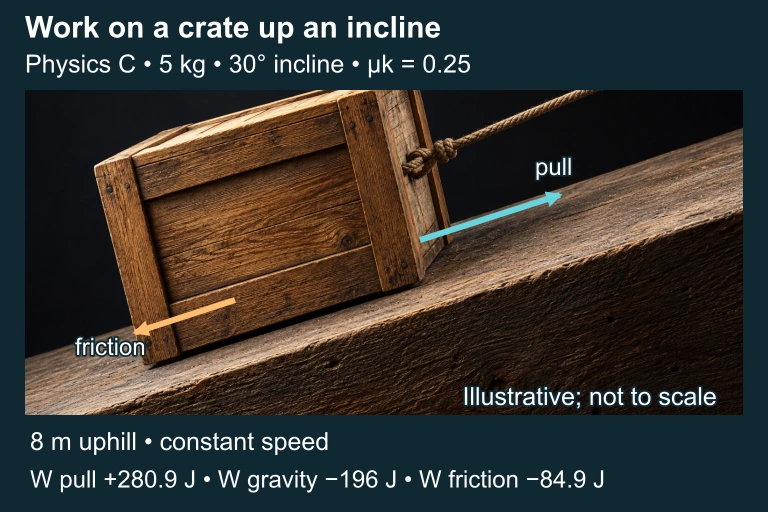 Physics C • 5 kg • 30° incline • μk = 0.25; illustrative apparatus not to scale.
SECTION 7
Conservative and Non-Conservative Forces
A critical distinction in energy methods is whether the work done by a force depends only on the initial and final positions (conservative) or on the path taken (non-conservative). For conservative forces, the work around any closed path is zero, meaning the force can store energy as potential energy that is fully recoverable. Non-conservative forces, such as kinetic friction, dissipate mechanical energy as heat or sound, and their work is path-dependent — dragging a box along a longer path dissipates more energy than along a shorter one.
| Property | Conservative Forces | Non-Conservative Forces |
|---|---|---|
| Examples | Gravity, spring (Hooke's law), electrostatic | Kinetic friction, air resistance, applied/push forces |
| Path dependence | Work depends only on initial and final positions | Work depends on the entire path taken |
| Closed-loop work | ∮ F · dr = 0 | ∮ F · dr ≠ 0 |
| Potential energy | An associated potential energy U can be defined: W = −ΔU | No associated potential energy function exists |
| Energy accounting | Mechanical energy is fully recoverable; Emech is conserved if only conservative forces act | Mechanical energy is converted to thermal or other non-mechanical forms |
Comparison of conservative and non-conservative forces
KEY TAKEAWAY
SECTION 8
Connection to Power and Advanced Energy Methods
Work is the conceptual gateway to the broader energy framework of mechanics. Once you master work, the related quantities of power, potential energy, and the Lagrangian formulation follow naturally. Power, defined as the time rate at which work is done, connects work to how quickly energy is transferred — a concept with extensive engineering applications.
| Concept | Relation to Work | AP Physics C Context |
|---|---|---|
| Power (P) | P = dW/dt = F · v | Instantaneous power is the dot product of force and velocity. Average power is Pavg = W/Δt. |
| Potential energy (U) | Wconservative = −ΔU | Potential energy is defined as the negative of work done by a conservative force. F = −dU/dx in one dimension. |
| Conservation of energy | Wnc = Δ(K + U) | When Wnc = 0, mechanical energy is conserved. This eliminates the need to know the path entirely. |
| Lagrangian mechanics | L = K − U; Euler-Lagrange equations | Beyond AP scope, but shows how the energy framework (rooted in work) generalizes to advanced classical mechanics. |
How work connects to advanced energy concepts
Looking forward, the relationship F = −dU/dx allows you to extract force from a potential energy graph — a common AP Physics C free-response technique. The slope of U(x) at any point gives the magnitude of the force, and the negative sign ensures the force points toward lower potential energy. This connection between work, force, and potential energy is at the heart of why energy methods are often more efficient than direct application of Newton's laws, especially in systems with complex paths or varying forces.
SECTION 9
Practice Problems
Question 1: CONCEPTUAL
- A. Positive, because gravity continuously accelerates the satellite
- B. Negative, because gravity opposes the satellite's motion
- C. Zero, because the gravitational force is always perpendicular to the satellite's velocity
- D. Zero, because the satellite returns to its starting point and gravity is conservative
Show answer (C, D)
Question 2: BASIC CALCULATION
- A. 37.8 J
- B. 45.0 J
- C. 58.8 J
- D. −37.8 J
Show answer (A)
Question 3: INTERMEDIATE
- A. W = 48 J, ΔK = 48 J
- B. W = 52 J, ΔK = 52 J
- C. W = 54 J, ΔK = 54 J
- D. W = 52 J, ΔK = 26 J
Show answer (B)
Question 4: APPLIED
10 ptsShow answer
Question 5: CRITICAL THINKING
7 ptsShow answer
SUMMARY
Summary — Work in AP Physics C: Mechanics
Summary
Work is the scalar measure of energy transferred to or from an object by a force acting over a displacement. For a constant force, W = Fd cos θ, where only the component of force parallel to displacement contributes. For a variable force, work is computed as the line integral W = ∫ F · dr, which graphically corresponds to the area under the F-versus-x curve. The work-energy theorem (Wnet = ΔK) links the total work done on an object to its change in kinetic energy, providing a powerful alternative to force analysis.
Forces are classified as conservative (gravity, springs — path-independent, with an associated potential energy) or non-conservative (friction, applied pushes — path-dependent, dissipating mechanical energy). The generalized energy equation Wnc = Δ(K + U) unifies these ideas: when only conservative forces act, mechanical energy is conserved. Power (P = dW/dt = F · v) extends the concept to the rate of energy transfer. Mastering work — its sign conventions, its integral formulation, and its connection to energy — is essential for success on the AP Physics C: Mechanics exam.