

SECTION 1
Historical Context & Motivation
The concept of kinetic energy — the energy an object possesses due to its motion — arose from centuries of philosophical and scientific inquiry into the nature of force and motion. Long before physicists formalized the idea, natural philosophers debated whether a moving body carried some intrinsic quantity that distinguished it from a body at rest. The resolution of this debate required the careful separation of momentum from what we now recognize as kinetic energy, and the development of the work-energy theorem that unifies them. Understanding this historical arc is valuable because it reveals how the concept of translational kinetic energy was not merely postulated but was derived from experimental observation and mathematical necessity.
1687 • Newton's Principia
1686–1726 • The Vis Viva Controversy
1829 • Coriolis Defines Kinetic Energy
1847 • Conservation of Energy
1905 • Relativistic Correction
The central question that the concept of translational kinetic energy addresses is deceptively simple: how do we quantify the capacity of a moving object to do work? Momentum alone cannot answer this question because two objects with the same momentum can have vastly different abilities to compress a spring or deform a surface upon impact. The scalar quantity K = ½mv², together with the work-energy theorem, provides the rigorous bridge between force applied over distance and the resulting change in a body's state of motion.
SECTION 2
Core Principles & Definitions
Translational kinetic energy belongs to the broader family of mechanical energies and describes the energy associated with the center-of-mass motion of an object through space, as distinguished from rotational kinetic energy, which involves spinning about an axis. Because kinetic energy is a scalar quantity, it has magnitude but no direction, which makes energy methods particularly powerful for solving problems where the vector nature of forces and accelerations would complicate the analysis. The following core principles form the foundation for all energy-based problem solving in AP Physics C: Mechanics.
Definition of Translational KE
The Work-Energy Theorem
Scalar Nature
Quadratic Velocity Dependence
SI Units
KEY TAKEAWAY
SECTION 3
Visual Explanation
Kinetic Energy vs. Speed: The Quadratic Relationship
The graph above illustrates the most important qualitative feature of translational kinetic energy: its quadratic dependence on speed. For a constant mass, the curve K(v) = ½mv² is a parabola opening upward with its vertex at the origin. Each colored data point represents the kinetic energy at a particular speed for a 1 kg object. The shaded area under the curve serves as a visual reminder that the incremental energy cost of speeding up is not constant — it grows linearly with the speed at which you are already traveling. This insight is directly relevant to braking problems: the work required by friction to stop a car scales as v², which is why doubling your highway speed quadruples the minimum stopping distance, assuming constant braking force.
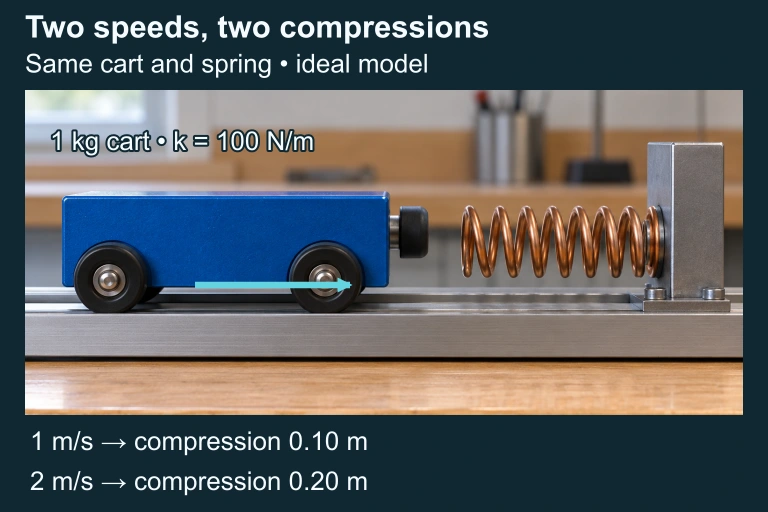 The same 1 kg cart encounters a 100 N/m spring. Incoming speeds 1 and 2 m/s give kinetic energies 0.5 and 2 J and maximum compressions 0.10 and 0.20 m. The required companion compares compression on one common ruler.
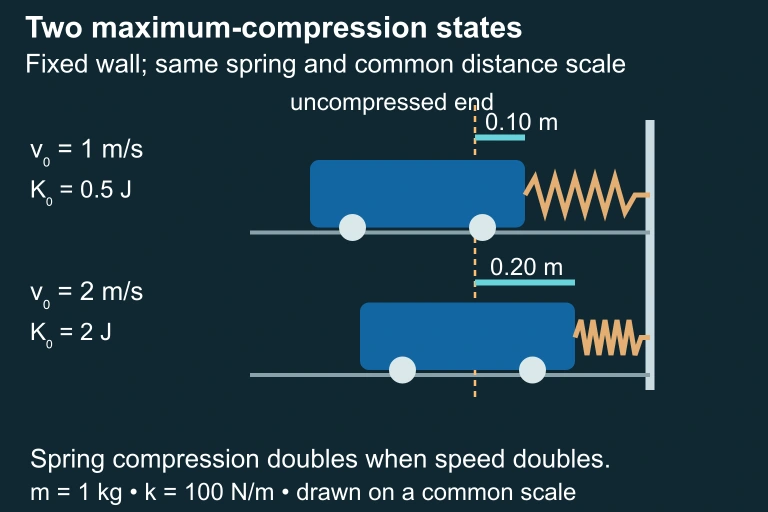 Two exact maximum-compression states at a common scale.
SECTION 4
Mathematical Framework
Derivation from Newton's Second Law
The expression for translational kinetic energy is not simply asserted — it is derived from Newton's second law by computing the work done by a net force on a particle. Consider a particle of mass m subject to a net force Fnet. By Newton's second law, Fnet = ma. The net work done as the particle moves from position xi to xf is the integral of the net force with respect to displacement. Using the chain rule (dv/dt = (dv/dx)(dx/dt) = v dv/dx) allows us to change the variable of integration from position to velocity, yielding the work-energy theorem in its most elegant form.
NET WORK INTEGRAL
Fnet = net force on the particle; m = mass; a = acceleration; dx = infinitesimal displacement
CHAIN RULE SUBSTITUTION
Using a = v(dv/dx), the integral transforms to velocity space. The result is the difference between the final and initial kinetic energies.
WORK-ENERGY THEOREM
Wnet = net work done on the particle (J); ΔK = change in translational kinetic energy (J); vf and vi = final and initial speeds (m/s)
TRANSLATIONAL KINETIC ENERGY
K = translational kinetic energy (J); m = mass (kg); v = speed of the center of mass (m/s). This is the scalar quantity that appears as the natural result of integrating Fnet · dx.
Calculus Connection
An important conceptual point deserves emphasis. The work-energy theorem is valid for any net force — constant or variable, conservative or non-conservative. When you compute Wnet = ΔK, you are summing the work contributions of all forces acting on the particle. This generality is what makes the theorem such a powerful tool in AP Physics C: even when forces vary along a path, the integral formulation handles the complexity seamlessly. However, note that this theorem in the form Wnet = ΔK applies to a single particle or to the translational motion of a rigid body's center of mass; for extended deformable systems, internal energy changes must also be considered.
SECTION 5
Detailed Breakdown: KE in Context
Kinetic Energy Across Scales
To build physical intuition for the magnitude of translational kinetic energy, it is helpful to compare representative values across a range of everyday and scientific contexts. The table below shows that kinetic energy spans many orders of magnitude, from the subatomic to the astronomical, and that the quadratic velocity dependence means that even modest masses at high speeds carry enormous energies.
| Object | Mass (kg) | Speed (m/s) | KE (J) |
|---|---|---|---|
| Walking person | 70 | 1.5 | 79 |
| Sprinting athlete | 70 | 10 | 3,500 |
| Car at highway speed | 1,500 | 30 | 675,000 |
| Rifle bullet | 0.004 | 900 | 1,620 |
| Commercial aircraft | 80,000 | 250 | 2.5 × 10⁹ |
Representative translational kinetic energies across different scales
The diagram above captures the essence of the work-energy theorem in a single visual. Notice that the normal force and gravitational force are perpendicular to the displacement and therefore do zero work on the block. Only the component of force along the displacement contributes to the net work integral. This reinforces a critical principle for AP Physics C: when computing work, you must evaluate W = ∫F · dr, where the dot product automatically extracts the parallel component. For a constant force at angle θ to the displacement, this reduces to W = Fd cos θ.
Energy Spectrum: Kinetic Energy Orders of Magnitude
SECTION 6
Worked Example
Variable Force and the Work-Energy Theorem
A 2.0 kg block starts from rest on a frictionless surface. A position-dependent force F(x) = 6x (in newtons, with x in meters) is applied to the block in the direction of motion. Find the speed of the block after it has traveled 4.0 m.
Using Integration to Find Final Speed
- 1
Step 1 — Identify Given Values
Mass m = 2.0 kg; initial speed vi = 0 (starts from rest); force F(x) = 6x N; displacement from x = 0 to x = 4.0 m; frictionless surface (no non-conservative work losses). - 2
Step 2 — Write the Work-Energy Theorem
Since the surface is frictionless and F(x) is the only horizontal force, the net work equals the work done by F(x): Wnet = ΔK = ½mvf2 − ½mvi2. Since vi = 0, this simplifies to Wnet = ½mvf2. - 3
Step 3 — Compute the Net Work via Integration
Wnet = ∫₀⁴ F(x) dx = ∫₀⁴ 6x dx = 6 × [x²/2] from 0 to 4 = 6 × (16/2 − 0) = 6 × 8 = 48 J.Wnet = 48 J - 4
Step 4 — Solve for the Final Speed
Set Wnet = ½mvf2: 48 = ½(2.0)vf2 → 48 = vf2 → vf = √48 ≈ 6.93 m/s.vf = √48 ≈ 6.93 m/s - 5
Step 5 — Verify with Dimensional Analysis
The units check out: [W] = N·m = kg·m²/s² = J. Then J / kg = m²/s², and √(m²/s²) = m/s, which is indeed a speed. The answer is physically reasonable — the block gains a moderate speed under a force that increases with displacement.
AP Exam Tip
SECTION 7
Strengths, Limitations & Comparisons
Energy Methods vs. Force Methods
One of the most important strategic decisions in AP Physics C problem solving is choosing between an energy approach and a force-based (Newton's second law) approach. Neither is universally superior, but each has distinct advantages depending on the problem's structure. The table below summarizes when translational kinetic energy and the work-energy theorem offer the most efficient path to a solution, and when Newton's laws may be more appropriate.
| Criterion | Energy Method (Work-KE Theorem) | Force Method (Newton's 2nd Law) |
|---|---|---|
| Information needed | Relates speed to position; does not require time | Provides acceleration as a function of time; can find trajectories |
| Variable forces | Handles naturally via integration ∫F · dr | Requires solving differential equations, which can be complex |
| Multi-dimensional paths | Scalar calculation — direction of velocity is irrelevant, only speed matters | Requires component-by-component vector analysis |
| Finding time | Cannot directly determine elapsed time | Directly provides time information through kinematics |
| Non-conservative forces | Must calculate work done by friction/drag explicitly | Included automatically in ΣF = ma |
| Curved paths | Path integral needed for non-conservative forces; for conservative forces, only endpoints matter | Requires tangential and normal force decomposition at every point |
Strategic comparison: energy vs. force methods in AP Physics C
WHEN TO CHOOSE ENERGY
SECTION 8
Connection to Advanced Theory
Beyond ½mv²: Rotational KE, Relativity & Lagrangian Mechanics
Translational kinetic energy is only one component of a body's total kinetic energy. For a rigid body that both translates and rotates, the total kinetic energy is the sum of the translational kinetic energy of the center of mass and the rotational kinetic energy about the center of mass: Ktotal = ½mv²cm + ½Iω². This decomposition, known as König's theorem, is essential for rolling-without-slipping problems that appear frequently on the AP exam. Furthermore, in Lagrangian mechanics — which students will encounter in upper-division physics — kinetic energy expressed in generalized coordinates becomes the foundation for deriving equations of motion without ever constructing free-body diagrams.
| Aspect | Classical KE (AP Mechanics) | Advanced Framework |
|---|---|---|
| Expression | K = ½mv² | K = (γ − 1)mc² (relativistic); T = ½ Σ q̇_i² (Lagrangian generalized) |
| Validity | v ≪ c (speeds much less than the speed of light) | All speeds (relativistic); all coordinate systems (Lagrangian) |
| Rotation | Treated separately as ½Iω² | Naturally incorporated into generalized kinetic energy tensor |
| Symmetries & conservation | Conservation derived from W_net = 0 | Noether's theorem: time-translation symmetry → energy conservation |
Classical vs. advanced formulations of kinetic energy
For your AP Physics C exam, the classical expression ½mv² is entirely sufficient since all problems involve non-relativistic speeds. However, knowing that this is an approximation within a broader framework enriches your conceptual understanding. The factor of ½ and the quadratic velocity dependence reappear consistently: in rotational KE (½Iω²), in elastic potential energy (½kx²), and in the energy stored in a capacitor (½CV²). Recognizing this structural pattern — a quadratic form multiplied by ½ — signals that these quantities all arise from integrating a linear restoring or driving quantity with respect to its conjugate variable.
SECTION 9
Practice Problems
Question 1: CONCEPTUAL
- A. ½
- B. 1/√2
- C. √2
- D. 2
Show answer (B)
Question 2: BASIC CALCULATION
- A. 3.0 J
- B. 6.0 J
- C. 36 J
- D. 72 J
Show answer (C)
Question 3: INTERMEDIATE
- A. 4.0 m/s
- B. 2√6 m/s ≈ 4.9 m/s
- C. 6.0 m/s
- D. 8.0 m/s
Show answer (B)
Question 4: APPLIED
5 ptsShow answer
Question 5: CRITICAL THINKING
4 ptsShow answer
SUMMARY
Lesson Summary
Summary
Translational kinetic energy is defined as K = ½mv², a scalar quantity representing the energy of an object's center-of-mass motion. It is always non-negative and depends on the square of the speed, meaning that doubling velocity quadruples kinetic energy. The expression arises naturally from integrating Newton's second law with respect to displacement, producing the work-energy theorem: Wnet = ΔK = ½mvf2 − ½mvi2.
Energy methods are especially powerful when problems ask for speed as a function of position or involve variable forces that must be integrated. On the AP Physics C exam, be prepared to derive the work done by position-dependent and velocity-dependent forces using calculus, and to connect translational KE with rotational kinetic energy (½Iω²) for extended-body problems. The ½ factor and quadratic form are signatures of energies arising from integration of linear quantities — a structural pattern that recurs throughout physics.