

SECTION 1
Historical Context & Motivation
Long before Newton formalized his laws of motion, artisans and engineers exploited the elastic properties of materials in bows, catapults, and clockwork mechanisms. The quantitative study of elasticity, however, began in earnest during the Scientific Revolution, when natural philosophers sought universal mathematical laws governing the behavior of matter under stress. The concept of a restoring force proportional to displacement became one of the earliest linear force laws in physics, and it remains a cornerstone of mechanics, materials science, and wave theory to this day. Understanding the history of spring forces reveals how a deceptively simple empirical observation opened the door to vibration analysis, acoustics, and the broader framework of linear response theory.
1660 • Hooke's Anagram
1678 • Hooke's Law Published
1807 • Young's Modulus
1909 • Simple Harmonic Motion Formalized
The central question Hooke answered remains relevant today: how does a deformable object respond when displaced from equilibrium, and how can we predict the magnitude and direction of the resulting force? Answering this question leads directly into the mathematical framework of Hooke's law, the energy stored in elastic systems, and the oscillatory motion that springs produce when released.
SECTION 2
Core Principles & Definitions
Spring forces belong to the broader category of restoring forces — forces that always act to return a system to its equilibrium position. The defining feature of an ideal spring is that this restoring force is linearly proportional to the displacement from equilibrium, a relationship encoded in Hooke's law. While real springs deviate from this idealization at extreme deformations, the linear model accurately describes a wide range of elastic systems encountered in both laboratory settings and engineering applications. Mastering these core principles is essential for the AP Physics C: Mechanics exam, where spring forces appear in contexts ranging from static equilibrium to oscillatory dynamics and energy conservation.
Equilibrium Position
Spring Constant (k)
Restoring Direction
Elastic Limit
KEY TAKEAWAY
SECTION 3
Visual Explanation — The Spring Force in Action
The top panel illustrates the physical configuration: when the spring is at its natural length no force acts on the mass; when stretched in the positive direction the spring pulls the mass back toward equilibrium (negative force); when compressed the spring pushes the mass in the positive direction. The bottom panel confirms the algebraic relationship — force is a linear function of displacement with a negative slope equal in magnitude to the spring constant k. This linearity is the hallmark of Hooke's law and the reason spring systems produce simple harmonic motion.
SECTION 4
Mathematical Framework
The mathematical treatment of spring forces centers on three key expressions: the force law itself, the elastic potential energy stored in the spring, and the equation of motion that governs oscillatory behavior. Each builds logically on the previous one, and together they form a complete description of an ideal spring–mass system.
HOOKE'S LAW
where F is the restoring force (N), k is the spring constant (N/m), and x is the displacement from equilibrium (m). The negative sign ensures the force opposes the displacement.
ELASTIC POTENTIAL ENERGY
Derived by integrating the spring force from 0 to x: U = −∫₀ˣ (−kx′) dx′ = ½kx². This quadratic dependence means doubling the displacement quadruples the stored energy.
EQUATION OF MOTION (SHM)
Applying Newton's second law to a mass m on a spring yields a second-order ODE whose general solution is x(t) = A cos(ωt + φ), with angular frequency ω = √(k/m).
PERIOD OF OSCILLATION
The period depends only on the mass and spring constant — not on amplitude. This amplitude independence is a unique property of simple harmonic motion and follows directly from the linearity of Hooke's law.
Calculus Connection
SECTION 5
Spring Combinations & Effective Constants
In many exam and real-world scenarios, springs are combined in series or parallel arrangements. Understanding how to compute an effective spring constant for each configuration is essential, especially since AP Physics C free-response questions frequently test this skill. The rules for combining spring constants are analogous to combining resistors in circuits — but with an important inversion: springs in series combine like resistors in parallel, and vice versa.
The physical reasoning behind these formulas is straightforward. In a series arrangement, each spring must transmit the same force (by Newton's third law at the junction), but each stretches by a different amount depending on its stiffness, so the total displacement is the sum of the individual displacements. Dividing F = k_eff × x_total by the individual F = × relationships yields the reciprocal addition rule. In a parallel arrangement, both springs undergo the same displacement but contribute independent forces, so the total force is the sum of the individual forces, giving k_eff = k₁ + k₂. Recognizing which springs share force versus which share displacement is the key to solving combination problems quickly.
 Connecting springs in series or parallel changes their effective stiffness. Series connections carry the same force; parallel connections impose the same extension.
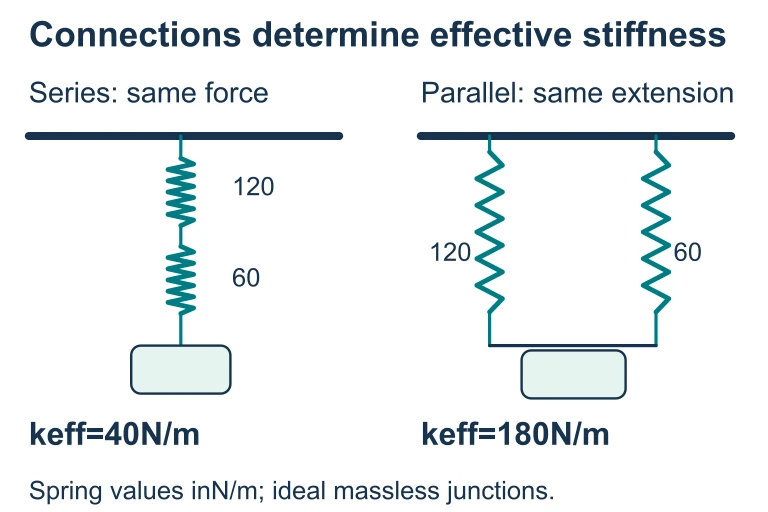 Springs of 120 and 60 N/m have effective stiffness 40 N/m in series and 180 N/m in parallel. Series springs carry the same force; parallel springs attached to a rigid crossbar have the same extension.
SECTION 6
Worked Example — Spring on an Inclined Plane
A 2.0 kg block rests on a frictionless 30° incline and is attached to a spring with spring constant k = 80 N/m, anchored at the top of the incline. The spring is aligned along the surface of the incline. Find (a) the spring's equilibrium extension, (b) the elastic potential energy stored at that extension, and (c) the period of small oscillations about this new equilibrium.
Block–Spring System on a Frictionless Incline
- 1
Step 1 — Draw the Free-Body Diagram & Choose Coordinates
Choose x positive down the incline, measured from the block position at the spring's natural length. Positive x is extension of the spring anchored uphill. The spring force along the incline is −kx and the gravitational component is +mg sin θ. The normal force balances the perpendicular component of gravity. - 2
Step 2 — Find Equilibrium Extension
At equilibrium, mg sin θ − kx₀ = 0. Therefore x₀ = mg sin θ/k = (2.0)(9.8)(sin 30°)/80 = 9.8/80 = +0.1225 m. The stretched spring pulls uphill with 9.8 N, balancing gravity's downhill component.x₀ = +0.1225 m ≈ +0.12 m (extended 12.25 cm) - 3
Step 3 — Calculate Elastic Potential Energy
Using U = ½kx₀²: U = ½(80)(0.1225)² = 40 × 0.01501 = 0.600 J.U ≈ 0.60 J - 4
Step 4 — Determine Period of Oscillation
For small oscillations about the new equilibrium on an incline, gravity shifts the equilibrium position but does not change the restoring force's dependence on displacement from that equilibrium. With ξ = x − x₀, the equation of motion is mξ̈ = −kξ. The effective spring constant remains k = 80 N/m. Therefore T = 2π√(m/k) = 2π√(2.0/80) = 2π√(0.025) = 2π(0.1581).T ≈ 0.993 s ≈ 1.0 s - 5
Step 5 — Physical Interpretation
Gravity on the incline shifts where the block sits at rest (the equilibrium point moves down the incline) and stores energy in the extended spring, but it does not alter the oscillation frequency. This is a hallmark of Hooke's law: a constant external force shifts equilibrium without changing the dynamics around that equilibrium — a principle tested frequently on AP Physics C.
 Physics C • 2 kg • k = 80 N/m; illustrative apparatus not to scale.
SECTION 7
Strengths, Limitations & Common Pitfalls
| Aspect | Strengths of the Ideal Spring Model | Limitations / Pitfalls |
|---|---|---|
| Linearity | Produces exactly solvable SHM; superposition applies directly. | Real springs become nonlinear beyond the elastic limit; Hooke's law fails for large deformations. |
| Massless spring | Simplifies analysis — only the attached mass determines dynamics. | A heavy spring requires distributed-mass treatment, altering the effective mass in T = 2π√(m/k) by adding roughly m_spring/3. |
| No damping | Energy is perfectly conserved between kinetic and elastic potential. | Real systems lose energy to friction and air resistance; oscillations decay without external driving. |
| Sign convention | The negative sign in F = −kx automatically handles direction. | Students often drop the negative sign or confuse the sign of x with the sign of force, leading to incorrect direction of the restoring force. |
Comparison of ideal spring model strengths and real-world limitations.
EXAM TIP
SECTION 8
Connection to Advanced Theory
Hooke's law is the first-order term in a Taylor expansion of any restoring force about a stable equilibrium point. If U(x) is the potential energy of a general system near a minimum at x₀, then U(x) ≈ U(x₀) + ½U″(x₀)(x − x₀)², and the restoring force is F ≈ −U″(x₀)(x − x₀). This means every system near a stable equilibrium behaves like a spring with effective spring constant k_eff = U″(x₀), a principle that makes simple harmonic motion ubiquitous in physics — from molecular vibrations described by the Lennard-Jones potential to oscillations of atoms in a crystal lattice.
| Feature | Ideal Spring (Hooke's Law) | General Restoring Force |
|---|---|---|
| Force law | F = −kx (linear) | F(x) — may include cubic, higher-order, or discontinuous terms |
| Oscillation type | Simple harmonic — sinusoidal, frequency independent of amplitude | Anharmonic — waveform distorted, period depends on amplitude |
| Energy | U = ½kx² (parabolic potential well) | U(x) is asymmetric or higher-order; energy levels unequally spaced (quantum case) |
| Superposition | Applies — solutions can be added | Fails — nonlinear coupling leads to phenomena like chaos and mode mixing |
Hooke's law versus general (anharmonic) restoring forces.
For AP Physics C, you are expected to handle only the linear regime. However, awareness that Hooke's law is an approximation — valid near equilibrium but breaking down for large displacements — deepens conceptual understanding and occasionally appears in qualitative free-response questions. In more advanced coursework such as classical mechanics (Lagrangian and Hamiltonian formulations) and quantum mechanics (the quantum harmonic oscillator), the parabolic potential well of Hooke's law serves as the starting point for perturbation theory and is one of the few exactly solvable systems.
SECTION 9
Practice Problems
Question 1: CONCEPTUAL
- A. The velocity is zero and the acceleration is at its maximum magnitude.
- B. The velocity is at its maximum magnitude and the acceleration is zero.
- C. Both velocity and acceleration are at their maximum magnitudes.
- D. Both velocity and acceleration are zero.
Show answer (B)
Question 2: BASIC CALCULATION
- A. F = 30 N, U = 2.25 J
- B. F = 30 N, U = 4.50 J
- C. F = 15 N, U = 2.25 J
- D. F = 30 N, U = 1.50 J
Show answer (A)
Question 3: INTERMEDIATE
- A. T ≈ 0.81 s
- B. T ≈ 1.22 s
- C. T ≈ 1.72 s
- D. T ≈ 2.10 s
Show answer (C)
Question 4: APPLIED
7 ptsShow answer
Question 5: CRITICAL THINKING
5 ptsShow answer
SUMMARY
Summary — Spring Forces
Summary
Spring forces are governed by Hooke's law, F = −kx, which states that the restoring force exerted by an ideal spring is linearly proportional to and opposite in direction to the displacement from equilibrium. The spring constant k (in N/m) quantifies stiffness, and the elastic potential energy stored in a spring is U = ½kx², derived by integrating the force. Springs in series combine via reciprocal addition (1/k_eff = Σ 1/kᵢ), while springs in parallel combine by direct addition (k_eff = Σ kᵢ).
Applying Newton's second law to a mass on a spring yields the simple harmonic motion differential equation, whose solution gives sinusoidal oscillations with period T = 2π√(m/k) — independent of amplitude. A constant external force (e.g., gravity on an incline) shifts the equilibrium position but does not alter the oscillation frequency. Hooke's law is the linearized approximation to any restoring force near a stable equilibrium, making it the foundation for vibration analysis across all of physics.