

SECTION 1
Historical Context & Motivation
The concept of rotational kinetic energy evolved alongside humanity's growing understanding of rotational motion, from the ancient potter's wheel to the sophisticated turbines powering modern civilization. Although translational kinetic energy was well established by the mid-eighteenth century through the work of Émilie du Châtelet and others, the mathematical treatment of energy in rotating bodies required a deeper framework—one that connected each mass element's contribution to the rotation axis. The quest to quantify the energy stored in a spinning flywheel or a rolling planet drove some of the most creative minds in classical mechanics to develop the concepts of moment of inertia and angular velocity, ultimately revealing an elegant rotational analogue to ½mv².
1673 • Huygens' Compound Pendulum
1749 • Euler Formalizes Moment of Inertia
1788 • Lagrange's Analytical Mechanics
1850s • Industrial Flywheel Design
The central question motivating this topic is deceptively simple: when an object spins, how much kinetic energy does it possess, and how does the distribution of mass about the rotation axis affect that energy? Answering this question requires moving beyond point-particle mechanics and embracing the full richness of rigid-body dynamics—a transition that is at the heart of AP Physics C: Mechanics.
SECTION 2
Core Principles & Definitions
Rotational kinetic energy is the energy an object possesses due to its rotation about an axis. Just as translational kinetic energy depends on mass and linear velocity, rotational kinetic energy depends on the moment of inertia and the angular velocity. These two quantities encode both how mass is distributed relative to the axis and how rapidly the object spins, respectively. Understanding their interplay is essential for solving problems involving rolling, spinning, and orbiting objects throughout the AP Physics C curriculum.
Moment of Inertia (I)
Angular Velocity (ω)
K_rot = ½Iω²
Parallel-Axis Theorem
Total KE of Rolling Objects
KEY TAKEAWAY
SECTION 3
Visual Explanation
The diagram above illustrates the fundamental physical picture behind rotational kinetic energy. Every infinitesimal mass element in a rotating rigid body traces a circular path around the axis of rotation. The linear speed of that element is v = rω, where r is its perpendicular distance from the axis. Consequently, each element carries translational kinetic energy ½(dm)v² = ½(dm)r²ω². Summing (or integrating) over the entire body yields ½Iω², where I = ∫r²dm absorbs all of the geometric information about how mass is distributed relative to the axis. This is why two objects of identical mass can store dramatically different amounts of rotational energy at the same angular velocity: a thin hoop (I = MR²) stores twice the rotational KE of a solid disk (I = ½MR²) of the same mass and radius.
SECTION 4
Mathematical Framework
Derivation from First Principles
Consider a rigid body rotating with angular velocity ω about a fixed axis. Partition the body into N small mass elements dm₁, dm₂, …, dmₙ, each located at a perpendicular distance rᵢ from the axis. Because the body is rigid, every element shares the same angular velocity ω. The linear speed of the i-th element is vᵢ = rᵢω, so its kinetic energy is dKᵢ = ½(dmᵢ)(rᵢω)² = ½(dmᵢ)rᵢ²ω². Summing over all elements and pulling the constant ω² outside the sum yields the expression for the total rotational kinetic energy.
ROTATIONAL KINETIC ENERGY
where I = ∫r²dm is the moment of inertia (kg·m²) and ω is the angular velocity (rad/s). This expression is the rotational analogue of K = ½mv².
MOMENT OF INERTIA (CONTINUOUS BODY)
r is the perpendicular distance from the rotation axis to the mass element dm. For uniform density ρ, the integral reduces to ρ∫r²dV over the volume of the body.
PARALLEL-AXIS THEOREM
I_cm is the moment of inertia about an axis through the center of mass, M is the total mass, and d is the perpendicular distance between the two parallel axes. This theorem is indispensable for computing rotational KE about off-center axes.
TOTAL KE FOR ROLLING WITHOUT SLIPPING
For an object rolling without slipping, the total kinetic energy is the sum of its translational KE (of the center of mass) and its rotational KE (about the center of mass). The rolling constraint v_cm = Rω allows either ω or v_cm to be eliminated.
Exam Tip
 Kinetic friction slows the center of mass and increases the spin of an initially nonspinning solid cylinder. Slipping ends when v = Rω; one-third of the initial mechanical energy has been dissipated in this model.
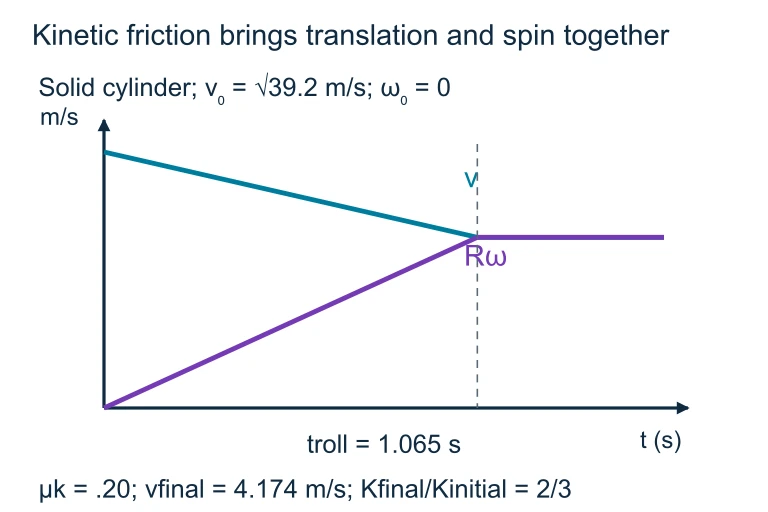 Kinetic friction slows the center of mass and increases the spin of an initially nonspinning solid cylinder. Slipping ends when v = Rω; one-third of the initial mechanical energy has been dissipated in this model.
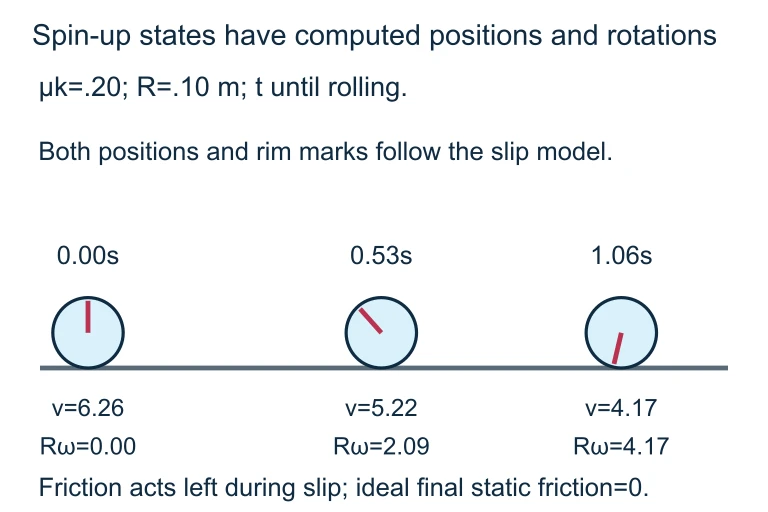 Kinetic friction slows the center of mass and increases the spin of an initially nonspinning solid cylinder. Slipping ends when v = Rω; one-third of the initial mechanical energy has been dissipated in this model.
SECTION 5
Common Moments of Inertia
Because rotational kinetic energy is proportional to the moment of inertia, knowing the moments of common geometric shapes is essential for efficient problem-solving on the AP exam. The table below summarizes the most frequently tested cases. Notice how the coefficient in front of MR² reflects the mass distribution: a thin hoop with all mass at radius R has the largest coefficient (1), while a solid sphere has the smallest (2/5), because more of its mass lies close to the axis.
| Object | Axis | Moment of Inertia | K_rot at given ω |
|---|---|---|---|
| Thin hoop (ring) | Through center, ⊥ to plane | MR² | ½MR²ω² |
| Solid disk / cylinder | Through center, ⊥ to flat face | ½MR² | ¼MR²ω² |
| Solid sphere | Through center | ⅖MR² | ⅕MR²ω² |
| Thin spherical shell | Through center | ⅔MR² | ⅓MR²ω² |
| Thin rod | Through center, ⊥ to rod | ¹⁄₁₂ML² | ¹⁄₂₄ML²ω² |
| Thin rod | Through end, ⊥ to rod | ⅓ML² | ⅙ML²ω² |
Common moments of inertia and corresponding rotational kinetic energies
The stacked bar chart above powerfully demonstrates a key consequence of rotational kinetic energy: when objects roll without slipping down an incline, the object with the smallest moment of inertia coefficient reaches the bottom with the greatest translational speed. This result is independent of mass and radius—a classic and frequently tested AP Physics C result. For a shape with I = cMR², where c is a dimensionless constant, the fraction of total KE that goes into translation is 1/(1 + c), while the rotational fraction is c/(1 + c). Understanding this partition is critical for energy conservation problems involving rolling.
SECTION 6
Worked Example
A solid cylinder of mass M = 4.0 kg and radius R = 0.10 m starts from rest on a frictionless ramp of vertical height h = 2.0 m. It slides without rotating, then enters a rough horizontal surface. Kinetic friction slows its translation and starts its rotation until it rolls without slipping. Determine its translational speed after rolling without slipping begins. Neglect any additional loss at the smooth change in track direction.
Solid Cylinder: Sliding to Rolling
- 1
Step 1 — Identify the Energy at the Bottom of the Ramp
On the frictionless ramp the cylinder slides without rotating. Conservation of mechanical energy gives ½Mu² = Mgh, so u = √(2gh) = √39.2 = 6.26099 m/s at the bottom, with angular speed zero. This is the speed before kinetic friction acts on the horizontal section.KE at bottom of ramp = Mgh = 4.0 × 9.8 × 2.0 = 78.4 J - 2
Step 2 — Apply Linear and Angular Impulse During Slipping
Let J be the magnitude of the backward friction impulse. Linear impulse gives M(v − u) = −J. Taking the rolling rotation as positive, angular impulse about the center gives Iω = JR. For a solid cylinder, I = ½MR². At the end of slipping, v = Rω; therefore J = Iv/R² = ½Mv. Kinetic friction dissipates energy during this transition, so mechanical energy is not conserved. - 3
Step 3 — Solve for v
Substitute J = ½Mv into M(v − u) = −J: v − u = −v/2. Thus v = 2u/3 = 4.17399 m/s. The final angular speed is ω = v/R = 41.7399 rad/s.v ≈ 4.17 m/s; ω ≈ 41.7 rad/s - 4
Step 4 — Verify Energy Partition
K_trans = ½Mv² = 34.8444 J and K_rot = ½Iω² = 17.4222 J, so K_final = 52.2667 J. The thermal energy produced is 78.4 − 52.2667 = 26.1333 J, one third of the initial kinetic energy. The remaining kinetic energy has the expected cylinder partition: two thirds translational and one third rotational.K_trans ≈ 34.8 J; K_rot ≈ 17.4 J; K_final ≈ 52.3 J; thermal energy ≈ 26.1 J
SECTION 7
Translational vs. Rotational Kinetic Energy
One of the most powerful features of rotational mechanics is the systematic analogy between translational and rotational quantities. Every translational concept has a direct rotational counterpart, and the mathematical structure of the energy expressions is identical in form. Mastering this correspondence not only simplifies problem-solving but also deepens conceptual understanding of what energy means in both domains.
| Translational Quantity | Symbol | Rotational Analogue | Symbol |
|---|---|---|---|
| Mass | m | Moment of inertia | I |
| Velocity | v | Angular velocity | ω |
| Kinetic energy | ½mv² | Rotational kinetic energy | ½Iω² |
| Momentum | p = mv | Angular momentum | L = Iω |
| Force | F | Torque | τ |
| Work by force | W = ∫F·dx | Work by torque | W = ∫τ dθ |
Complete translational-rotational analogy table
KEY TAKEAWAY
SECTION 8
Connections to Advanced Theory
Rotational kinetic energy in the AP Physics C framework assumes rotation about a single fixed axis, but real-world problems often involve more complex scenarios. Understanding how the basic formula extends prepares you for both the trickier exam questions and for future coursework in classical mechanics and engineering dynamics.
| AP Physics C Level | Advanced / University Level |
|---|---|
| K_rot = ½Iω² for fixed-axis rotation | K_rot = ½ω⃗ᵀ·𝐈·ω⃗ using the full inertia tensor (3×3 matrix) for arbitrary rotation |
| Parallel-axis theorem: I = I_cm + Md² | Generalized parallel-axis theorem for inertia tensors in 3D, including products of inertia |
| Rolling constraint: v = Rω | Non-holonomic constraints and Lagrangian mechanics for rolling on curved surfaces |
| Energy conservation with ½mv² + ½Iω² | Lagrangian T − V formulation where T includes full rotational KE via generalized coordinates |
| Moment of inertia as a scalar quantity | Principal axes and principal moments; Euler's equations for torque-free precession |
How AP-level rotational KE concepts extend to advanced mechanics
The work-energy theorem also extends naturally to rotation: the net work done by all torques equals the change in rotational kinetic energy, W_net = ΔK_rot = ½Iω_f² − ½Iω_i². This relationship is tested on the AP exam through problems that involve angular acceleration driven by a constant or variable torque. In the Lagrangian formulation studied in upper-division mechanics courses, both translational and rotational kinetic energies are unified within a single scalar kinetic energy function T expressed in generalized coordinates, and the equations of motion follow from the Euler-Lagrange equations—an elegant framework that the AP-level energy methods naturally foreshadow.
SECTION 9
Practice Problems
Question 1: CONCEPTUAL
- A. The solid sphere, because more of its mass is concentrated near the axis.
- B. The hollow sphere, because its moment of inertia is larger.
- C. They have the same rotational kinetic energy because they have the same mass and angular velocity.
- D. The solid sphere, because solid objects always store more energy than hollow ones.
Show answer (B)
Question 2: BASIC CALCULATION
- A. 0.30 J
- B. 0.60 J
- C. 1.2 J
- D. 3.0 J
Show answer (D)
Question 3: INTERMEDIATE
- A. 4.04 rad/s
- B. 4.95 rad/s
- C. 5.72 rad/s
- D. 7.00 rad/s
Show answer (B)
Question 4: APPLIED
10 ptsShow answer
Question 5: CRITICAL THINKING
7 ptsShow answer
SUMMARY
Lesson Summary
Summary
Rotational kinetic energy is given by K_rot = ½Iω², the direct rotational analogue of ½mv². The moment of inertia I = ∫r²dm quantifies the resistance of a body to angular acceleration and determines how kinetic energy is stored in rotation. Objects with mass concentrated far from the axis (like a thin hoop with I = MR²) store more rotational energy at a given ω than objects with mass near the axis (like a solid sphere with I = ⅖MR²). The parallel-axis theorem (I = I_cm + Md²) allows you to shift the rotation axis for more complex geometries.
For rolling without slipping, the total kinetic energy is the sum of translational and rotational contributions: K_total = ½mv² + ½Iω², linked by the constraint v = Rω. For an object with I = cMR², the center-of-mass speed at the bottom of a ramp of height h is v = √(2gh/(1 + c)), and the fraction of energy in rotation is c/(1 + c). This result is independent of mass and radius, making it one of the most elegant predictions in classical mechanics and a frequent target on the AP Physics C exam.