

SECTION 1
Historical Context & Motivation
The physics of rolling motion has fascinated natural philosophers and engineers for millennia, from the invention of the wheel around 3500 BCE in Mesopotamia to the precision bearings in modern turbines. Rolling is one of the most common forms of motion in everyday life, yet its complete mathematical description requires the simultaneous treatment of translational and rotational dynamics—a synthesis that did not emerge until the development of classical mechanics in the seventeenth and eighteenth centuries. The seemingly simple act of a ball rolling down a ramp conceals a rich interplay between linear and angular kinematics, friction forces, and the distribution of kinetic energy between translation and rotation.
~3500 BCE • Invention of the Wheel
1687 • Newton's Laws of Motion
1750s • Euler's Rigid-Body Dynamics
1834 • Hamilton's Principle & Lagrangian Mechanics
Modern Era • Engineering Applications
The central question that rolling poses for physics students is deceptively straightforward: when a rigid object rolls along a surface, how do we properly account for the fact that it is both translating and spinning? How does friction—ordinarily associated with energy dissipation—serve as the very agent that enables rolling without slipping and yet does no work? Answering these questions requires a careful synthesis of Newton's second law for translation, its rotational counterpart for torque, and the rolling constraint that links linear and angular velocities.
SECTION 2
Core Principles of Rolling
Rolling motion combines translation of the center of mass with rotation about that center. To analyze it rigorously, we must understand several foundational ideas that connect kinematics, dynamics, and energy. The following principles form the backbone of every rolling problem you will encounter on the AP Physics C exam and beyond.
Rolling Constraint (No-Slip Condition)
Dual Kinetic Energy
Static Friction as the Agent
Instantaneous Axis of Rotation
Moment of Inertia Matters
KEY TAKEAWAY
SECTION 3
Visual Explanation: Velocity Distribution in Rolling
The key insight into rolling without slipping is that every point on the rolling object has a velocity that is the vector sum of the translational velocity of the center of mass and the rotational velocity about the center. The following diagram illustrates the velocity vectors at several key points on a rolling disk, showing how these two contributions combine.
Notice the crucial result at the contact point: the translational velocity (vcm to the right) and the rotational velocity (ωR to the left) are equal and opposite, yielding zero net velocity at the bottom. This is the defining feature of rolling without slipping. Any point on the rim traces out a cycloid in the lab frame: a curve that touches the ground with zero speed at each cusp and reaches maximum speed (2vcm) at the peak. For the right-side point, the translational (rightward) and rotational (downward) velocities are perpendicular, yielding a resultant of magnitude √2 × ωR directed at 45° below the rightward horizontal.
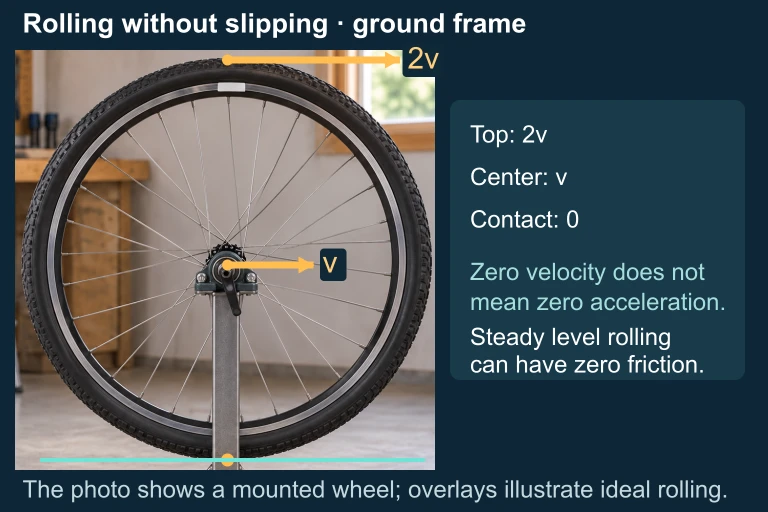 The photograph shows mounted apparatus. The modeled arrows describe ideal rightward rolling on a stationary surface: top speed 2v, center speed v, contact speed zero. The required vector-sum companion explains translation plus rotation; zero speed does not imply zero acceleration.
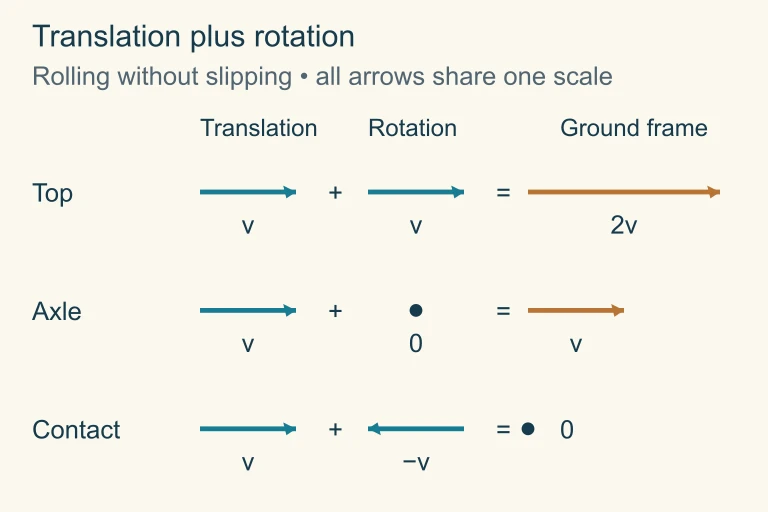 In the ground frame, v_point = v_CM + ω × r. Top: v + v = 2v; center: v + 0 = v; contact: v − v = 0. Zero contact velocity does not imply zero contact acceleration.
SECTION 4
Mathematical Framework
The mathematical treatment of rolling rests on three pillars: the rolling constraint that links kinematics, Newton's second law applied separately for translation and rotation, and the energy formulation that partitions kinetic energy into translational and rotational parts. We develop each in turn.
The Rolling Constraint
ROLLING CONSTRAINT (NO-SLIP)
vcm = speed of center of mass, ω = angular velocity, R = radius, acm = linear acceleration, α = angular acceleration. Differentiating v = ωR with respect to time yields the acceleration constraint.
Newton's Second Law for Rolling
TRANSLATIONAL (ALONG INCLINE)
m = mass, g = gravitational acceleration, θ = incline angle, fs = static friction force (acts up the incline to oppose slipping).
ROTATIONAL (ABOUT CENTER OF MASS)
Only static friction exerts a torque about the center of mass because gravity and the normal force have zero moment arm about the center. Icm is the moment of inertia about the center of mass.
Substituting α = acm/R into the torque equation gives fs = Icmacm/R². Substituting into the translational equation and solving for acm yields the general result for rolling on an incline.
ACCELERATION ON AN INCLINE
The factor (1 + Icm/mR²) quantifies how much the rotational inertia slows the translational acceleration. A sliding block (Icm = 0 effectively) would have acm = g sin θ.
Energy of a Rolling Object
TOTAL KINETIC ENERGY
Using vcm = ωR, the rotational term ½Icmω² becomes ½(Icm/R²)v²cm. This compact form is especially useful in energy-conservation problems.
Why Static Friction Does No Work
SECTION 5
Moment of Inertia and the Rolling Race
A classic demonstration in physics involves releasing objects of different shapes simultaneously down an incline. Despite having the same mass and radius, a solid sphere always beats a solid cylinder, which in turn beats a hollow cylinder. The reason lies in how each shape distributes its mass relative to the rotational axis, captured by the ratio Icm/mR². Objects with more mass concentrated near the axis (lower Icm/mR²) devote a smaller fraction of their kinetic energy to rotation, leaving more for translation, and thus accelerate faster.
| Object | I_cm | I_cm / mR² | a_cm on incline |
|---|---|---|---|
| Solid sphere | ⅖ mR² | 2/5 = 0.40 | (5/7)g sin θ ≈ 0.714g sin θ |
| Solid cylinder (disk) | ½ mR² | 1/2 = 0.50 | (2/3)g sin θ ≈ 0.667g sin θ |
| Hollow sphere (thin shell) | ⅔ mR² | 2/3 ≈ 0.667 | (3/5)g sin θ = 0.600g sin θ |
| Hollow cylinder (hoop) | mR² | 1.00 | (1/2)g sin θ = 0.500g sin θ |
Comparison of common rolling objects. The solid sphere wins the race because it has the smallest I_cm/mR² ratio.
Mass and Radius Cancel
SECTION 6
Worked Example: Solid Sphere Rolling Down a Ramp
A solid sphere of mass m = 2.0 kg and radius R = 0.10 m starts from rest at the top of a ramp of height h = 3.0 m inclined at θ = 30°. The sphere rolls without slipping down the ramp. Find (a) the speed of the center of mass at the bottom, (b) the angular velocity at the bottom, and (c) the linear acceleration along the ramp.
Solid Sphere Rolling Down a Ramp
- 1
Step 1 — Identify Given Values and Model
We have m = 2.0 kg, R = 0.10 m, h = 3.0 m, θ = 30°, and the sphere starts from rest (v₀ = 0, ω₀ = 0). For a solid sphere, Icm = (2/5)mR². Since the sphere rolls without slipping, static friction does no work, and we can use conservation of mechanical energy. - 2
Step 2 — Apply Conservation of Energy
Setting gravitational PE at the bottom as zero: mgh = ½mv² + ½Icmω². Substitute Icm = (2/5)mR² and ω = v/R: mgh = ½mv² + ½(2/5)mR²(v/R)² = ½mv² + (1/5)mv² = (7/10)mv². Cancel m and solve: v² = 10gh/7.v = √(10gh/7) = √(10 × 9.8 × 3.0 / 7) = √(42.0) ≈ 6.48 m/s - 3
Step 3 — Find Angular Velocity
Using the rolling constraint ω = v/R:ω = 6.48 / 0.10 = 64.8 rad/s - 4
Step 4 — Find Linear Acceleration
Using the general result acm = g sin θ / (1 + Icm/mR²) = g sin θ / (1 + 2/5) = (5/7)g sin θ:acm = (5/7)(9.8)(sin 30°) = (5/7)(9.8)(0.50) = 3.5 m/s² - 5
Step 5 — Verify with Kinematics
The ramp length is L = h/sin θ = 3.0/0.50 = 6.0 m. Using v² = 2aL: v² = 2(3.5)(6.0) = 42.0, so v = √42.0 ≈ 6.48 m/s. ✓ This matches our energy result, confirming internal consistency.
SECTION 7
Rolling Without Slipping vs. Other Regimes
Not all rolling motion is pure rolling. Depending on the applied forces and friction conditions, an object can be in one of three regimes: rolling without slipping, rolling with slipping, or pure sliding. Understanding the distinctions is critical both for the AP exam and for physical intuition.
| Feature | Rolling Without Slipping | Rolling With Slipping |
|---|---|---|
| Contact point velocity | Zero (vcontact = 0) | Nonzero (vcm ≠ ωR) |
| Type of friction | Static friction (fs ≤ μsN) | Kinetic friction (fk = μkN) |
| Work done by friction | Zero (contact point at rest) | Nonzero—dissipates energy as heat |
| Energy conservation | Mechanical energy is conserved | Must account for friction losses |
| Constraint equation | vcm = ωR (always holds) | vcm ≠ ωR until friction brings them into agreement |
Comparison of rolling without slipping versus rolling with slipping.
KEY TAKEAWAY
The minimum static friction coefficient required for rolling without slipping on an incline can be derived by combining the translational and rotational equations. For a general object with Icm = cmR², the required condition is μs ≥ (c × tan θ)/(1 + c). If the incline is too steep or the surface too smooth, the object will slip and kinetic friction must be used instead.
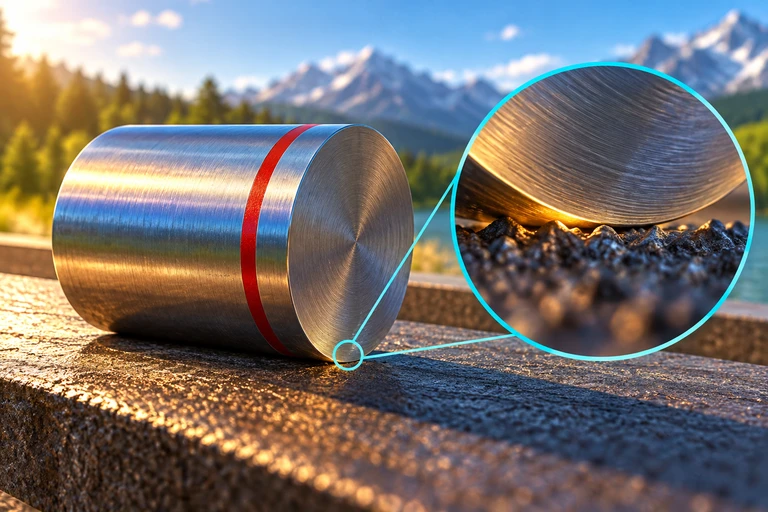 Kinetic friction slows the center of mass and increases the spin of an initially nonspinning solid cylinder. Slipping ends when v = Rω; one-third of the initial mechanical energy has been dissipated in this model.
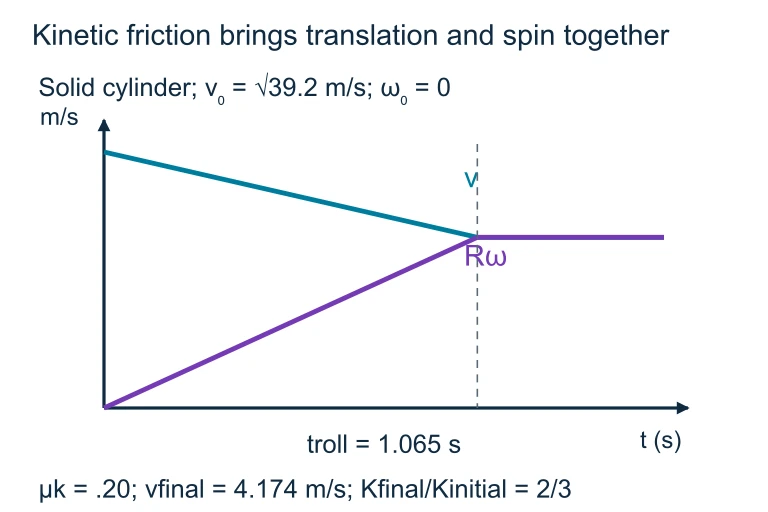 Kinetic friction slows the center of mass and increases the spin of an initially nonspinning solid cylinder. Slipping ends when v = Rω; one-third of the initial mechanical energy has been dissipated in this model.
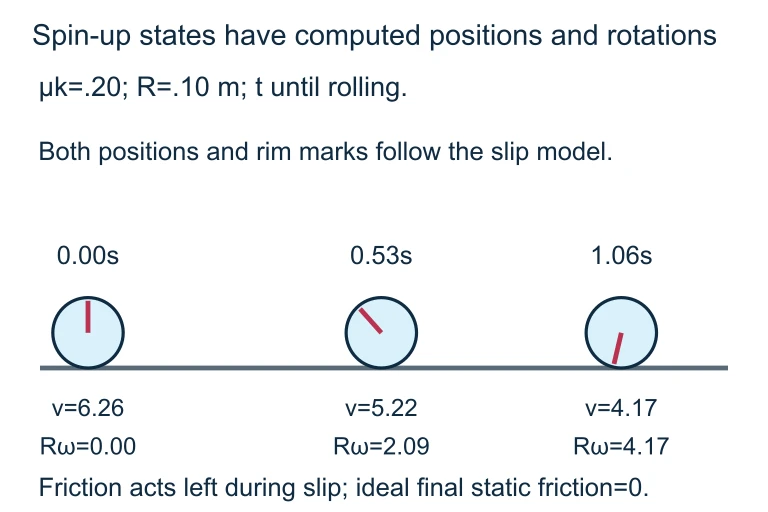 Kinetic friction slows the center of mass and increases the spin of an initially nonspinning solid cylinder. Slipping ends when v = Rω; one-third of the initial mechanical energy has been dissipated in this model.
SECTION 8
Connections to Angular Momentum and Advanced Theory
Rolling motion connects directly to the broader framework of angular momentum and energy in rotating systems. On the AP Physics C exam, rolling problems frequently appear in contexts that also require angular momentum conservation or the work–energy theorem in rotational form. Understanding these connections enriches your problem-solving toolkit and prepares you for the most challenging free-response questions.
| Concept | Standard Rolling Treatment | Advanced / Extended Treatment |
|---|---|---|
| Kinetic energy | K = ½mv² + ½Icmω² | K = ½Icontactω² using the parallel axis theorem (Icontact = Icm + mR²) |
| Angular momentum | Lcm = Icmω | L about any point = Icmω + mvcmd (orbital + spin) |
| Torque analysis | τ = Icmα about center of mass | τcontact = Icontactα about instantaneous axis (eliminates friction from torque eq.) |
| Rolling on curved surfaces | Flat inclines only | Rolling inside/outside bowls and loops requires centripetal analysis at each point |
Rolling in standard vs. advanced contexts.
One particularly elegant advanced technique is analyzing rolling about the instantaneous axis of rotation (the contact point). By applying the parallel axis theorem, Icontact = Icm + mR², and writing K = ½Icontactω², you can verify that this yields the same total kinetic energy as ½mv² + ½Icmω². When computing torques about the contact point, friction has zero moment arm, which can simplify certain problems. This approach is especially powerful for rolling problems involving applied forces or rolling on curved surfaces, where it can eliminate the unknown friction force from the torque equation entirely.
SECTION 9
Practice Problems
Question 1: CONCEPTUAL
- A. They all slide down without rotating and reach the bottom at the same time.
- B. The solid sphere reaches the bottom first because it has the smallest moment of inertia ratio.
- C. The hollow sphere reaches the bottom first because all its mass is at the surface.
- D. They all roll without slipping and reach the bottom at the same time because they have the same mass.
Show answer (A)
Question 2: BASIC CALCULATION
- A. 72 J
- B. 108 J
- C. 144 J
- D. 36 J
Show answer (B)
Question 3: INTERMEDIATE
- A. 7.7 m/s
- B. 9.9 m/s
- C. 8.4 m/s
- D. 6.5 m/s
Show answer (A)
Question 4: APPLIED
10 ptsShow answer
Question 5: CRITICAL THINKING
7 ptsShow answer
SUMMARY
Rolling — Key Concepts Review
Summary
Rolling motion is a simultaneous combination of translation and rotation. For rolling without slipping, the rolling constraint vcm = ωR ensures the contact point is momentarily at rest. Static friction provides the torque needed to maintain rolling but does zero work, allowing mechanical energy conservation. The total kinetic energy is K = ½mv² + ½Icmω², and the moment of inertia determines how energy is partitioned between translational and rotational modes.
On inclines, the acceleration is acm = g sin θ / (1 + Icm/mR²), showing that objects with more mass concentrated near the axis accelerate faster in rolling races. When rolling with slipping occurs, kinetic friction dissipates energy and simultaneously adjusts vcm and ω until the no-slip condition is reached. Mastering rolling requires fluency with Newton's second law in both translational and rotational forms, the rolling constraint, and energy methods—skills that are tested extensively on the AP Physics C: Mechanics exam.