

SECTION 1
Historical Context & Motivation
Oscillatory motion is among the oldest phenomena studied in physics, yet its full mathematical representation required centuries of insight from astronomy, mechanics, and analysis. Ancient observers noted the isochronism of pendulums—the remarkable fact that the period of a small-amplitude swing is independent of its amplitude—but lacked the calculus-based framework to express position, velocity, and acceleration as continuous functions of time. The quest to represent simple harmonic motion (SHM) precisely drove innovations in differential equations, Fourier analysis, and energy methods that underpin modern physics and engineering.
1583 • Galileo and the Pendulum
1678 • Hooke's Law Published
1687 • Newton's Principia
1822 • Fourier's Theorem
The central question this lesson addresses is: How do we translate the physics of a linear restoring force into a complete, self-consistent set of time-dependent functions for position, velocity, acceleration, and energy, and how do the graphical representations of these quantities reveal the phase relationships and conservation laws that govern SHM?
SECTION 2
Core Principles & Definitions
Simple harmonic motion arises whenever a system experiences a linear restoring force proportional to its displacement from equilibrium. This single condition—expressed as F = −kx for a spring or, more generally, as a differential equation with sinusoidal solutions—generates a rich family of interrelated quantities. Before deriving equations, it is essential to establish the vocabulary and conceptual pillars upon which all representations rest.
Amplitude (A)
Angular Frequency (ω)
Phase Constant (φ₀)
Phase Relationships
Energy Conservation
KEY TAKEAWAY
SECTION 3
Visual Explanation — Kinematic Graphs of SHM
The most powerful way to internalize SHM is to see the three kinematic quantities—position, velocity, and acceleration—plotted on the same time axis. The following diagram shows one complete cycle for an oscillator starting at maximum positive displacement (φ₀ = 0). Notice the quarter-period phase offsets between successive curves: when position is at a maximum, velocity is zero and acceleration is at its most negative (pointing back toward equilibrium).
Several critical observations emerge from the diagram. First, whenever position reaches an extremum (±A), the velocity passes through zero—the object momentarily stops before reversing. Second, whenever velocity reaches its maximum magnitude, the position crosses zero (equilibrium) and the acceleration also passes through zero. Third, the acceleration curve is a mirror image (inverted) of the position curve, consistent with a = −ω²x. These three graphs are the kinematic fingerprint of any system executing SHM, regardless of whether the restoring force is elastic, gravitational, or electromagnetic.
SECTION 4
Mathematical Framework
Starting from Newton's second law applied to a mass on a spring, the equation of motion for SHM is a second-order linear ODE. Its general solution, combined with time derivatives, yields the complete kinematic description. The energy expressions follow from the kinematic functions and the work-energy theorem.
The Differential Equation of SHM
EQUATION OF MOTION
This arises from F = ma → −kx = m(d²x/dt²). Dividing by m and defining ω² = k/m produces the standard form. The general solution is x(t) = A cos(ωt + φ₀).
Position, Velocity, and Acceleration
POSITION
A = amplitude (m), ω = angular frequency (rad/s), φ₀ = initial phase (rad). The argument (ωt + φ₀) is the instantaneous phase.
VELOCITY
Maximum speed vmax = Aω occurs at equilibrium (x = 0). The negative sine is phase-shifted by π/2 ahead of the cosine.
ACCELERATION
Maximum magnitude amax = Aω² occurs at the turning points (x = ±A). The relation a = −ω²x is the defining kinematic signature of SHM.
Energy Functions
ENERGY IN SHM
The potential energy U = ½kA² cos²(ωt + φ₀) and kinetic energy K = ½kA² sin²(ωt + φ₀) each oscillate at frequency 2ω, while their sum remains constant at ½kA².
Determining φ₀ from Initial Conditions
SECTION 5
Energy Diagrams & Phase Space
Beyond the kinematic time graphs, two additional representations give deep insight into SHM. The energy-vs-position diagram shows how kinetic and potential energy trade off as the oscillator moves, while the phase-space plot (v versus x) reveals the elliptical trajectory that encodes conservation of energy in a single closed curve. Both representations are essential for the AP exam, where translation between graphical representations is a core skill.
The energy-versus-position diagram reveals that at x = 0 the potential energy is zero and the kinetic energy equals the total energy, while at x = ±A the kinetic energy vanishes and all energy is stored as potential. The phase-space ellipse encodes the same information geometrically: every point on the ellipse satisfies ½mv² + ½kx² = ½kA², so the ellipse is simply the constant-energy contour of the Hamiltonian. For the AP exam, you should be able to read initial conditions directly from the phase-space plot (the starting point) and determine the direction of motion (clockwise for standard SHM with our sign conventions).
Energy Oscillation Frequency
 With linear damping, the phase trajectory contracts and mechanical energy decreases at the rate −bv². The undamped comparison has constant total mechanical energy.
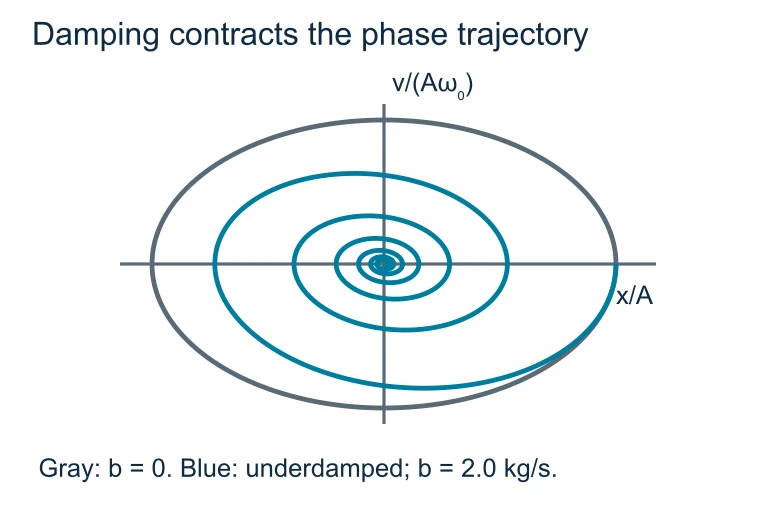 With linear damping, the phase trajectory contracts and mechanical energy decreases at the rate −bv². The undamped comparison has constant total mechanical energy.
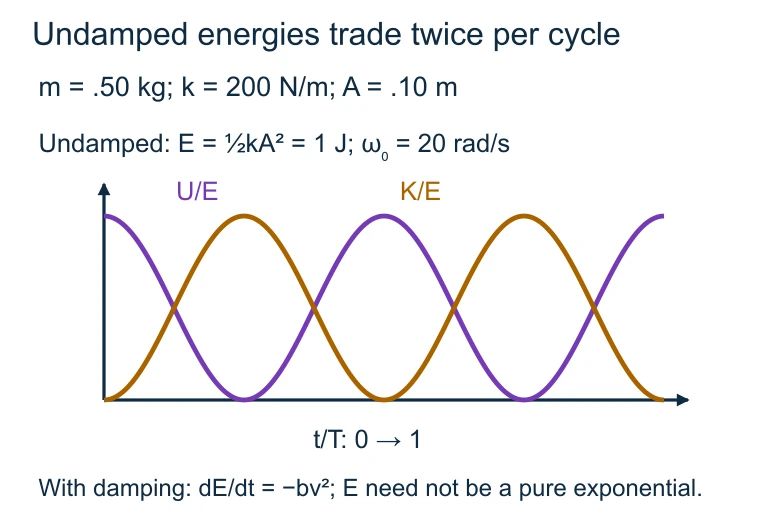 For m = 0.50 kg, k = 200 N/m and A = 0.10 m, total energy is 1 J and angular frequency is 20 rad/s. Kinetic and potential energies exchange at twice the displacement frequency.
SECTION 6
Worked Example
A 0.50 kg block is attached to a horizontal spring (k = 200 N/m) on a frictionless surface. At t = 0 the block is displaced 0.10 m to the right of equilibrium and released from rest. Determine the position, velocity, and acceleration as functions of time, the maximum speed, and the total mechanical energy.
Spring-Block Oscillator — Full Kinematic Description
- 1
Step 1 — Identify Parameters
Given: m = 0.50 kg, k = 200 N/m, x(0) = 0.10 m, v(0) = 0. Because the block starts at maximum displacement with zero velocity, the phase constant is φ₀ = 0 and the amplitude A = 0.10 m.A = 0.10 m, φ₀ = 0 - 2
Step 2 — Compute Angular Frequency
ω = √(k/m) = √(200/0.50) = √400 = 20 rad/s. The period is T = 2π/ω = 2π/20 ≈ 0.314 s.ω = 20 rad/s, T ≈ 0.314 s - 3
Step 3 — Write Kinematic Functions
x(t) = (0.10 m) cos(20t). Taking the first time derivative: v(t) = −(0.10)(20) sin(20t) = −2.0 sin(20t) m/s. The second derivative: a(t) = −(0.10)(20²) cos(20t) = −40 cos(20t) m/s².x(t) = 0.10 cos(20t) m; v(t) = −2.0 sin(20t) m/s; a(t) = −40 cos(20t) m/s² - 4
Step 4 — Maximum Speed and Acceleration
v_max = Aω = (0.10)(20) = 2.0 m/s, occurring at x = 0. a_max = Aω² = (0.10)(400) = 40 m/s², occurring at x = ±0.10 m.v_max = 2.0 m/s, a_max = 40 m/s² - 5
Step 5 — Total Mechanical Energy
E = ½kA² = ½(200)(0.10)² = 1.0 J. Equivalently, E = ½mv²_max = ½(0.50)(2.0)² = 1.0 J, confirming energy conservation.E = 1.0 J
SECTION 7
Comparing Representations of SHM
The AP Physics C exam frequently tests your ability to translate between different representations of SHM. Each representation emphasizes different aspects of the motion, and selecting the right one can streamline problem-solving. The table below compares the major representations, highlighting what each reveals most naturally and where each has limitations.
| Representation | Best Reveals | Limitations |
|---|---|---|
| x(t), v(t), a(t) Equations | Exact values at any time t; phase relationships; maximum magnitudes of kinematic quantities. | Requires knowledge of A, ω, and φ₀; does not directly show energy; algebraically intensive for non-standard initial conditions. |
| Kinematic Time Graphs | Visual phase offsets between x, v, and a; the period and amplitude can be read directly; slopes give derivative relationships. | Does not show energy; requires careful reading of scales; harder to extract exact numerical values than equations. |
| Energy vs. Position Diagram | Turning points (where K = 0); speed at any position (from K); conservation of total energy; the parabolic shape of U(x). | No time information; cannot determine phase constant or direction of motion. |
| Phase-Space Plot (v vs. x) | Complete state of the system at a glance; direction of motion (clockwise); energy (from enclosed area); amplitude and max speed from semi-axes. | No explicit time axis; difficult to read specific t values; ellipse shape is unfamiliar to some students. |
| Reference Circle / Phasor | Intuitive explanation of phase; simultaneous view of all components; powerful for combining two oscillations of the same frequency. | Less useful for energy analysis; can be confusing if the connection between rotation and linear oscillation is not clear. |
Summary of the principal representations used in SHM analysis.
TRANSLATION STRATEGY
SECTION 8
Connection to Advanced Theory
The idealized SHM model assumes a perfectly linear restoring force and no energy dissipation. Real systems deviate from these assumptions in two important ways: damping causes the amplitude to decay exponentially over time, and anharmonicity (nonlinear restoring forces) causes the oscillation frequency to depend on amplitude. Understanding where ideal SHM ends and these richer phenomena begin is critical for physical intuition and for the free-response section of the AP exam.
| Feature | Ideal SHM | Damped / Anharmonic Oscillations |
|---|---|---|
| Restoring Force | F = −kx (strictly linear) | F = −kx + higher-order terms (e.g., cubic), or includes velocity-dependent drag |
| Amplitude | Constant for all time | Decays as A(t) = A₀ in the underdamped case |
| Frequency | ω = √(k/m), independent of amplitude | Slightly shifted: ω' = √(ω² − γ²) for damping; amplitude-dependent for anharmonic |
| Energy | Conserved: E = ½kA² | Decreases over time due to dissipative forces; E(t) = E₀ |
| Phase-Space Trajectory | Closed ellipse | Inward spiral (damped); distorted closed curve (anharmonic) |
Ideal SHM vs. more realistic oscillatory models.
For the AP Physics C exam, you will not be tested on the full mathematical treatment of damped oscillations, but you should qualitatively understand how the sinusoidal graphs and phase-space ellipse change when energy is dissipated. In advanced coursework, adding a periodic driving force to the damped oscillator leads to resonance—a dramatic amplitude increase when the driving frequency matches the natural frequency—one of the most consequential phenomena in all of physics and engineering.
SECTION 9
Practice Problems
Question 1: CONCEPTUAL
- A. The velocity is zero and the acceleration is at its maximum magnitude.
- B. The velocity is at its maximum magnitude and the acceleration is zero.
- C. Both the velocity and the acceleration are at their maximum magnitudes.
- D. Both the velocity and the acceleration are zero.
Show answer (B)
Question 2: BASIC CALCULATION
- A. 0.80 m/s
- B. 1.6 m/s
- C. 3.2 m/s
- D. 20 m/s
Show answer (B)
Question 3: INTERMEDIATE
- A. −1.04 m/s
- B. +1.04 m/s
- C. −0.60 m/s
- D. +0.60 m/s
Show answer (A)
Question 4: APPLIED
10 ptsShow answer
Question 5: CRITICAL THINKING
7 ptsShow answer
SUMMARY
Summary
Summary
Simple harmonic motion is fully characterized by three parameters: amplitude A, angular frequency ω, and phase constant φ₀. The position function x(t) = A cos(ωt + φ₀) generates the velocity v(t) = −Aω sin(ωt + φ₀) and acceleration a(t) = −Aω² cos(ωt + φ₀) through successive differentiation. The velocity leads the position by π/2 radians, and the acceleration is always π radians out of phase with position, obeying a = −ω²x.
Energetically, total mechanical energy E = ½kA² is conserved, with kinetic and potential energy trading at twice the oscillation frequency. Key representations—kinematic time graphs, energy-versus-position diagrams, and the phase-space ellipse—each reveal complementary aspects of the motion. Mastering the ability to translate among these representations is essential for success on both the multiple-choice and free-response sections of the AP Physics C: Mechanics exam.