

SECTION 1
Historical Context & Motivation
The question of whether motion is absolute or relative has shaped physics since antiquity. When you sit in a moving train and watch another train glide past, it can be genuinely impossible to tell which train is in motion — an observation that troubled natural philosophers for centuries. The resolution of this puzzle required a formal concept: the reference frame, a coordinate system attached to an observer from which all measurements of position, velocity, and acceleration are made. In classical mechanics, the machinery of reference frames allows us to translate kinematic quantities between observers moving at different velocities, a skill that is essential for analyzing collisions, projectile problems on moving platforms, and rotating systems.
~350 BCE • Aristotelian Natural Motion
1632 • Galileo's Ship Thought Experiment
1687 • Newton's Principia
1905 • Einstein's Special Relativity
The central question this lesson addresses is deceptively simple: if two observers measure the position or velocity of the same object, how are their measurements related? Answering this requires building the Galilean transformation equations, understanding the distinction between inertial and non-inertial frames, and recognizing when fictitious forces appear. These tools are indispensable throughout AP Physics C: Mechanics and beyond.
SECTION 2
Core Principles & Definitions
Before diving into the mathematics, it is important to establish clear definitions. A reference frame is a coordinate system — typically Cartesian — together with a set of clocks, all attached to a particular observer. Every kinematic quantity (position, velocity, acceleration) is measured with respect to a chosen reference frame, and different frames generally yield different numerical values for the same event. The following grid summarizes the foundational ideas.
Inertial Frame
Non-Inertial Frame
Relative Velocity
Galilean Invariance
KEY TAKEAWAY
SECTION 3
Visual Explanation — Two Frames Observing a Particle
In the diagram above, the solid blue axes represent the laboratory frame S, while the dashed violet axes represent a second frame S′ that moves to the right with constant velocity v⃗₀. At time t = 0 the two origins coincide, so the displacement of O′ from O at a later time t is simply v⃗₀t (shown in amber). The pink particle P has position vector r⃗ in S and r⃗′ in S′. By simple vector addition, r⃗ = r⃗′ + v⃗₀t. Differentiating once gives the velocity transformation v⃗ = v⃗′ + v⃗₀, and differentiating again yields a⃗ = a⃗′ — acceleration is identical in both frames, provided v⃗₀ is constant. This invariance of acceleration is what guarantees that Newton's second law has the same form for all inertial observers.
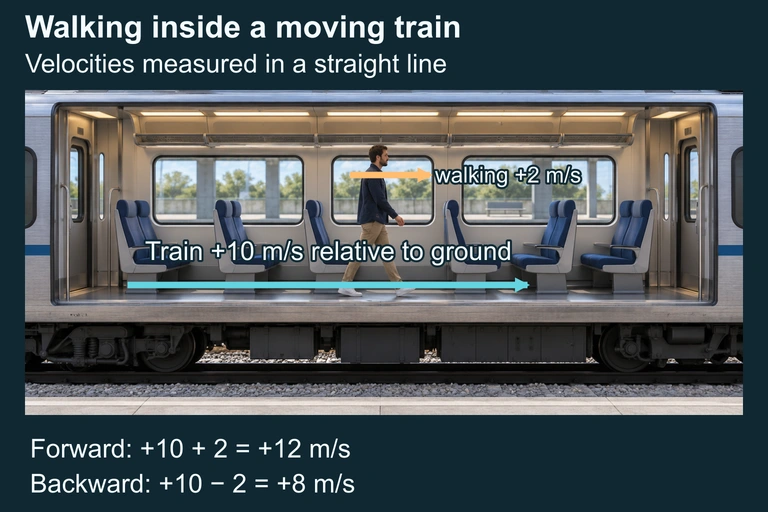 The train moves at +10 m/s relative to the ground. Walking at +2 or −2 m/s relative to the train gives ground velocities +12 or +8 m/s.
SECTION 4
Mathematical Framework
Let frame S be an inertial frame and let frame S′ move with constant velocity v⃗₀ relative to S. We choose the origins to coincide at t = 0, so that at time t the origin of S′ is displaced by v⃗₀t from the origin of S. The particle of interest occupies a single point in space; its position is simply described differently by the two coordinate systems.
POSITION TRANSFORMATION
r⃗ = position in S, r⃗′ = position in S′, v⃗₀ = velocity of S′ relative to S, t = time (universal in Galilean relativity).
VELOCITY TRANSFORMATION
Obtained by differentiating the position equation with respect to time. The velocity measured in S equals the velocity measured in S′ plus the velocity of S′ relative to S.
ACCELERATION INVARIANCE
Because v⃗₀ is constant, its time derivative vanishes. Acceleration is the same in every inertial frame — this is the mathematical cornerstone of Galilean invariance.
In component form (for motion in the xy-plane with S′ moving at speed v₀ along the x-axis), the transformation becomes: x = x′ + v₀t, y = y′, vₓ = vₓ′ + v₀, and vᵧ = vᵧ′. These equations are the Galilean transformation for kinematics. Notice that the time coordinate t is the same for both frames — an assumption that breaks down in special relativity but is perfectly valid for speeds much less than c.
Subscript Notation Convention
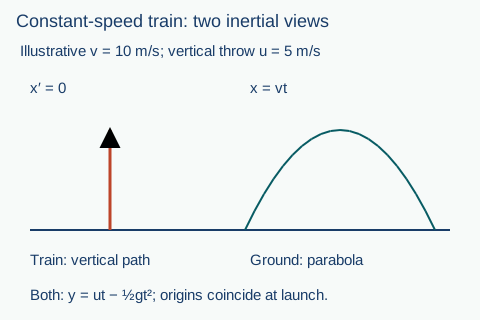 A train moves at constant 10 m/s while a ball is launched vertically at 5 m/s relative to the train. With g = 9.8 m/s² and negligible air resistance, the train observer sees a vertical path and the ground observer sees a parabola.Open full diagram
SECTION 5
Non-Inertial Frames & Fictitious Forces
When the relative velocity between two frames is not constant — that is, when one frame accelerates — the derivative dv⃗₀/dt no longer vanishes, and a⃗ ≠ a⃗′. Applying Newton's second law naïvely in such a non-inertial frame yields incorrect results unless we introduce a correction term: a fictitious (pseudo) force. In a linearly accelerating frame with acceleration A⃗, an observer writes F⃗real − mA⃗ = ma⃗′, where −mA⃗ is the fictitious force. These forces have no agent — no physical interaction produces them — but they are mathematically necessary for consistency within the accelerating frame.
The diagram above illustrates a classic AP problem: a pendulum of mass m deflects to angle θ inside a car accelerating at A. In the ground (inertial) frame S, only gravity and tension act, producing a net horizontal force T sin θ = mA. In the car's (non-inertial) frame S′, the observer adds a fictitious force −mA⃗ directed to the left, so the pendulum appears to be in equilibrium. Both analyses yield the same physical prediction — tan θ = A/g — but the non-inertial description introduces the pseudo-force to compensate for the accelerating coordinate system.
Exam Note
 In the ground frame, tension and gravity are the real forces on a pendulum settled inside an accelerating cabin. The horizontal component of tension produces the cabin’s acceleration.
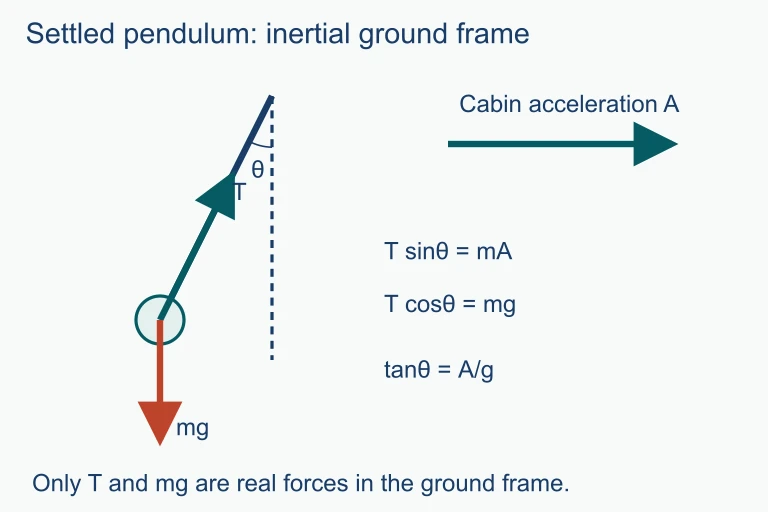 In the ground frame, tension and gravity are the real forces on a pendulum settled inside an accelerating cabin. The horizontal component of tension produces the cabin’s acceleration.
SECTION 6
Worked Example — River-Crossing Problem
A motorboat can travel at 5.0 m/s in still water. The pilot wishes to cross a river that is 80 m wide and flows due east at 3.0 m/s. The pilot aims the boat at an angle θ west of north (upstream) so that the resultant velocity is directed straight north across the river. Find θ, the time to cross, and the boat's speed relative to the ground.
River-Crossing with Current
- 1
Step 1 — Define frames and label velocities
Let the ground be frame S and the river water be frame S′ moving east at v⃗WG = 3.0 m/s (east). The boat's speed relative to the water is |v⃗BW| = 5.0 m/s. We want v⃗BG to point due north (no east–west drift). - 2
Step 2 — Apply the velocity addition rule
v⃗BG = v⃗BW + v⃗WG. In components (x = east, y = north): The east component must vanish, so vBG,x = vBW,x + 3.0 = 0 → vBW,x = −3.0 m/s (boat aims west).vBW,x = −3.0 m/s - 3
Step 3 — Find θ
sin θ = |vBW,x| / |v⃗BW| = 3.0 / 5.0 = 0.60 → θ = arcsin(0.60) ≈ 36.9° upstream from north.θ ≈ 36.9° upstream - 4
Step 4 — Find the boat's speed relative to the ground
vBW,y = 5.0 × cos 36.9° = 4.0 m/s. Since the east component is zero, the ground speed equals the north component.vBG = 4.0 m/s due north - 5
Step 5 — Find the crossing time
The river is 80 m wide (north–south). t = d / vBG = 80 / 4.0 = 20 s.t = 20 s
SECTION 7
Strengths & Limitations of the Galilean Framework
| Feature | Strength | Limitation |
|---|---|---|
| Velocity Addition | Simple vector addition; intuitive and algebraically easy | Breaks down at relativistic speeds (v ≈ c) |
| Time | Universal time simplifies kinematics — all observers agree on Δt | Time is not absolute in special relativity (time dilation) |
| Acceleration Invariance | Newton's 2nd law has identical form in all inertial frames | Fails in non-inertial frames without pseudo-force corrections |
| Applicability | Covers virtually all AP-level mechanics scenarios | Cannot handle electrodynamics or light-speed problems |
Galilean transformation: strengths versus limitations
KEY TAKEAWAY
SECTION 8
Connection to Special Relativity & Advanced Topics
| Aspect | Galilean (Classical) | Lorentz (Relativistic) |
|---|---|---|
| Position | x′ = x − v₀t | x′ = γ(x − v₀t) |
| Time | t′ = t | t′ = γ(t − v₀x/c²) |
| Velocity addition | u′ = u − v₀ | u′ = (u − v₀)/(1 − uv₀/c²) |
| Acceleration invariance | a′ = a (always) | a′ ≠ a in general; depends on velocity |
| Valid regime | v₀ ≪ c (all of AP Mech) | All speeds including v₀ → c |
Galilean vs. Lorentz transformations
The Lorentz factor γ = 1/√(1 − v₀²/c²) reduces to 1 when v₀ ≪ c, recovering the Galilean equations as a limiting case. In AP Physics C: Mechanics, you will never need the Lorentz transformation, but understanding that the Galilean framework is a low-speed approximation connects your study to the broader structure of physics. If you continue to AP Physics C: Electricity & Magnetism or Physics 2, you will see hints of why electrodynamics forced Einstein to rethink Galileo's simple addition rule. For now, the key insight is that every transformation in physics has a domain of validity, and recognizing that domain is itself a skill the AP exam rewards.
Beyond special relativity, the concept of non-inertial frames leads directly into rotating reference frames in intermediate mechanics, where the Coriolis and centrifugal pseudo-forces explain phenomena ranging from weather patterns to the behavior of gyroscopes. If you master the principles in this lesson — velocity addition, acceleration invariance, and pseudo-force correction — you will have the conceptual scaffolding for all of these more advanced treatments.
SECTION 9
Practice Problems
Question 1: CONCEPTUAL
- A. A straight vertical line
- B. A parabola
- C. A straight line at an angle to the vertical
- D. A circle
Show answer (B)
Question 2: BASIC CALCULATION
- A. 5 m/s west
- B. 55 m/s east
- C. 55 m/s west
- D. 5 m/s east
Show answer (C)
Question 3: INTERMEDIATE
- A. 206 m/s at 14.0° east of north
- B. 250 m/s at 14.0° east of north
- C. 206 m/s at 76.0° east of north
- D. 150 m/s at 14.0° east of north
Show answer (A)
Question 4: APPLIED
6 ptsShow answer
Question 5: CRITICAL THINKING
4 ptsShow answer
SUMMARY
Lesson Summary
Summary
A reference frame is a coordinate system plus clocks attached to an observer. The Galilean transformation relates measurements between two inertial frames (those in uniform relative motion): r⃗ = r⃗′ + v⃗₀t and v⃗ = v⃗′ + v⃗₀. A critical consequence is that acceleration is invariant across inertial frames, ensuring Newton's second law holds universally for all such observers.
In non-inertial (accelerating) frames, fictitious (pseudo) forces like −mA⃗ must be introduced to use F = ma in its standard form. The double-subscript notation (v⃗AB = v⃗AC + v⃗CB) is the most reliable bookkeeping tool for relative velocity problems. Master these ideas and you will be well-prepared for every kinematics and dynamics problem on the AP Physics C: Mechanics exam that involves multiple observers or moving platforms.