
SECTION 1
Historical Context & Motivation
Before Isaac Newton formalized the laws of motion, natural philosophers struggled to explain why objects interact the way they do. Aristotelian physics held that a mover must continually exert force on an object to sustain its motion, and the idea of a reciprocal reaction was entirely absent from this framework. It was not until the Scientific Revolution of the seventeenth century that a coherent, mathematically grounded picture of forces began to emerge. Newton synthesized decades of preceding work — from Galileo's studies on inertia to Huygens' collision experiments — into three compact axioms published in the Principia Mathematica of 1687. The third of these axioms, which Newton called the law of action and reaction, remains one of the most frequently tested — and most frequently misunderstood — principles in classical mechanics.
1638 • Galileo's Two New Sciences
1668 • Huygens, Wallis & Wren on Collisions
1687 • Newton's Principia Published
1743 • D'Alembert's Principle
The central question Newton's Third Law addresses is deceptively simple: when you push on a wall, what pushes back? Without a rigorous answer, free-body analysis collapses — you cannot correctly identify the forces acting on a single object unless you understand that every force arises as one half of a mutual interaction. For AP Physics C, this principle is the conceptual foundation for constructing free-body diagrams, analyzing systems of coupled bodies, and applying conservation of momentum.
SECTION 2
Core Principles & Definitions
Newton's Third Law is often paraphrased as 'every action has an equal and opposite reaction,' but that slogan obscures important subtleties that the AP exam regularly tests. The law makes a precise claim about interaction pairs (sometimes called third-law pairs or action-reaction pairs): the two forces in a pair are always equal in magnitude, opposite in direction, the same type of force, and they act on two different objects. Because they act on different objects, they never cancel each other in a free-body diagram of a single body.
Equal Magnitude
Opposite Direction
Same Type of Force
Different Objects
Simultaneous Action
SECTION 3
Visual Explanation — Interaction Pairs
The diagram above illustrates two distinct third-law pairs. In the upper panel, blocks A and B are in contact: A exerts a force on B to the right, and B exerts a force on A to the left. These forces are equal in magnitude regardless of the fact that the blocks have different masses — mass asymmetry affects acceleration, not force magnitude. In the lower panel, the gravitational interaction between Block A and Earth forms another pair. The weight W = m₁g that pulls A toward Earth's center is paired with an equal upward pull that A exerts on Earth. Earth's enormous mass means its resulting acceleration is negligibly small (a = F/MEarth ≈ 0), but the force itself is never zero.
SECTION 4
Mathematical Framework
Newton's Third Law can be stated in compact vector notation. If bodies A and B interact, the force that A exerts on B and the force that B exerts on A satisfy a strict vector relationship. This formalism is essential when you analyze systems with multiple interacting bodies, because it allows you to write coupled Newton's Second Law equations and solve for internal and external forces systematically.
NEWTON'S THIRD LAW — VECTOR FORM
F⃗_AB = force exerted by A on B; F⃗_BA = force exerted by B on A. The negative sign ensures opposite direction. Magnitudes are equal: |F⃗_AB| = |F⃗_BA|.
Deriving Conservation of Momentum from Newton's Third Law
One of the most powerful consequences of the Third Law is conservation of linear momentum for an isolated two-body system. Consider bodies A and B interacting with no external forces. By Newton's Second Law applied to each body individually, and using the Third Law constraint, we can derive that the total momentum of the system is constant.
SECOND LAW FOR EACH BODY
Since F⃗_BA = −F⃗_AB, adding the two equations yields · a⃗_A + · a⃗_B = 0⃗.
MOMENTUM CONSERVATION (DERIVED)
Because a⃗ = dv⃗/dt, the sum · a⃗_A + · a⃗_B = 0 is equivalent to saying the time derivative of total momentum vanishes. This derivation generalizes to N-body systems: all internal third-law pairs cancel in the sum, leaving only external forces.
Applying the Third Law to Coupled Systems
For AP Physics C, a standard technique involves choosing a system boundary carefully. When you draw a free-body diagram for the entire system (e.g., two blocks connected by a string), all internal third-law pairs cancel, and only external forces remain. When you then isolate individual objects within the system, the internal forces reappear as the unknowns you solve for. This dual approach — system FBD plus individual FBDs — is the workhorse strategy for Atwood machines, blocks on inclines with strings, and stacked-block friction problems.
SYSTEM VS. INDIVIDUAL
The first equation gives the common acceleration of the system under external forces. The second equation, applied to body B alone, yields the internal contact or tension force between A and B.
SECTION 5
Identifying Third-Law Pairs in Complex Scenarios
A reliable method for identifying third-law pairs is the A-on-B / B-on-A naming convention. For any force, label it as 'the force that [object 1] exerts on [object 2].' The third-law partner is automatically 'the force that [object 2] exerts on [object 1].' If swapping the two objects in the label produces a real physical force, you have correctly identified a pair. If the swap does not make physical sense, the two forces are not a third-law pair — they merely happen to be equal in a special equilibrium scenario.
| Force on Book | Third-Law Partner | Acts On |
|---|---|---|
| Weight (Earth pulls book down) | Book pulls Earth up | Earth |
| Normal force (table pushes book up) | Book pushes table down | Table |
| Friction (table pushes book horizontally) | Book pushes table horizontally (opposite) | Table |
Third-law partners for every force on the book
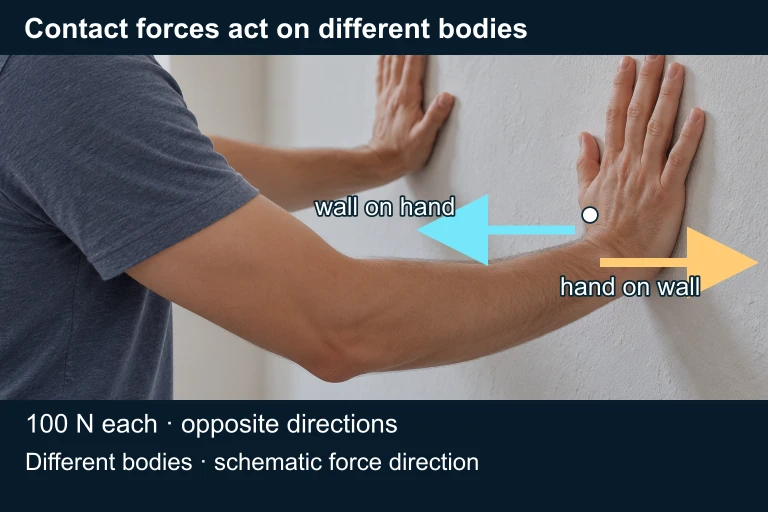 A hand exerts 100 N on a wall and the wall exerts 100 N on the hand in the opposite direction. These third-law forces act on different bodies and are not a net-force balance on one body.
SECTION 6
Worked Example — Atwood Machine
An Atwood machine consists of two masses m₁ = 6.0 kg and m₂ = 4.0 kg connected by a massless, inextensible string over a frictionless, massless pulley. Find (a) the acceleration of the system and (b) the tension in the string. Demonstrate where Newton's Third Law enters the analysis.
Worked example
- 1
Step 1 — Draw Free-Body Diagrams
For mass m₁ (heavier, accelerates downward): forces are weight m₁g downward and tension T upward. For mass m₂ (lighter, accelerates upward): forces are weight m₂g downward and tension T upward. The string exerts T on m₁ and T on m₂. By Newton's Third Law, m₁ pulls the string with force T downward on its side, and m₂ pulls the string with force T downward on its side. Since the string is massless, these forces must be equal in magnitude (otherwise the string would have infinite acceleration), so the tension is the same throughout. - 2
Step 2 — Write Newton's Second Law for Each Mass
Choose the positive direction as the direction of acceleration — down for m₁, up for m₂. For m₁: m₁g − T = m₁a. For m₂: T − m₂g = m₂a. These are two equations with two unknowns (T and a). - 3
Step 3 — Solve for Acceleration (System Approach)
Add the two equations: m₁g − T + T − m₂g = m₁a + m₂a. The tension cancels — this is equivalent to treating the two masses as a single system where internal third-law forces vanish. Solving: a = (m₁ − m₂)g / (m₁ + m₂).a = (6.0 − 4.0)(9.8) / (6.0 + 4.0) = 1.96 m/s² - 4
Step 4 — Solve for Tension (Individual Body)
Substitute a back into the equation for m₂: T = m₂(g + a) = 4.0 × (9.8 + 1.96).T = 4.0 × 11.76 = 47.0 N - 5
Step 5 — Verify with Third-Law Consistency
Check using the m₁ equation: m₁g − T = 6.0(9.8) − 47.0 = 58.8 − 47.0 = 11.8 N. And m₁a = 6.0 × 1.96 = 11.76 N ≈ 11.8 N. ✓ The slight difference is rounding. The tension is the same on both sides, consistent with the massless string transmitting the third-law interaction between the two masses.
SECTION 7
Common Misconceptions & Exam Pitfalls
Newton's Third Law is conceptually straightforward but is the source of some of the most persistent errors on the AP Physics C exam. The table below catalogs the most common misconceptions alongside the correct reasoning. Recognizing these patterns will help you avoid traps on both the multiple-choice and free-response sections.
| Misconception | Why It's Wrong | Correct Statement |
|---|---|---|
| "The bigger object exerts a larger force." | Third-law forces are always equal in magnitude regardless of mass. Mass affects acceleration (F = ma), not the force in the pair. | A truck and a compact car exert equal forces on each other in a collision; the car accelerates more because of its smaller mass. |
| "Action comes first, then reaction." | The labels 'action' and 'reaction' are arbitrary. Both forces arise simultaneously and persist for the same duration. | The terms are interchangeable; there is no temporal ordering. |
| "Third-law pairs cancel, so nothing accelerates." | The two forces act on different objects. Forces only cancel when they act on the same object. | Each force appears on a different FBD. Net force on each individual object determines its acceleration. |
| "Weight and normal force are a third-law pair." | Weight involves the object and Earth (gravitational). Normal force involves the object and the surface (contact). Different interactions. | The partner of the normal force is the object pushing on the surface. The partner of weight is the object's gravitational pull on Earth. |
Common Third-Law Misconceptions on the AP Exam
Key takeaway
SECTION 8
Connection to Advanced Theory
Newton's Third Law, while remarkably powerful in classical mechanics, is best understood as a special case of deeper conservation principles. In Lagrangian and Hamiltonian mechanics — frameworks you may encounter in upper-division physics — the Third Law is a consequence of translational symmetry of the interaction potential. If the potential energy between two particles depends only on the vector separating them, V = V(r⃗₁ − r⃗₂), then the internal forces are automatically equal and opposite. This connection is formalized by Noether's theorem, which links every continuous symmetry of a physical system to a conserved quantity — translational symmetry yields conservation of momentum.
| Feature | Newton's Third Law (Classical) | Lagrangian / Advanced View |
|---|---|---|
| Statement | F⃗_AB = −F⃗_BA (axiom) | Follows from ∂V/∂r⃗₁ = −∂V/∂r⃗₂ when V = V(r⃗₁ − r⃗₂) |
| Scope | Contact and gravitational forces; instantaneous | Any potential-based interaction; extends to fields with care |
| Limitations | Breaks down for electromagnetic forces between moving charges (magnetic forces are velocity-dependent) | Resolved by including field momentum; total momentum (particles + field) is conserved |
| Conserved Quantity | Linear momentum (derived) | Linear momentum (from Noether's theorem) |
Newton's Third Law in Classical vs. Advanced Frameworks
For the AP Physics C exam, you are not expected to use Lagrangian mechanics, but understanding that Newton's Third Law is intimately linked to momentum conservation will deepen your problem-solving intuition. Anytime you invoke conservation of momentum, you are implicitly relying on the Third Law to guarantee that internal forces cancel in the system sum. Conversely, any scenario where momentum is not conserved signals the presence of external forces — forces whose third-law partners act on objects outside your defined system.
SECTION 9
Practice Problems
Question 1: CONCEPTUAL
- A. The truck exerts a greater force on the car than the car exerts on the truck.
- B. The car exerts a greater force on the truck than the truck exerts on the car.
- C. The car and the truck exert forces of equal magnitude on each other.
- D. The relative magnitudes depend on which vehicle was initially moving faster.
Show answer (C)
Question 2: BASIC CALCULATION
- A. 9.0 N
- B. 15 N
- C. 24 N
- D. 40 N
Show answer (B)
Question 3: INTERMEDIATE
- A. μ_s · m · g
- B. 3μ_s · m · g
- C. 2μ_s · m · g
- D. μ_s · 2m · g
Show answer (B)
Question 4: APPLIED
Show answer
Question 5: CRITICAL THINKING