

SECTION 1
Historical Context & Motivation
Before Isaac Newton's landmark contributions, the prevailing Aristotelian view held that a continuous force was required merely to sustain motion—objects were thought to naturally come to rest unless something actively pushed them. This framework, dominant for nearly two millennia, could not quantitatively predict how objects accelerate, how projectiles trace parabolic arcs, or why the planets orbit the Sun in ellipses rather than circles. The intellectual revolution that overturned these ideas unfolded across centuries, drawing on the insights of Galileo, Descartes, and Huygens before culminating in Newton's precise mathematical formulation.
1638 • Galileo's Kinematics
1644 • Descartes and Conservation of Motion
1673 • Huygens and Centripetal Acceleration
1687 • Newton's Principia Published
1905 • Einstein's Relativistic Generalization
The central question Newton's Second Law addresses is deceptively simple: given a known set of forces acting on an object, how does that object's velocity change with time? By providing a precise, differential equation-based answer, the Second Law transforms mechanics from a qualitative catalogue of phenomena into a predictive, calculational science. For the AP Physics C: Mechanics exam, mastery of this law—including its vector nature, its connection to free-body diagrams, and its application in both Cartesian and non-Cartesian coordinate systems—is absolutely essential.
SECTION 2
Core Principles & Definitions
Newton's Second Law is more than a formula to memorize—it encodes several deep physical ideas that must be unpacked before the equation becomes a reliable tool. At its heart, the law asserts that the net external force acting on a body equals the time rate of change of its linear momentum. When mass is constant—the typical situation in introductory mechanics—this reduces to the familiar product of mass and acceleration. The principles below unpack the conceptual machinery behind this deceptively compact statement.
Vector Nature of Force
Net Force, Not Individual Forces
Mass as Inertia
Momentum Formulation
Inertial Reference Frames
KEY TAKEAWAY
SECTION 3
Visual Explanation — Free-Body Diagram & Net Force
The free-body diagram (FBD) is the essential visual tool for applying Newton's Second Law. By isolating the object of interest and representing every external force as a labeled vector arrow originating from the object's center of mass, the FBD makes the vector sum ΣF explicit. The diagram below shows a block on an inclined plane subject to gravity, the normal force, and kinetic friction, with the resulting net force and acceleration vectors.
Constructing a correct free-body diagram is the single most important step in any Newton's Second Law problem. The process involves three disciplined steps: (1) isolate the object of interest, (2) identify every external force and draw it as a vector originating at the center of mass, and (3) choose a coordinate system—typically with one axis aligned along the expected acceleration direction—so that the vector equation ΣF = ma can be decomposed into scalar component equations. On an inclined plane, for instance, tilting the coordinate axes so that the x-axis runs parallel to the surface and the y-axis runs perpendicular simplifies the algebra considerably, because the normal force and friction then each lie along a single axis.
SECTION 4
Mathematical Framework
Newton originally stated the Second Law in terms of momentum: the net external force on a body equals the instantaneous rate of change of its linear momentum. When mass is constant, this naturally reduces to the product of mass and acceleration. Both forms are critical for AP Physics C, since the momentum formulation underpins impulse analysis and variable-mass problems, while the constant-mass form is the workhorse for nearly every force problem you will encounter.
GENERAL (MOMENTUM) FORM
ΣF is the vector sum of all external forces (N); p = mv is the linear momentum (kg·m/s); t is time (s). This form is valid even when mass varies with time.
CONSTANT-MASS FORM
When dm/dt = 0, the derivative reduces to m(dv/dt) = ma. Here m is the object's mass (kg) and a = dv/dt is its instantaneous acceleration (m/s²). This is the form used in the vast majority of AP Physics C problems.
COMPONENT FORM (CARTESIAN)
Because the law is a vector equation, it decouples into independent scalar equations along each coordinate axis. Choosing axes wisely—aligned with constraints or the direction of acceleration—minimizes the number of unknowns.
IMPULSE-MOMENTUM THEOREM
Integrating both sides of ΣF = dp/dt over a time interval yields the impulse J, equal to the change in momentum. This is especially useful when force varies with time, as in collisions.
A subtle but important point: Newton's Second Law is a second-order ordinary differential equation for the position of the object. Since a = d²x/dt², writing ΣF = ma is equivalent to writing m(d²x/dt²) = ΣF(x, v, t). When the forces depend on position (as in springs) or velocity (as in drag), solving for x(t) requires techniques from differential equations—integration, separation of variables, or characteristic equations. This perspective is what separates AP Physics C from algebra-based physics: you are expected to set up and solve these differential equations, not merely plug numbers into kinematic formulas.
SECTION 5
Common Force Scenarios & Classifications
Newton's Second Law takes on distinctive forms depending on the types of forces present. The diagram below classifies the most common force scenarios encountered in AP Physics C: Mechanics and maps each to its characteristic equation of motion. Understanding these categories helps you quickly identify the mathematical structure of a problem and select the appropriate solution technique.
| Force Type | Equation of Motion | Solution Form | Key Feature |
|---|---|---|---|
| Constant net force | a = F₀/m = const | x(t) = x₀ + v₀t + ½at² | Parabolic trajectory |
| Linear restoring (−kx) | d²x/dt² = −(k/m)x | x(t) = A cos(ωt + φ) | Oscillation at ω = √(k/m) |
| Linear drag (−bv) | m dv/dt = mg − bv | v(t) = (1 − ) | Exponential approach to = mg/b |
| Quadratic drag (−cv²) | m dv/dt = mg − cv² | v(t) = tanh(gt/) | Terminal speed = √(mg/c) |
Common force scenarios and their characteristic solutions
 A bead released from rest accelerates until upward drag balances its weight in the model. Linear and quadratic drag give different equations and approach curves, with coefficients and conditions specified separately.
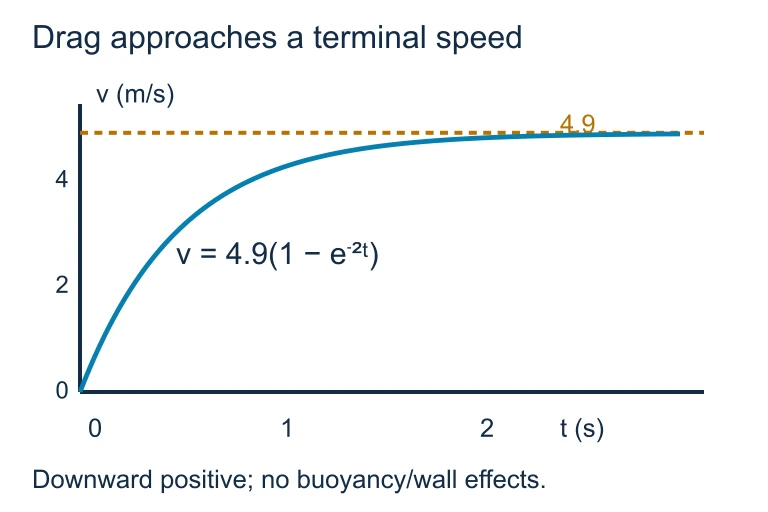 For downward motion from rest with linear drag and negligible buoyancy, v = 4.9(1 − e⁻²ᵗ) m/s. Acceleration decreases as speed approaches the terminal value 4.9 m/s.
SECTION 6
Worked Example — Atwood Machine
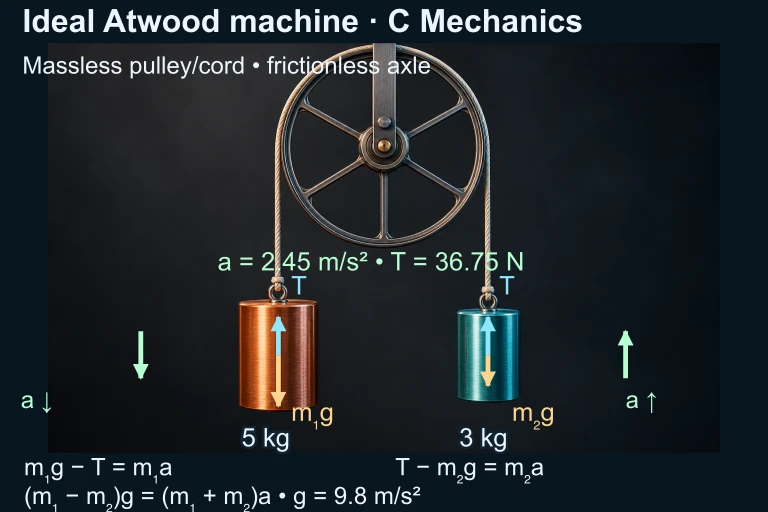
The Atwood machine is a classic system consisting of two masses connected by a light, inextensible string draped over an ideal (massless, frictionless) pulley. It elegantly demonstrates Newton's Second Law applied to a two-body system with a constraint. Suppose mass m₁ = 5.0 kg and mass m₂ = 3.0 kg are connected in this arrangement. Find the acceleration of the system and the tension in the string.
Atwood Machine: Finding Acceleration and Tension
- 1
Step 1 — Draw Free-Body Diagrams
Isolate each mass. For m₁ (heavier, accelerates downward): weight m₁g acts downward, tension T acts upward. For m₂ (lighter, accelerates upward): weight m₂g acts downward, tension T acts upward. The string is inextensible and massless, so the magnitude of tension is the same throughout and both masses have the same magnitude of acceleration a. - 2
Step 2 — Choose Sign Convention & Write ΣF = ma
Define positive as the direction of m₁'s motion (downward for m₁, upward for m₂). For m₁: m₁g − T = m₁a. For m₂: T − m₂g = m₂a. These are two equations with two unknowns (a and T). - 3
Step 3 — Solve for Acceleration
Add the two equations to eliminate T: m₁g − m₂g = (m₁ + m₂)a. Therefore a = (m₁ − m₂)g / (m₁ + m₂). Substituting: a = (5.0 − 3.0)(9.8) / (5.0 + 3.0) = (2.0)(9.8) / 8.0.a = 2.45 m/s² - 4
Step 4 — Solve for Tension
Substitute a back into the equation for m₂: T = m₂(g + a) = 3.0(9.8 + 2.45) = 3.0 × 12.25.T = 36.75 N - 5
Step 5 — Check Limiting Cases
If m₁ = m₂, then a = 0 and T = mg, consistent with static equilibrium. If m₂ = 0, then a = g and T = 0, consistent with free fall. Our answer falls between these limits (a = 2.45 m/s² < g and T = 36.75 N, which lies between m₂g = 29.4 N and m₁g = 49.0 N), so the result is physically reasonable.
AP EXAM TIP
 C Mechanics:5kg and3kg
SECTION 7
Strengths, Limitations & Common Pitfalls
Newton's Second Law is extraordinarily powerful, but it is not universally applicable in its elementary form. Understanding its domain of validity and common student errors is essential for both the AP exam and deeper physics study. The table below contrasts situations where the law shines with those where it requires modification or where alternative approaches (energy, momentum) are preferable.
| Strengths | Limitations / Pitfalls |
|---|---|
| Provides instantaneous acceleration from known forces—gives complete trajectory when integrated | Fails at relativistic speeds (v ≈ c); must use relativistic momentum p = γmv |
| Vector equation: handles multi-directional forces naturally through component decomposition | Not directly useful when forces are unknown or paths are complex—energy methods (work-energy theorem) are often easier |
| Applies to systems: treating multiple objects as a single system with net external forces can simplify analysis | Valid only in inertial frames; in rotating or accelerating frames, pseudo-forces must be introduced |
| Momentum form (dp/dt) handles variable-mass systems like rockets | Common error: students forget that friction and normal force are reaction forces that adjust to satisfy constraints—they are not independent inputs |
| Directly connects to free-body diagrams, providing a systematic problem-solving framework | Common error: applying ΣF = ma to individual components without consistent sign conventions leads to sign errors |
When ΣF = ma is ideal vs. when alternative approaches are needed
WHEN TO CHOOSE A DIFFERENT TOOL
SECTION 8
Connection to Advanced Theory
Newton's Second Law is the launching pad for virtually all of advanced mechanics. In the Lagrangian formulation, the law is recast in terms of generalized coordinates and the principle of least action, making it far easier to handle constraints and non-Cartesian coordinate systems. In Hamiltonian mechanics, the law transforms into pairs of first-order differential equations that reveal deep connections to quantum mechanics and statistical physics. Even within AP Physics C, you encounter extensions—circular motion, oscillations, and rotational dynamics—that are all built directly on ΣF = ma or its rotational analog Στ = Iα.
| Newtonian Mechanics (AP C Level) | Advanced Formulation |
|---|---|
| ΣF = ma (vector, Cartesian) | Euler–Lagrange equation: d/dt(∂L/∂q̇) − ∂L/∂q = 0 |
| Free-body diagram identifies forces explicitly | Lagrangian L = T − V encodes forces through potential energy; constraint forces vanish automatically |
| Momentum p = mv defined separately | Canonical momentum p = ∂L/∂q̇ emerges naturally; Hamiltonian H(q, p, t) governs evolution |
| Constant mass assumed; variable mass handled ad hoc (rocket equation) | Relativistic dynamics: F = dp/dt with p = γmv; mass–energy equivalence E² = (pc)² + (mc²)² |
How Newtonian mechanics generalizes in upper-division physics
For now, the critical takeaway is that ΣF = ma is not merely an approximate recipe—it is the exact, non-relativistic limit of a more general framework, and mastering it thoroughly at the AP C level builds the precise mathematical habits (drawing diagrams, decomposing vectors, solving differential equations) that carry forward into every branch of physics and engineering.
SECTION 9
Practice Problems
Question 1: CONCEPTUAL
- A. The normal force and the weight act on different objects, so they cannot be a Third Law pair.
- B. The Third Law reaction to the book's weight is the gravitational pull the book exerts on the Earth, not the normal force from the table.
- C. The normal force is always greater than the weight because the table must also support its own weight.
- D. The normal force and the weight are a Third Law pair; the student's claim is actually correct.
Show answer (B)
Question 2: BASIC CALCULATION
- A. 3.73 m/s²
- B. 6.67 m/s²
- C. 2.94 m/s²
- D. 4.73 m/s²
Show answer (A)
Question 3: INTERMEDIATE
- A. 20.0 N
- B. 25.0 N
- C. 30.0 N
- D. 50.0 N
Show answer (C)
Question 4: APPLIED
10 ptsShow answer
Question 5: CRITICAL THINKING
7 ptsShow answer
SUMMARY
Summary — Newton's Second Law
Summary
Newton's Second Law states that the net external force on an object equals the rate of change of its linear momentum (ΣF = dp/dt), which reduces to ΣF = ma when mass is constant. As a vector equation, it decomposes into independent scalar equations along each coordinate axis, and is valid only in inertial reference frames. The systematic problem-solving approach—draw a free-body diagram, choose a coordinate system, write ΣF = ma for each axis, and solve the resulting equations—applies universally to constant-force, position-dependent, and velocity-dependent force problems.
Key force scenarios include constant forces (yielding constant acceleration and kinematic solutions), spring forces (leading to simple harmonic motion), and drag forces (requiring separation of variables and producing exponential approach to terminal velocity). On the AP exam, always check answers against limiting cases and dimensional analysis to catch algebraic errors before moving on.