

SECTION 1
Historical Context & Motivation
Friction is so ubiquitous that humans have grappled with it since the earliest attempts at engineering. Ancient Egyptians used sledges lubricated with water to move massive stones, and Roman engineers empirically discovered that polished surfaces reduced resistance. Yet a systematic, quantitative understanding of friction took centuries to develop—emerging from careful experiments that revealed surprisingly simple laws governing a remarkably complex phenomenon.
1493 • Leonardo da Vinci's Experiments
1699 • Amontons' Laws
1785 • Coulomb's Friction Model
1950s–present • Tribology & Microscopic Models
The central question that the study of friction addresses is deceptively simple: why do objects resist being set into motion, and why does less force seem necessary to keep them moving than to start them? The Amontons–Coulomb model provides a remarkably effective macroscopic framework that AP Physics C leverages to analyze everything from blocks on inclined planes to braking automobiles.
SECTION 2
Core Principles & Definitions
Friction arises whenever two surfaces are in contact and there is either a tendency toward or actual relative motion between them. The classical model captures this behavior through two distinct regimes—static friction and kinetic friction—each characterized by a dimensionless coefficient multiplied by the normal force. These coefficients encapsulate surface material properties, roughness, and microscopic adhesion into a single empirical number.
Static Friction (fₛ)
Kinetic Friction (fₖ)
Normal Force (N)
μₛ > μₖ (Typically)
SECTION 3
Visual Explanation: Forces on a Surface
The diagram above illustrates the four forces that govern the motion of a block on a flat surface. When the block is stationary, static friction adjusts its magnitude to exactly balance the horizontal component of the applied force, maintaining equilibrium. As the applied force increases, static friction increases proportionally until it reaches the threshold fₛ,max = μₛN. Beyond that point, the block begins to slide and kinetic friction—constant in magnitude—takes over. Notice that on a horizontal surface with no vertical applied force component, the normal force equals the object's weight, but this equality breaks down on inclines or when forces have vertical components.
SECTION 4
Mathematical Framework
The Amontons–Coulomb friction model is expressed through two compact relationships. Understanding when each applies—and how to determine the normal force in non-trivial geometries—is the core mathematical skill required for AP Physics C problems involving friction.
STATIC FRICTION (INEQUALITY)
fₛ = magnitude of static friction force; μₛ = coefficient of static friction (dimensionless); N = normal force. The inequality reflects the self-adjusting nature of static friction: it equals μₛN only at the threshold of impending motion.
KINETIC FRICTION
fₖ = magnitude of kinetic friction force; μₖ = coefficient of kinetic friction. This is an equality: once sliding occurs, kinetic friction has a fixed magnitude regardless of speed (in the Coulomb model).
NORMAL FORCE ON AN INCLINE
On an inclined plane of angle θ with no additional applied forces, the normal force equals the component of gravity perpendicular to the surface. The friction force then becomes f = μ mg cos θ, while the gravitational pull along the plane is mg sin θ.
CRITICAL ANGLE FOR IMPENDING SLIP
Setting mg sin θ = μₛ mg cos θ and solving yields the critical angle θ_c at which a block on an incline is on the verge of sliding. This is a clean derivation frequently tested on AP exams.
SECTION 5
Friction on Inclined Planes
The inclined-plane scenario is one of the most commonly tested friction configurations on the AP Physics C exam. By choosing a coordinate system with one axis parallel to the incline and the other perpendicular, you decompose gravity into two components: mg sin θ along the plane and mg cos θ into the surface. The perpendicular equilibrium immediately yields N = mg cos θ (assuming no other perpendicular forces), so friction becomes f = μ mg cos θ. The net force along the plane is then mg sin θ − μ mg cos θ = ma for a block sliding down, or you reverse the friction direction for a block being pushed up.
A particularly elegant result emerges at the critical angle θ_c, where static friction reaches its maximum and the block is on the verge of sliding. Setting mg sin θ_c = μₛ mg cos θ_c gives tan θ_c = μₛ. This relationship means you can experimentally measure μₛ by slowly tilting a surface until the block just begins to slide, then measuring the angle—a classic laboratory technique.
SECTION 6
Worked Example: Acceleration on an Incline
A 5.0 kg block is placed on a 30° incline. The coefficient of kinetic friction between the block and the surface is μₖ = 0.20. The block is sliding down the incline. Find the acceleration of the block down the incline.
Worked example
- 1
Step 1 — Draw the Free-Body Diagram & Choose Coordinates
Orient the x-axis along the incline (positive down the slope) and the y-axis perpendicular to the surface (positive away from the surface). The forces are: weight mg downward, normal force N perpendicular to the surface, and kinetic friction fₖ up the incline (opposing the sliding direction). - 2
Step 2 — Apply Newton's Second Law Perpendicular to the Incline
In the y-direction there is no acceleration, so Σ = N − mg cos θ = 0, giving N = mg cos θ = (5.0)(9.8) cos 30° = (49)(0.866).N = 42.4 N - 3
Step 3 — Calculate the Kinetic Friction Force
With the block sliding, fₖ = μₖ N = (0.20)(42.4 N).fₖ = 8.49 N - 4
Step 4 — Apply Newton's Second Law Along the Incline
Σ = mg sin θ − fₖ = ma. Substituting: (5.0)(9.8) sin 30° − 8.49 = (5.0) a, so 24.5 − 8.49 = 5.0 a, which gives 16.01 = 5.0 a.a = 3.2 m/s² down the incline - 5
Step 5 — Verify & Interpret
Without friction the acceleration would be g sin 30° = 4.9 m/s². Friction reduces this to 3.2 m/s², a decrease of about 35%. The result is positive (down the slope), confirming our assumed direction was correct.
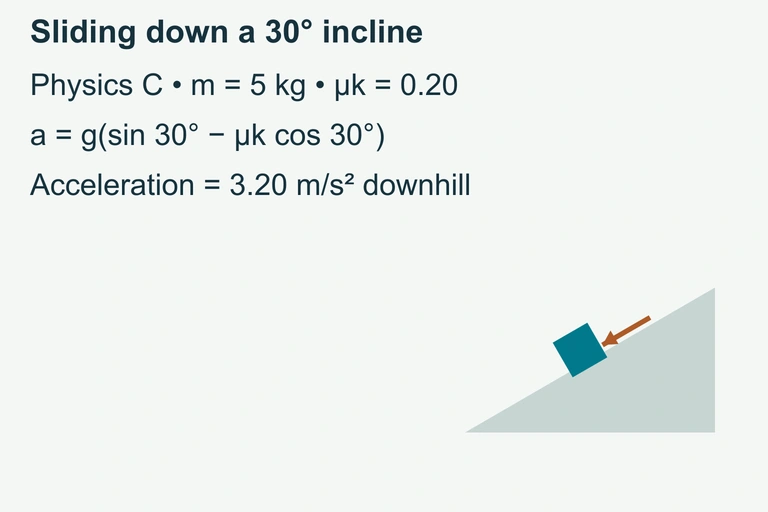 Sliding down a 30° incline; a separate idealized course-specific preset.
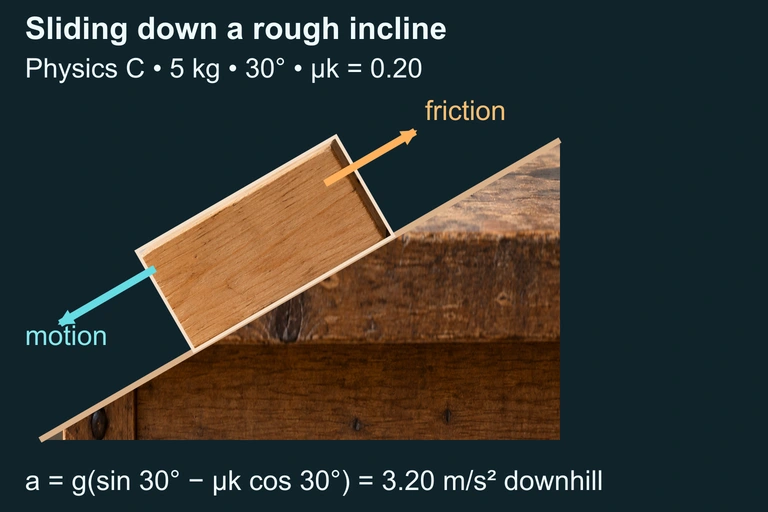 Sliding block • Physics C; exact schematic, not a measured apparatus.
SECTION 7
Static vs. Kinetic Friction: Key Comparisons
| Property | Static Friction | Kinetic Friction |
|---|---|---|
| When it acts | Surfaces at rest relative to each other | Surfaces sliding relative to each other |
| Magnitude | Variable: 0 ≤ fₛ ≤ μₛN | Constant: fₖ = μₖN |
| Direction | Opposes tendency of relative motion | Opposes direction of relative sliding |
| Coefficient size | μₛ (typically larger) | μₖ (typically smaller) |
| Depends on speed? | No (object is not moving) | Approximately no (Coulomb model) |
| Can do positive work? | Yes (e.g., friction accelerates a passenger in a car) | No—always negative work on the system, converting kinetic energy to thermal energy |
Comparison of static and kinetic friction properties
SECTION 8
Connection to Advanced Theory
The Coulomb friction model is a powerful approximation, but it has well-known limitations. At the microscopic level, friction arises from the interlocking of surface asperities—tiny peaks on each surface that bond through adhesion and must be sheared for sliding to occur. Modern tribology and condensed-matter physics treat friction through statistical mechanics and surface science, revealing phenomena such as velocity-dependent friction, stick-slip dynamics (which cause earthquakes and squeaking brakes), and ultra-low friction in atomically smooth materials.
| Feature | Coulomb Model (AP Level) | Advanced Tribology |
|---|---|---|
| Speed dependence | fₖ independent of speed | Friction can vary with velocity (e.g., Stribeck curve) |
| Area dependence | Independent of apparent contact area | Depends on real contact area (sum of asperity contacts) |
| Temperature effects | Not considered | Coefficients change with temperature; surface melting can reduce friction |
| Mathematical framework | Algebraic inequalities and equalities | Statistical mechanics, contact mechanics (Hertz theory), molecular dynamics |
Coulomb model versus modern friction theory
For AP Physics C, the Coulomb model is fully sufficient and is the framework used on the exam. However, awareness of its limitations enriches your understanding—particularly in experimental-design FRQs, where you may need to discuss sources of error. The fact that μₖ can vary slightly with speed, that surfaces deform under high loads, or that environmental factors like humidity change friction coefficients are all valid error-analysis points.
SECTION 9
Practice Problems
Question 1: CONCEPTUAL
- A. The static friction force is equal to μₛN.
- B. The static friction force is 50 N, directed opposite your push.
- C. The kinetic friction force is 50 N, directed opposite your push.
- D. The friction force is zero because the crate is not moving.
Show answer (B)
Question 2: BASIC CALCULATION
- A. 29.4 N
- B. 39.2 N
- C. 49.0 N
- D. 98.0 N
Show answer (B)
Question 3: INTERMEDIATE
- A. 0.60
- B. 0.80
- C. 0.75
- D. 0.48
Show answer (C)
Question 4: APPLIED
Show answer
Question 5: CRITICAL THINKING