
SECTION 1
Historical Context & Motivation
The quest to understand why objects fall and why celestial bodies follow predictable paths stretches back to antiquity, but it was not until the Scientific Revolution that a single, unified framework emerged. Ancient Greek philosophers, led by Aristotle, believed that heavy objects naturally sought the center of the Earth—a qualitative explanation that persisted for nearly two millennia. The breakthrough came when Isaac Newton synthesized terrestrial and celestial mechanics into one elegant law, demonstrating that the same force pulling an apple downward also keeps the Moon in its orbit around the Earth.
Newton's insight depended critically on the earlier work of astronomers and mathematicians who carefully catalogued the motions of planets. Johannes Kepler's empirical laws of planetary motion provided the essential data that Newton's gravitational theory would later explain from first principles. The development of calculus—independently by Newton and Leibniz—gave physicists the mathematical tools necessary to derive orbital trajectories from an inverse-square force law, marking one of the greatest intellectual achievements in the history of science.
1609 • Kepler's Laws of Planetary Motion
1687 • Newton's Principia Published
1798 • Cavendish Experiment
1915 • Einstein's General Relativity
For the AP Physics C: Mechanics course, Newton's Law of Universal Gravitation remains the central framework. It accurately describes gravitational interactions for all scenarios you will encounter on the exam—projectile motion near Earth's surface, satellite orbits, and multi-body gravitational problems. The key question this concept addresses is deceptively simple: what determines the magnitude and direction of the gravitational force between any two masses, and how does this force shape the motion of objects from everyday scales to astronomical ones?
SECTION 2
Core Principles & Definitions
Gravitational force is one of the four fundamental forces of nature, and within the context of classical mechanics it possesses several defining characteristics that set it apart from contact forces like friction or the normal force. Understanding these properties is essential before diving into calculations, because they govern how gravitational interactions are modeled in free-body diagrams, energy analyses, and orbital mechanics problems alike.
Universal & Always Attractive
Inverse-Square Law
Action–Reaction Pair
Central Force
Shell Theorem
KEY TAKEAWAY
SECTION 3
Visual Explanation
Force Diagram: Two Point Masses
The diagram above captures the essential geometry of Newton's gravitational law. Notice that both force vectors point inward along the line joining the two centers—gravity is always attractive and always central. The distance r is measured center-to-center, which is critical when dealing with spheres of finite radius; for a person standing on Earth's surface, r equals Earth's radius, not zero. One of the most common errors on the AP exam involves confusing the surface-to-surface distance with the center-to-center distance r in the gravitational force law.
Also note the symmetry enforced by Newton's Third Law: the force on m1 due to m2 is exactly equal in magnitude to the force on m2 due to m1. The accelerations, however, differ because a = F/m: the less massive object accelerates more. This is why the Earth barely budges in response to the gravitational pull of an apple, even though both experience the same force magnitude.
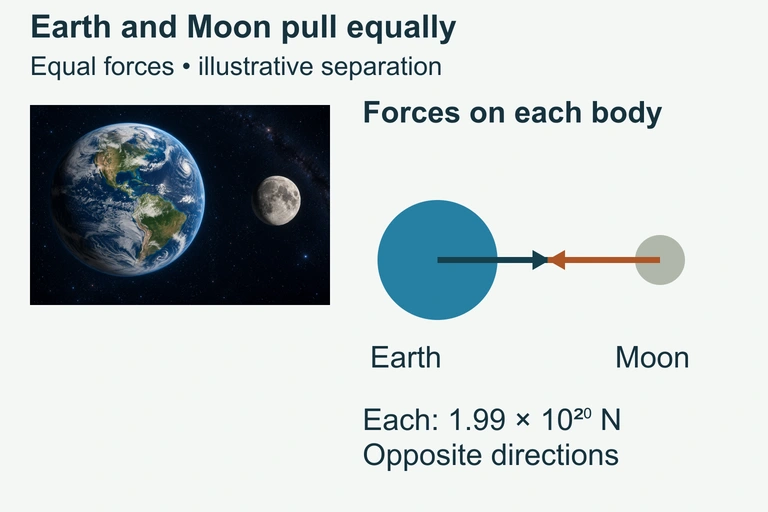 Earth and Moon exert equal and opposite gravitational forces, approximately 1.99 × 10²⁰ N, along their center line. Use center-to-center separation 3.84 × 10⁸ m; the depicted bodies are not to scale.
SECTION 4
Mathematical Framework
Newton's Law of Universal Gravitation
SCALAR FORM
F = magnitude of gravitational force (N), G = 6.674 × 10⁻¹¹ N·m²/kg² (universal gravitational constant), m₁, m₂ = masses of the two objects (kg), r = center-to-center distance between the two masses (m).
VECTOR FORM
The unit vector r̂₁₂ points from m₂ toward m₁. The negative sign ensures the force on m₁ is directed toward m₂ (attractive). This form is essential when superposing gravitational forces from multiple bodies.
The vector form is particularly important for AP Physics C because many free-response questions require you to determine the net gravitational force on an object due to multiple sources. In such cases, you compute each pairwise gravitational force vector separately and then add them using vector addition—decomposing into components if the forces are not collinear. The superposition principle holds exactly for Newtonian gravity.
Gravitational Acceleration Near a Surface
SURFACE GRAVITY
g = gravitational field strength (m/s²), M = mass of the planet or body, R = radius of the body. For Earth: g ≈ 9.8 m/s². This follows directly from setting F = mg equal to GMm/R².
GRAVITATIONAL FIELD (GENERAL)
The gravitational field at a point in space is the force per unit mass a test mass would experience there. It points radially inward toward M and has dimensions of acceleration (m/s²). At altitude h above the surface, r = R + h.
Exam Tip: Weight vs. Gravitational Force
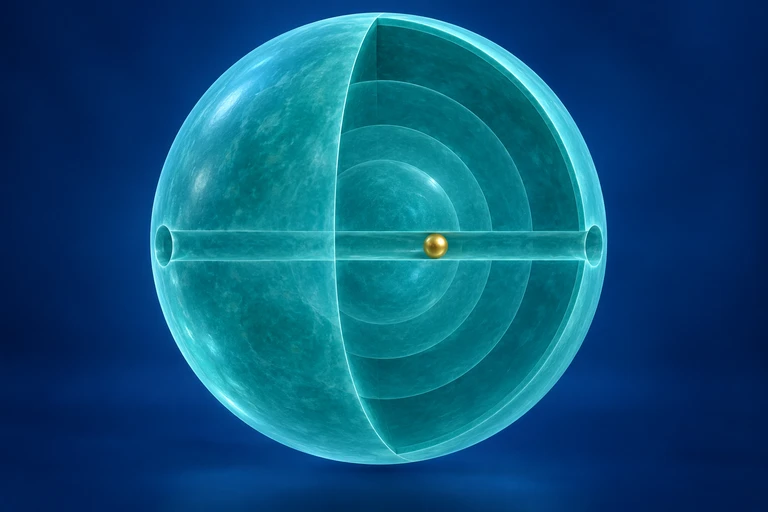 For a uniform-density sphere, the enclosed mass varies as r³ and the interior gravitational field varies linearly with radius. The field is zero at the center and joins continuously to the exterior inverse-square field.
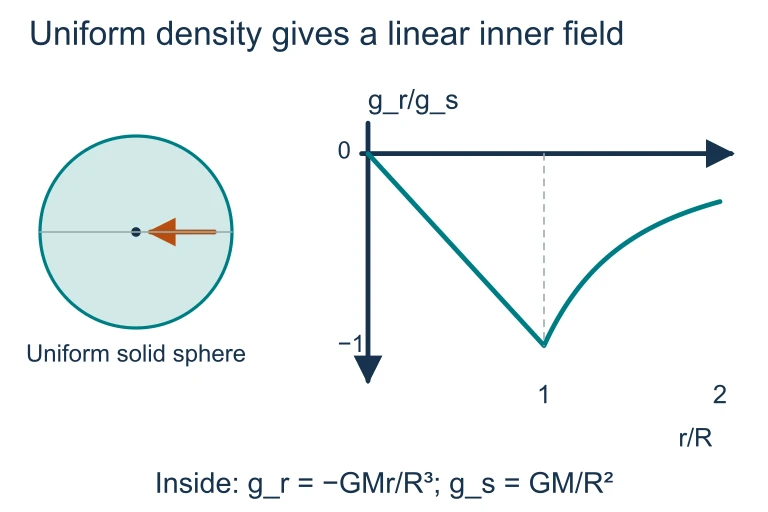 For a uniform-density sphere, the enclosed mass varies as r³ and the interior gravitational field varies linearly with radius. The field is zero at the center and joins continuously to the exterior inverse-square field.
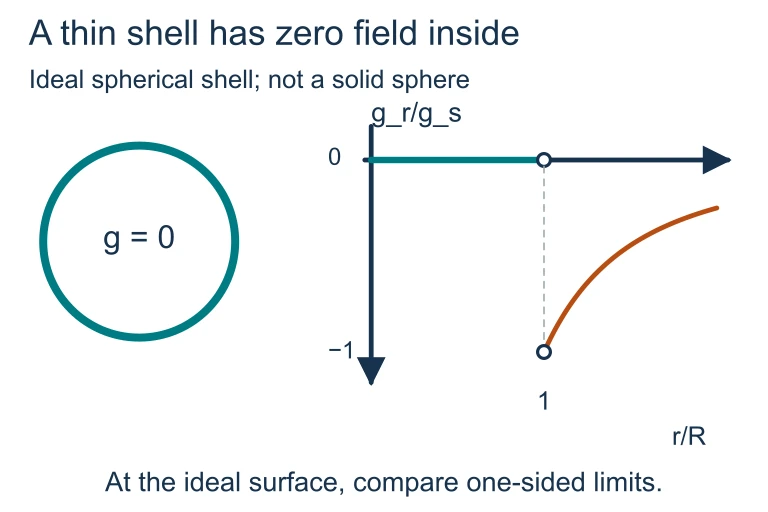 A uniform thin spherical shell has zero gravitational field everywhere inside. Outside, its field equals that of a point mass at its center; the ideal shell surface has distinct inner and outer limits.
SECTION 5
Gravitational Force in Orbital Motion
One of the most powerful applications of Newton's gravitational law is in deriving the orbital mechanics of satellites and planets. For a satellite in a circular orbit, the gravitational force provides exactly the centripetal force needed for uniform circular motion. Setting GMm/r² equal to mv²/r yields the orbital speed v = √(GM/r), which shows that satellites closer to the central body orbit faster—a result that also recovers Kepler's third law when combined with the circumference formula for the orbital period.
The relationship T² ∝ r³, shown in the diagram's inset, is Kepler's Third Law derived directly from Newton's gravitational force law combined with the kinematics of circular motion. On the AP Physics C exam, you should be comfortable deriving this from scratch: set the gravitational force equal to the centripetal force, solve for v, substitute v = 2πr/T, and isolate T. This derivation also reveals that the orbital period depends only on the central mass M and the orbital radius r—not on the satellite's mass m, which cancels.
Apparent Weightlessness
SECTION 6
Worked Example
Geostationary Orbit Radius
A communication satellite must orbit Earth with a period of exactly 24 hours so it remains stationary relative to a point on the equator. Determine the orbital radius of this geostationary orbit. Use ME = 5.97 × 10²⁴ kg and G = 6.674 × 10⁻¹¹ N·m²/kg².
Finding the Geostationary Orbit Radius
- 1
Step 1 — Identify Given Values and Target
We know the orbital period T = 24 h = 86,400 s, Earth's mass ME = 5.97 × 10²⁴ kg, and the gravitational constant G = 6.674 × 10⁻¹¹ N·m²/kg². We seek the orbital radius r. - 2
Step 2 — Set Gravitational Force Equal to Centripetal Force
For a circular orbit: GMEm/r² = mv²/r. The satellite mass m cancels, giving GME/r = v². Since v = 2πr/T, substitute to get GME/r = 4π²r²/T². - 3
Step 3 — Solve Algebraically for r
Multiply both sides by r: GME = 4π²r³/T². Rearrange: r³ = GMET²/(4π²). Therefore r = [GMET²/(4π²)]^(1/3). - 4
Step 4 — Substitute Numerical Values
r³ = (6.674 × 10⁻¹¹)(5.97 × 10²⁴)(86,400)²/(4π²). First compute GME = 3.986 × 10¹⁴ m³/s². Then T² = 7.465 × 10⁹ s². So r³ = (3.986 × 10¹⁴)(7.465 × 10⁹)/(39.478) = 7.534 × 10²² m³. - 5
Step 5 — Compute Final Answer
r = = 4.224 × 10⁷ m ≈ 42,200 km from Earth's center. Subtracting Earth's radius (6,371 km) gives an altitude of approximately 35,800 km above the surface.r ≈ 4.22 × 10⁷ m (≈ 42,200 km from Earth's center)
Dimensional Check
SECTION 7
Strengths & Limitations of Newton's Gravitational Model
Newton's Law of Universal Gravitation is remarkably successful, but it is important to understand where it excels and where it breaks down. For the AP Physics C exam, the Newtonian framework is entirely sufficient, but an awareness of its boundaries demonstrates deeper physical understanding and is occasionally tested in conceptual questions.
| Aspect | Strengths | Limitations |
|---|---|---|
| Accuracy | Predicts planetary orbits, tides, satellite trajectories, and projectile motion to high precision for most practical scenarios. | Fails to account for the 43 arcsec/century precession of Mercury's perihelion; general relativity is needed for strong-field corrections. |
| Speed of Propagation | Computation is straightforward: force is determined instantaneously from positions. | Assumes instantaneous action at a distance. In reality, gravitational effects propagate at the speed of light, as described by general relativity. |
| Mathematical Simplicity | Inverse-square law is analytically tractable; closed-form solutions exist for two-body problems (Kepler orbits). | Three-body and N-body problems generally have no closed-form solutions and require numerical integration. |
| Applicability | Valid for all scenarios on the AP Physics C exam: near-Earth problems, satellite orbits, and multi-body gravitational calculations. | Breaks down near black holes, neutron stars, or any scenario where v ≈ c or gravitational fields are extremely strong. |
Comparison of Newton's gravitational model strengths and limitations
KEY TAKEAWAY
SECTION 8
Connection to Gravitational Potential Energy & Advanced Theory
The gravitational force is intimately connected to gravitational potential energy, a concept you will study in the energy unit of AP Physics C. Because gravity is a conservative force, the work done by gravity depends only on the initial and final positions, not on the path taken. This means we can define a potential energy function U(r) = −GMm/r, where the negative sign reflects the convention that U → 0 as r → ∞. The force is recovered via F = −dU/dr, a relationship that AP Physics C frequently tests in both multiple-choice and free-response formats.
| Feature | Newtonian Gravity (AP Level) | General Relativity (Beyond AP) |
|---|---|---|
| Nature of Gravity | Force between masses, described by F = GMm/r² | Curvature of spacetime caused by mass-energy |
| Potential Energy | U = −GMm/r; F = −dU/dr | Described by the metric tensor; reduces to Newtonian potential in the weak-field limit |
| Key Predictions | Kepler's laws, surface gravity, orbital mechanics, tides | Gravitational lensing, time dilation, gravitational waves, black holes |
| Mathematical Tools | Calculus, vectors, conservation laws | Differential geometry, tensor calculus, Einstein field equations |
Newtonian gravity vs. general relativity
Looking ahead within the AP Physics C curriculum, you will use U(r) = −GMm/r to analyze escape velocity (vesc = √(2GM/R)), energy in orbits (E = −GMm/2r for circular orbits), and the transition between bound and unbound trajectories. These results all flow directly from the gravitational force law combined with energy conservation. Mastering the force equation in this lesson provides the essential foundation upon which the entire gravitational energy framework is built.
SECTION 9
Practice Problems
Question 1: CONCEPTUAL
- A. F₁ = 3F₂
- B. F₁ = F₂
- C. F₂ = 3F₁
- D. F₁ = 9F₂
Show answer (B)
Question 2: BASIC CALCULATION
- A. W/3
- B. W/4
- C. W/9
- D. W/2
Show answer (C)
Question 3: INTERMEDIATE
- A. Gm²/L²
- B. √3 Gm²/L²
- C. 2Gm²/L²
- D. 3Gm²/L²
Show answer (B)
Question 4: APPLIED
5 ptsShow answer
Question 5: CRITICAL THINKING
4 ptsShow answer
SUMMARY
Lesson Summary
Summary
Newton's Law of Universal Gravitation states that every mass attracts every other mass with a force F = Gm₁m₂/r², where G = 6.674 × 10⁻¹¹ N·m²/kg² is the universal gravitational constant and r is the center-to-center distance. The force is always attractive, acts along the line joining the two masses, and obeys the inverse-square law. By the Shell Theorem, a uniform sphere acts gravitationally as if all its mass were at its center for external points, and produces zero net force on internal particles.
Near a planetary surface, the gravitational field simplifies to g = GM/R², giving the familiar weight expression W = mg. For circular orbits, equating the gravitational force to the centripetal force yields v = √(GM/r) and Kepler's Third Law T² ∝ r³. The gravitational force is conservative, enabling the definition of gravitational potential energy U = −GMm/r and the derivation of escape velocity and orbital energy. Mastering both the algebraic manipulation of the force law and the physical reasoning behind Newton's Third Law pairs and superposition is essential for success on the AP Physics C: Mechanics exam.