

SECTION 1
Historical Context & Motivation
The study of oscillatory motion has deep roots in the history of physics, stretching back to Galileo's famous observation that a swinging chandelier in the Cathedral of Pisa maintained a remarkably constant period regardless of its amplitude. This observation hinted at a profound underlying regularity in periodic motion, one that would eventually be formalized through the concept of simple harmonic motion (SHM). Understanding the energy stored in and exchanged by oscillating systems proved essential not only for designing accurate clocks and musical instruments but also for developing the broader framework of classical mechanics and, ultimately, quantum theory.
1583 • Galileo's Pendulum Observations
1678 • Hooke's Law Published
1687 • Newton's Principia Mathematica
1788 • Lagrange's Mécanique Analytique
1900 • Planck's Quantized Oscillators
The central question this lesson addresses is: How is energy stored, transformed, and conserved in a simple harmonic oscillator? By the end, you will be able to write expressions for kinetic, potential, and total energy as functions of position and time, and you will understand the deep connection between energy conservation and the sinusoidal character of SHM — a connection that pervades every branch of physics from acoustics to quantum field theory.
SECTION 2
Core Principles & Definitions
Before diving into the energy expressions, it is important to establish the foundational ideas that govern the energetics of simple harmonic oscillators. Recall that SHM arises whenever a system experiences a linear restoring force proportional to displacement from equilibrium, F = −kx. The resulting motion is sinusoidal with angular frequency ω = √(k/m), and the system continuously converts energy between kinetic and potential forms without any net loss (in the ideal, undamped case). The following grid summarizes the four core principles that structure the energy analysis.
Elastic Potential Energy
Kinetic Energy
Total Mechanical Energy
Energy–Time Oscillation
KEY TAKEAWAY
SECTION 3
Visualizing Energy Exchange in SHM
The diagram below shows a mass–spring system at five key positions across one half-cycle, along with energy bar charts illustrating how kinetic and potential energy trade off at each location. Pay careful attention to the relative heights of the K and U bars: their sum is always equal to the total energy E = ½kA².
Observe the symmetry in the diagram: the energy distribution at x = −A/2 is identical to that at x = +A/2, which reflects the fact that potential energy depends on x² and kinetic energy depends on v², both of which are even functions of displacement or velocity. At the halfway displacement x = A/2, the spring holds only one-quarter of the total energy because U = ½k(A/2)² = ¼(½kA²) = ¼E, leaving three-quarters for kinetic energy. This non-intuitive result — that halfway in position does not correspond to halfway in energy — is a favorite AP exam target.
SECTION 4
Mathematical Framework
The energy analysis of SHM begins with two fundamental expressions — one for kinetic energy and one for elastic potential energy — which can be written either as functions of position or as functions of time. Both representations are essential for the AP C exam, so we develop them systematically below.
Energy as a Function of Position
ELASTIC POTENTIAL ENERGY
k = spring constant (N/m), x = displacement from equilibrium (m). This follows directly from integrating Hooke's law: U = −∫F dx = −∫(−kx) dx = ½kx².
KINETIC ENERGY
m = mass (kg), v = velocity (m/s), A = amplitude (m). The second form comes from energy conservation: K = E − U = ½kA² − ½kx².
TOTAL MECHANICAL ENERGY
The total energy depends only on the amplitude A and the spring constant k (or equivalently on m, ω, and A). Since E is constant, it equals U at x = ±A (where K = 0) and equals K at x = 0 (where U = 0).
Energy as a Function of Time
For an oscillator with displacement x(t) = A cos(ωt + φ), the velocity is v(t) = −Aω sin(ωt + φ). Substituting into the energy expressions and applying the identity sin²θ + cos²θ = 1 yields:
POTENTIAL ENERGY VS TIME
Using the double-angle identity, this can be rewritten as U(t) = ¼kA²[1 + cos(2ωt + 2φ)], confirming that U oscillates at angular frequency 2ω.
KINETIC ENERGY VS TIME
Similarly K(t) = ¼kA²[1 − cos(2ωt + 2φ)]. The sum K + U = ½kA² is indeed time-independent, confirming conservation of energy.
AP Exam Tip
SECTION 5
Energy Graphs — Position and Time Dependence
Two complementary graphical representations are essential for mastering energy in SHM: the energy-versus-position plot and the energy-versus-time plot. The energy-versus-position graph shows U as a parabola opening upward, an inverted parabola for K, and a horizontal line for total energy E. The energy-versus-time graph instead shows two cos² curves (one for U, one for K) that are perfectly out of phase, summing to a flat line at E.
Several features of this graph deserve emphasis. First, the U(x) parabola and the K(x) curve intersect where U = K = E/2, which occurs at x = ±A/√2 ≈ ±0.707A — not at x = ±A/2 as many students initially guess. Second, the allowed range of motion is confined to −A ≤ x ≤ +A because the kinetic energy cannot be negative; the turning points where K = 0 are the classical boundaries of oscillation. Third, the curvature of U(x) is directly proportional to k: stiffer springs produce steeper parabolas and higher total energies for the same amplitude.
Common Misconception
 In the zero-damping spring model, kinetic and potential energies vary with position and time while total mechanical energy stays constant.
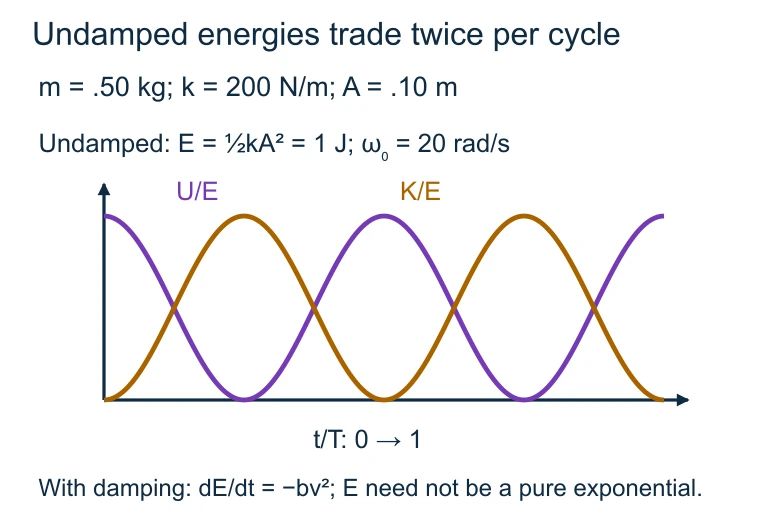 For m = 0.50 kg, k = 200 N/m and A = 0.10 m, total energy is 1 J and angular frequency is 20 rad/s. Kinetic and potential energies exchange at twice the displacement frequency.
SECTION 6
Worked Example
A 0.50 kg block is attached to a horizontal spring (k = 200 N/m) on a frictionless surface. The block is pulled 0.10 m from equilibrium and released from rest. Find (a) the total mechanical energy, (b) the maximum speed, (c) the speed when x = 0.060 m, and (d) the position at which kinetic and potential energy are equal.
Spring–Block Oscillator Energy Analysis
- 1
Step 1 — Identify Given Values
Mass m = 0.50 kg, spring constant k = 200 N/m, amplitude A = 0.10 m. The block is released from rest at x = A, so the initial phase gives x(0) = A cos(0) = A, consistent with v(0) = 0. - 2
Step 2 — Total Mechanical Energy (part a)
At the release point, all energy is potential: E = ½kA² = ½(200)(0.10)² = ½(200)(0.01) = 1.0 J. This total energy is conserved throughout the motion.E = 1.0 J - 3
Step 3 — Maximum Speed (part b)
Maximum speed occurs at x = 0 where all energy is kinetic: E = ½mv²_max, so v_max = √(2E/m) = √(2 × 1.0 / 0.50) = √4.0 = 2.0 m/s. Equivalently, v_max = Aω = A√(k/m) = 0.10 × √(200/0.50) = 0.10 × 20 = 2.0 m/s.v_max = 2.0 m/s - 4
Step 4 — Speed at x = 0.060 m (part c)
Apply energy conservation: ½mv² + ½kx² = E. Solving for v: v = √[(2/m)(E − ½kx²)] = √[(2/0.50)(1.0 − ½(200)(0.060)²)]. Calculate ½kx² = ½(200)(0.0036) = 0.36 J. Therefore v = √[(2/0.50)(1.0 − 0.36)] = √[(4)(0.64)] = √2.56 = 1.6 m/s.v = 1.6 m/s at x = 0.060 m - 5
Step 5 — Position Where K = U (part d)
When K = U, each equals E/2. Setting U = E/2: ½kx² = ½(½kA²), which simplifies to x² = A²/2, so x = ±A/√2 = ±0.10/√2 ≈ ±0.0707 m. Note this is about 70.7% of the amplitude, not 50%.x = ±A/√2 ≈ ±0.071 m
SECTION 7
Strengths, Limitations & Comparisons
The energy approach to SHM is remarkably powerful, but it has its domain of applicability. Understanding when the energy method excels and where it falls short will help you choose the most efficient solution strategy on the AP exam. The table below compares the energy method with the force/kinematics approach and highlights limitations of the ideal SHM model.
| Feature | Energy Method | Force / Kinematics Method |
|---|---|---|
| Speed at a given position | Direct: solve ½mv² = E − ½kx² in one step | Must solve x(t) first, then differentiate and eliminate t |
| Time to reach a position | Not directly available; must invert x(t) | Direct from x(t) = A cos(ωt + φ) |
| Amplitude changes | Easily handles energy added or removed (e.g., collisions) | Must re-derive initial conditions and solve ODE again |
| Damped / driven oscillators | Provides energy-loss rate; exact solution requires modified ODE | Full differential equation approach required |
| Non-linear restoring forces | Energy conservation still applies; U(x) is no longer parabolic | Equation of motion becomes non-linear; analytical solutions rare |
Comparison of energy and force/kinematics approaches for oscillator problems
STRATEGIC INSIGHT
SECTION 8
Connection to Advanced Topics
The ideal SHM energy framework extends naturally into several advanced areas that you may encounter in later physics courses or in the more challenging AP C free-response problems. Two of the most important extensions are damped oscillations (where friction or drag dissipates energy) and quantum harmonic oscillators (where energy levels become discrete). The table below compares the ideal classical oscillator with these more general models.
| Property | Ideal (Undamped) SHM | Damped SHM | Quantum HO |
|---|---|---|---|
| Total energy | Constant: E = ½kA² | Decays: E(t) = E₀ | Quantized: Eₙ = (n + ½)ℏω |
| Amplitude | Constant over time | Decreases exponentially | Probabilistic; no sharp turning point |
| Energy spectrum | Continuous — any A is allowed | Continuous but decaying | Discrete, equally spaced levels |
| Ground-state energy | E = 0 when A = 0 | Approaches 0 as t → ∞ | E₀ = ½ℏω ≠ 0 (zero-point energy) |
| AP C relevance | Core topic — heavily tested | Qualitative understanding expected | Beyond AP C scope; context for E&M / Modern |
Classical ideal SHM vs. damped and quantum oscillators
For AP Physics C: Mechanics, you should be comfortable with the ideal model and qualitatively aware that real oscillators lose energy to dissipative forces. If a problem introduces a damping force F = −bv, the total mechanical energy is no longer conserved because the damping force does negative work on the system. The rate of energy loss is dE/dt = −bv², which you can derive by differentiating E = ½mv² + ½kx² and substituting ma = −kx − bv. This connection between the power dissipated and the damping coefficient b is a frequent AP C free-response target and illustrates how the ideal SHM energy framework generalizes gracefully.
SECTION 9
Practice Problems
Question 1: CONCEPTUAL
- A. x = A/2
- B. x = A/√2
- C. x = A/4
- D. x = 0
Show answer (B)
Question 2: BASIC CALCULATION
- A. 0.80 m/s
- B. 1.2 m/s
- C. 1.6 m/s
- D. 3.2 m/s
Show answer (C)
Question 3: INTERMEDIATE
- A. 0.025 m
- B. 0.035 m
- C. 0.050 m
- D. 0.071 m
Show answer (B)
Question 4: APPLIED
10 ptsShow answer
Question 5: CRITICAL THINKING
7 ptsShow answer
SUMMARY
Summary — Energy of Simple Harmonic Oscillators
Summary
In an ideal (undamped) simple harmonic oscillator, energy continuously converts between elastic potential energy U = ½kx² and kinetic energy K = ½mv² while the total mechanical energy E = ½kA² remains constant. The maximum speed v_max = Aω = A√(k/m) occurs at equilibrium, while the mass is momentarily at rest at the turning points x = ±A. The position at which K = U is x = ±A/√2, not ±A/2 — a frequently tested distinction.
Expressed as functions of time, both K and U oscillate sinusoidally at twice the natural frequency (2ω), with their time averages each equal to ½E = ¼kA². The energy method is the most efficient tool for finding speeds at arbitrary positions and for analyzing collisions or sudden changes in an oscillating system. For vertical spring–mass systems, shifting the coordinate origin to the equilibrium position absorbs gravity into a constant, making the energy analysis identical to the horizontal case.