

SECTION 1
Historical Context & Motivation
The study of collisions has driven the development of mechanics from its earliest days, well before Newton codified his laws. When two objects interact over a brief interval—billiard balls striking one another, subatomic particles scattering in an accelerator, or automobiles crashing on a highway—the physics of the encounter is governed by conservation of momentum and, in special cases, conservation of kinetic energy. These two conservation principles together provide the theoretical scaffolding for classifying every collision as elastic, inelastic, or perfectly inelastic. Understanding this classification is essential not only for AP Physics C: Mechanics but also for particle physics, engineering safety analysis, and astrophysics.
1668 • Wallis, Wren, and Huygens
1687 • Newton's Principia
1743 • d'Alembert's Principle
1911 • Rutherford Scattering
1960s–present • Particle Colliders
The central question this lesson addresses is deceptively simple: given two objects that interact briefly, what can we predict about their final velocities and the energy budget of the system? The answer hinges on whether kinetic energy is conserved, partially dissipated, or even increased—leading to the classification scheme that underpins virtually all collision problems on the AP Physics C exam.
SECTION 2
Core Principles & Definitions
Every collision analysis in classical mechanics rests on a small set of powerful ideas. Momentum conservation is always valid for an isolated system, but kinetic energy conservation is an additional constraint that applies only in the elastic case. By understanding when each conservation law holds—and when it does not—you gain the ability to solve a wide variety of collision problems efficiently and correctly.
Conservation of Linear Momentum
Elastic Collision
Inelastic Collision
Perfectly Inelastic Collision
Coefficient of Restitution
KEY TAKEAWAY
SECTION 3
Visual Explanation
Before-and-After Collision Diagrams
The diagram above illustrates the three canonical collision types in one dimension, all with the same initial configuration: mass m₁ approaches stationary mass m₂. In the elastic row (top), both objects rebound with velocities determined by two simultaneous equations—momentum conservation and kinetic energy conservation. In the inelastic row (middle), the objects still separate, but their relative speed after the collision is less than before, indicating kinetic energy has been converted to internal energy. In the perfectly inelastic row (bottom), the two masses coalesce into a single object, representing the maximum kinetic energy loss consistent with momentum conservation. Across all three scenarios, the total momentum is identical before and after—only the energy partition differs.
SECTION 4
Mathematical Framework
Conservation of Momentum (All Collisions)
MOMENTUM CONSERVATION
m₁, m₂ = masses of objects 1 and 2; v₁ᵢ, v₂ᵢ = initial velocities; v₁f, v₂f = final velocities. This equation is a vector relation—signs encode direction in 1-D.
Kinetic Energy Conservation (Elastic Only)
KINETIC ENERGY CONSERVATION
This constraint applies only in elastic collisions. Combining with momentum conservation yields two equations in two unknowns (v₁f, v₂f).
Solving the elastic collision system simultaneously is a standard exercise in AP Physics C. A powerful algebraic shortcut emerges when you rearrange the kinetic energy equation by factoring differences of squares. Starting from m₁(v₁ᵢ² − v₁f²) = m₂(v₂f² − v₂ᵢ²) and writing each side as a product of sum and difference, then dividing by the corresponding terms from the momentum equation, you arrive at the relative velocity condition:
RELATIVE VELOCITY (ELASTIC)
In an elastic collision, the relative velocity of approach equals the relative velocity of separation in magnitude but reverses sign. This replaces the quadratic KE equation with a linear one, greatly simplifying calculations.
Elastic Collision Final Velocities (1-D, Derived)
FINAL VELOCITY OF m₁
Derived by solving momentum conservation and the relative velocity condition simultaneously. When m₂ is initially at rest (v₂ᵢ = 0), this reduces to v₁f = [(m₁ − m₂)/(m₁ + m₂)]v₁ᵢ.
FINAL VELOCITY OF m₂
Symmetric companion to the v₁f equation. When v₂ᵢ = 0, this simplifies to v₂f = [2m₁/(m₁ + m₂)]v₁ᵢ.
Perfectly Inelastic Collision
PERFECTLY INELASTIC FINAL VELOCITY
Since the objects stick together, v₁f = v₂f = . Only momentum conservation is needed—one equation, one unknown. The kinetic energy lost is ΔKE = ½μ(v₁ᵢ − v₂ᵢ)², where μ = m₁m₂/(m₁ + m₂) is the reduced mass.
Derivation Tip
SECTION 5
Energy Analysis & Classification
The distinction between collision types is fundamentally an energy classification. While momentum conservation provides one constraint, the energy budget determines how many degrees of freedom remain and what fraction of the initial kinetic energy survives the interaction. The fractional kinetic energy loss ΔKE/KE_initial is the key diagnostic. In an elastic collision this ratio is zero, in a perfectly inelastic collision it reaches a maximum, and in a general inelastic collision it lies strictly between these extremes.
| Property | Elastic | Inelastic | Perfectly Inelastic |
|---|---|---|---|
| Momentum conserved? | Yes | Yes | Yes |
| KE conserved? | Yes | No (partial loss) | No (maximum loss) |
| Coefficient of restitution e | 1 | 0 < e < 1 | 0 |
| Objects after collision | Separate | Separate | Stick together |
| Equations needed | 2 (momentum + KE or rel. vel.) | 2 (momentum + restitution) | 1 (momentum only) |
| Real-world example | Billiard balls, atomic collisions | Car fender-bender, bouncing ball | Bullet embedding in block, coupling railroad cars |
Comparison of Collision Types
A useful result for the kinetic energy lost in a perfectly inelastic collision involves the reduced mass μ = m₁m₂/(m₁ + m₂). The energy dissipated is |ΔKE| = ½μ(v₁ᵢ − v₂ᵢ)², which depends only on the reduced mass and the initial relative velocity. This elegant expression shows that the energy loss scales with the square of the closing speed, underscoring why high-speed collisions are so destructive. In the center-of-mass frame, the perfectly inelastic collision dissipates all of the kinetic energy associated with relative motion, leaving only the kinetic energy of the center of mass—which, by definition, cannot be dissipated in any collision.
SECTION 6
Worked Example
Example: Elastic Collision with a Stationary Target
A 3.0 kg cart moving at 4.0 m/s to the right collides elastically with a 1.0 kg cart initially at rest on a frictionless track. Find the final velocities of both carts and verify that kinetic energy is conserved.
Elastic Collision Solution
- 1
Step 1 — Identify Given Values
m₁ = 3.0 kg, v₁ᵢ = +4.0 m/s (rightward positive), m₂ = 1.0 kg, v₂ᵢ = 0 m/s. The collision is elastic, so both momentum and kinetic energy are conserved. - 2
Step 2 — Apply Momentum Conservation
m₁v₁ᵢ + m₂v₂ᵢ = m₁v₁f + m₂v₂f. Substituting: (3.0)(4.0) + (1.0)(0) = 3.0·v₁f + 1.0·v₂f, which gives 12 = 3v₁f + v₂f. This is Equation (1).Equation (1): 3v₁f + v₂f = 12 - 3
Step 3 — Apply Relative Velocity Condition
For an elastic collision: v₁ᵢ − v₂ᵢ = −(v₁f − v₂f). Substituting: 4.0 − 0 = −(v₁f − v₂f), so v₂f − v₁f = 4.0. This is Equation (2). Using this linear equation rather than the quadratic KE equation greatly simplifies the algebra.Equation (2): v₂f − v₁f = 4.0 - 4
Step 4 — Solve the System
From Equation (2): v₂f = v₁f + 4.0. Substitute into Equation (1): 3v₁f + (v₁f + 4.0) = 12 → 4v₁f = 8.0 → v₁f = 2.0 m/s. Then v₂f = 2.0 + 4.0 = 6.0 m/s. Both velocities are positive, meaning both carts move to the right after the collision—but m₂ moves faster, so they separate.v₁f = +2.0 m/s, v₂f = +6.0 m/s - 5
Step 5 — Verify Kinetic Energy Conservation
KE_initial = ½(3.0)(4.0)² + ½(1.0)(0)² = 24.0 J. KE_final = ½(3.0)(2.0)² + ½(1.0)(6.0)² = 6.0 + 18.0 = 24.0 J. Since KE_initial = KE_final = 24.0 J, kinetic energy is indeed conserved, confirming the collision is elastic.KE_initial = KE_final = 24.0 J ✓ - 6
Step 6 — Cross-Check with Closed-Form Equations
Using the derived formulas: v₁f = [(m₁ − m₂)/(m₁ + m₂)]v₁ᵢ = [(3 − 1)/(3 + 1)](4.0) = (2/4)(4.0) = 2.0 m/s. v₂f = [2m₁/(m₁ + m₂)]v₁ᵢ = [2(3)/(4)](4.0) = (6/4)(4.0) = 6.0 m/s. Both match, providing a valuable sanity check on the algebraic solution.Confirmed: v₁f = 2.0 m/s, v₂f = 6.0 m/s
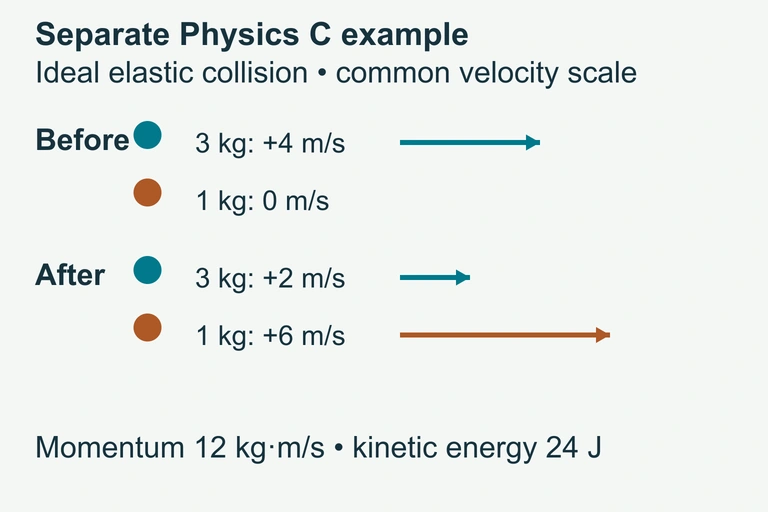 Separate idealized Physics C elastic collision example.
SECTION 7
Strengths, Limitations & Common Pitfalls
| Aspect | Strength / Advantage | Limitation / Pitfall |
|---|---|---|
| Momentum conservation | Always valid for an isolated system, regardless of collision type or internal forces. | Requires identifying the system correctly; external forces (friction, gravity components along the collision axis) can violate the conservation condition. |
| KE conservation (elastic) | Provides a second equation, allowing full determination of both final velocities in 1-D. | Rarely exactly satisfied in macroscopic collisions; students often misapply it to inelastic problems. |
| Relative velocity shortcut | Converts a quadratic system into two linear equations, greatly speeding computation. | Applies only to elastic collisions. Extending it carelessly to inelastic cases introduces errors. |
| Perfectly inelastic model | Simplest to solve—only one unknown. Useful for ballistic pendulum and explosion problems (time-reversed). | Students sometimes forget that maximum KE loss does not mean all KE is lost (except in the center-of-mass frame). |
| 2-D collisions | Momentum conservation applies component-wise, handling oblique impacts systematically. | An elastic 2-D collision with one unknown angle has 3 equations and 4 unknowns—additional info (e.g., scattering angle) is needed. |
Strengths and Limitations of Collision Analysis Tools
COMMON EXAM MISTAKES
SECTION 8
Connections to Advanced Theory
The collision framework introduced here extends naturally into several advanced domains. In the center-of-mass (CM) reference frame, collision analysis simplifies dramatically: the total momentum is zero by construction, so the two objects always approach each other with equal and opposite momenta. In an elastic collision in the CM frame, the speeds are unchanged—only the directions reverse. In a perfectly inelastic collision in the CM frame, both objects come to rest. This perspective is the gateway to understanding scattering theory in quantum mechanics, where differential cross-sections describe the probability of deflection at various angles.
| Topic in This Lesson | Advanced Extension |
|---|---|
| 1-D elastic collision formulas | 2-D and 3-D scattering with impact parameter; Rutherford scattering cross-section in nuclear physics. |
| Perfectly inelastic collision | Explosions as time-reversed perfectly inelastic collisions; rocket propulsion via the Tsiolkovsky equation. |
| Coefficient of restitution | Material science: e depends on material properties, impact speed, and temperature—it is not truly constant. |
| Center-of-mass frame | Relativistic collisions: invariant mass, four-momentum conservation, particle creation thresholds (E = mc²). |
| Energy dissipation in collisions | Thermodynamics of irreversible processes; entropy production during inelastic impacts. |
From AP Mechanics to Advanced Physics
For students continuing to AP Physics C: Electricity & Magnetism or university-level modern physics, the collision framework reappears in Compton scattering (photon–electron elastic collision obeying relativistic kinematics) and in the analysis of nuclear reactions, where Q-values quantify the kinetic energy gained or lost when rest mass changes. The habit of systematically writing conservation equations before solving—developed here—transfers directly into these more sophisticated settings.
SECTION 9
Practice Problems
Question 1: CONCEPTUAL
- A. Both momentum and kinetic energy are conserved.
- B. Momentum is conserved, but kinetic energy is not conserved.
- C. Kinetic energy is conserved, but momentum is not conserved.
- D. Neither momentum nor kinetic energy is conserved.
Show answer (B)
Question 2: BASIC CALCULATION
- A. 1.0 m/s
- B. 2.0 m/s
- C. 3.0 m/s
- D. 4.0 m/s
Show answer (B)
Question 3: INTERMEDIATE
- A. +1.0 m/s
- B. +2.0 m/s
- C. +2.5 m/s
- D. +3.0 m/s
Show answer (B)
Question 4: APPLIED
5 ptsShow answer
Question 5: CRITICAL THINKING
4 ptsShow answer
SUMMARY
Summary & Key Concepts
Summary
Collisions are classified by their energy budget. Conservation of linear momentum applies to every isolated collision—elastic, inelastic, or perfectly inelastic—because Newton's third law guarantees equal and opposite impulses between the colliding objects. In an elastic collision (e = 1), both momentum and kinetic energy are conserved, giving two equations for two unknowns. The powerful relative velocity condition v₁ᵢ − v₂ᵢ = −(v₁f − v₂f) replaces the quadratic KE equation with a linear one, simplifying calculations.
In a perfectly inelastic collision (e = 0), the objects stick together and the problem reduces to one equation in one unknown: = (m₁v₁ᵢ + m₂v₂ᵢ)/(m₁ + m₂). The kinetic energy lost is ½μ(v₁ᵢ − v₂ᵢ)², where μ is the reduced mass. General inelastic collisions (0 < e < 1) require momentum conservation plus the coefficient of restitution relation. On the AP exam, always begin by identifying the collision type, writing the appropriate conservation equations, and choosing a consistent sign convention before solving.