

SECTION 1
Historical Context & Motivation
The study of oscillatory motion stretches back to antiquity, but the formal mathematical treatment of what we now call simple harmonic motion (SHM) crystallized over several centuries of observation, experiment, and theoretical insight. Galileo Galilei's legendary observation of a swinging chandelier in the Cathedral of Pisa—whether apocryphal or not—highlighted the remarkable regularity of a pendulum's period, independent of its amplitude for small swings. This insight planted the seed for precision timekeeping and, more broadly, for a rigorous theory of periodic motion. Subsequent work by Robert Hooke, Isaac Newton, and Leonhard Euler transformed these observations into a complete mathematical framework that remains one of the most widely applicable models in all of physics.
1583 • Galileo and the Pendulum
1660 • Hooke's Law Published
1687 • Newton's Principia
1736 • Euler's Analytical Methods
1900s • Quantum Harmonic Oscillator
What unifies all these developments is a single, powerful idea: whenever a system experiences a restoring force proportional to displacement, it oscillates sinusoidally about its equilibrium position. This criterion—the defining hallmark of SHM—appears across an astonishing range of physical contexts, from mass–spring systems and pendulums to LC circuits and vibrating molecules. Our task in this lesson is to rigorously define SHM, derive its governing differential equation, and understand the physical quantities that characterize the motion.
SECTION 2
Core Principles & Definitions
Simple harmonic motion is a specific type of periodic, oscillatory motion governed by a strict set of conditions. Before diving into the mathematics, it is essential to establish the foundational ideas that distinguish SHM from other forms of oscillation—such as damped, driven, or anharmonic oscillations. The following core principles collectively define SHM and provide the conceptual scaffolding for the differential equation we will encounter in Section 4.
Linear Restoring Force
Sinusoidal Time Dependence
Constant Amplitude & Frequency
Isochronous Oscillation
Equilibrium as Reference
KEY TAKEAWAY
SECTION 3
Visual Explanation — Anatomy of SHM
The following diagram illustrates a mass–spring system executing SHM alongside the corresponding position-versus-time graph. The visual connects the physical configuration of the oscillator at key instants (maximum displacement, equilibrium, and maximum displacement in the opposite direction) with the sinusoidal waveform that describes the position x(t). Pay particular attention to how the restoring force arrow reverses direction as the mass crosses equilibrium and grows in magnitude as the mass moves farther from center.
Several critical features are visible in the diagram. First, notice that the restoring force arrows are longest at the turning points (x = ±A) and vanish at equilibrium—this is the graphical signature of the linear restoring force F = −kx. Second, at the equilibrium position the mass has its maximum velocity (all energy is kinetic), while at the turning points the velocity is momentarily zero (all energy is elastic potential). Finally, the position graph below is a smooth cosine curve, confirming that the motion is sinusoidal with constant amplitude A and period T. Every real SHM system—whether it involves a spring, a pendulum, or a vibrating tuning fork—shares precisely this qualitative structure.
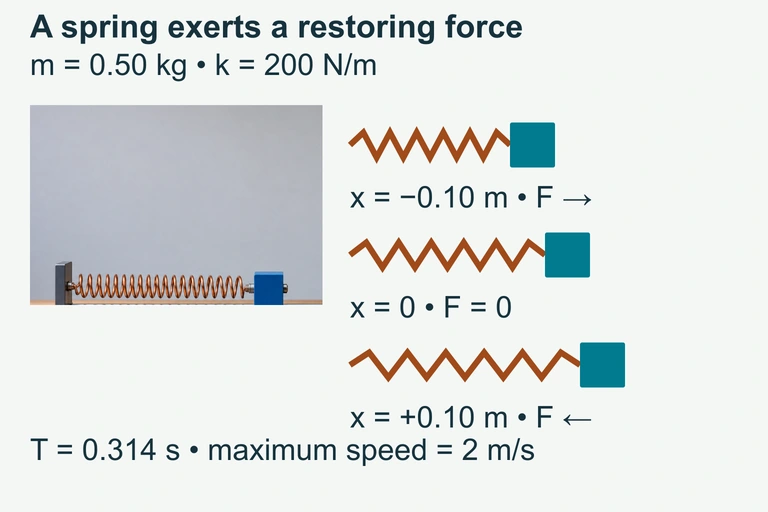 A spring exerts a restoring force. For m = 0.50 kg and k = 200 N/m, displacement −0.10 m gives rightward force, zero displacement gives zero force, and +0.10 m gives leftward force. T = 0.314 s and maximum speed is 2 m/s.
SECTION 4
Mathematical Framework
The mathematical definition of SHM emerges directly from Newton's second law applied to a linear restoring force. Let a particle of mass m be subject to a net force F = −kx, where x is the displacement from stable equilibrium and k is a positive constant (the spring constant for a Hookean spring). Newton's second law gives F = ma = m(d²x/dt²), and equating these expressions produces the defining differential equation of SHM.
DEFINING DIFFERENTIAL EQUATION OF SHM
where ω = √(k/m) is the angular frequency (rad/s), x is displacement from equilibrium (m), and t is time (s). This equation states that the acceleration is always proportional to, and oppositely directed from, the displacement.
The general solution to this second-order linear ODE with constant coefficients is well known from differential equations. Because the characteristic equation r² + ω² = 0 has purely imaginary roots r = ±iω, the general real solution takes the form of a sinusoidal function with two constants of integration determined by initial conditions.
GENERAL SOLUTION — POSITION
A is the amplitude—the maximum magnitude of displacement from equilibrium (m). φ is the phase constant (rad), determined by the initial position and velocity. An equivalent form is x(t) = C₁ cos(ωt) + C₂ sin(ωt), where A = √(C₁² + C₂²) and tan φ = −C₂/C₁.
Differentiating the position function once gives velocity; differentiating again gives acceleration. These expressions are essential for problem-solving on the AP exam.
VELOCITY IN SHM
Maximum speed occurs at equilibrium (x = 0): vmax = Aω. The velocity leads the position by π/2 radians.
ACCELERATION IN SHM
Maximum acceleration occurs at the turning points (x = ±A): amax = Aω². The acceleration is always anti-parallel to displacement—this is the mathematical restatement of the restoring force condition.
Period and Frequency Relations
 Measure displacement from equilibrium. For a linear restoring force, acceleration is proportional to that displacement and points in the opposite direction.
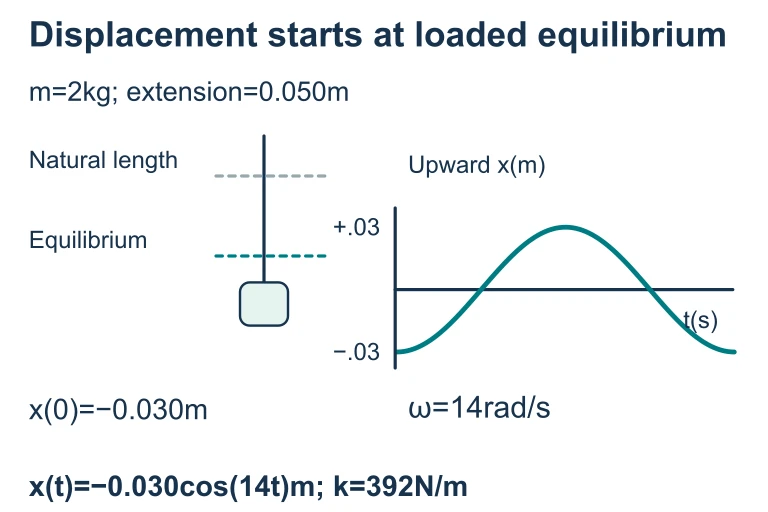 A 2 kg mass stretches the spring 0.050 m, giving k = 392 N/m and ω = 14 rad/s. With upward displacement measured from equilibrium and x(0) = −0.030 m, x(t) = −0.030 cos(14t) m.
SECTION 5
Energy in SHM & Graphical Relationships
A hallmark of SHM is the continuous, lossless exchange between kinetic energy and potential energy. For a mass on a spring, the elastic potential energy is U = ½kx² and the kinetic energy is K = ½mv². Because no non-conservative forces act in ideal SHM, the total mechanical energy E = K + U remains constant throughout the motion. Substituting the SHM solutions for x(t) and v(t) and using the identity sin²θ + cos²θ = 1 yields E = ½kA², confirming that the total energy depends only on the amplitude and the spring constant. The following diagram shows how x(t), v(t), K(t), and U(t) relate over one full period.
Several important observations arise from this energy diagram. The kinetic and potential energy curves each oscillate between 0 and ½kA² at twice the frequency of the displacement—mathematically because sin²(ωt) and cos²(ωt) both have period π/ω = T/2. When the displacement is at a maximum (a turning point), the velocity is zero and all energy is potential. At equilibrium, the displacement is zero, the velocity is at its maximum, and all energy is kinetic. At every intermediate instant, K + U = ½kA², forming the horizontal dashed line in the diagram. This energy conservation result is routinely tested on the AP exam, both conceptually (interpreting energy bar charts) and quantitatively (solving for velocity at a given displacement using ½kA² = ½kx² + ½mv²).
ENERGY CONSERVATION IN SHM
Solving for speed at displacement x gives v = ω√(A² − x²). This is extremely useful for finding the speed at any position without needing to know the time.
SECTION 6
Worked Example — Mass–Spring SHM
A 0.50 kg block attached to a horizontal spring (k = 200 N/m) on a frictionless surface is pulled 0.10 m from its equilibrium position and released from rest. Find (a) the angular frequency and period, (b) the position as a function of time, (c) the maximum speed, and (d) the speed when the block is 0.060 m from equilibrium.
Block on a Horizontal Spring
- 1
Step 1 — Identify Given Values
Mass m = 0.50 kg, spring constant k = 200 N/m, initial displacement x₀ = 0.10 m, initial velocity v₀ = 0 (released from rest). The motion is SHM because the spring exerts a linear restoring force F = −kx. - 2
Step 2 — Angular Frequency and Period
ω = √(k/m) = √(200/0.50) = √400 = 20 rad/s. The period is T = 2π/ω = 2π/20 = π/10 s ≈ 0.314 s.ω = 20 rad/s, T ≈ 0.314 s - 3
Step 3 — Position Function x(t)
The general solution is x(t) = A cos(ωt + φ). At t = 0, x(0) = A cos φ = 0.10 m and v(0) = −Aω sin φ = 0. The velocity condition requires sin φ = 0, so φ = 0 (choosing the principal value). Then A cos 0 = A = 0.10 m.x(t) = 0.10 cos(20t) m - 4
Step 4 — Maximum Speed
v_max = Aω = (0.10)(20) = 2.0 m/s. This maximum speed occurs as the block passes through x = 0.v_max = 2.0 m/s - 5
Step 5 — Speed at x = 0.060 m
Using energy conservation: v = ω√(A² − x²) = 20 × √(0.10² − 0.060²) = 20 × √(0.010 − 0.0036) = 20 × √0.0064 = 20 × 0.080 = 1.6 m/s.v = 1.6 m/s at x = 0.060 m
SECTION 7
SHM Compared to Other Types of Motion
SHM is an idealization—real oscillators inevitably encounter friction, external driving forces, or nonlinear restoring forces. Understanding how SHM relates to more general oscillatory motion helps clarify the assumptions and limitations of the model. The table below compares SHM with several closely related types of motion you may encounter on the AP exam or in more advanced coursework.
| Property | Simple Harmonic Motion | Damped Oscillation | Driven (Forced) Oscillation |
|---|---|---|---|
| Net restoring force | F = −kx (linear, proportional) | F = −kx − bv (includes velocity-dependent damping) | F = −kx − bv + F₀cos(ω_d t) |
| Amplitude | Constant — energy is conserved | Decreases exponentially over time | Reaches steady-state; can exhibit resonance |
| Period / Frequency | Independent of amplitude (isochronous) | Slightly altered by damping coefficient | Steady-state freq equals driving frequency ω_d |
| Energy | E = ½kA² = constant | Decreases due to dissipation by damping | External source replenishes energy; can grow at resonance |
| AP Exam relevance | Primary focus of Oscillations unit | Qualitative understanding expected; detailed math beyond scope | Qualitative understanding of resonance expected |
Comparison of SHM with damped and driven oscillatory motion
KEY TAKEAWAY
 With linear damping, the phase trajectory contracts and mechanical energy decreases at the rate −bv². The undamped comparison has constant total mechanical energy.
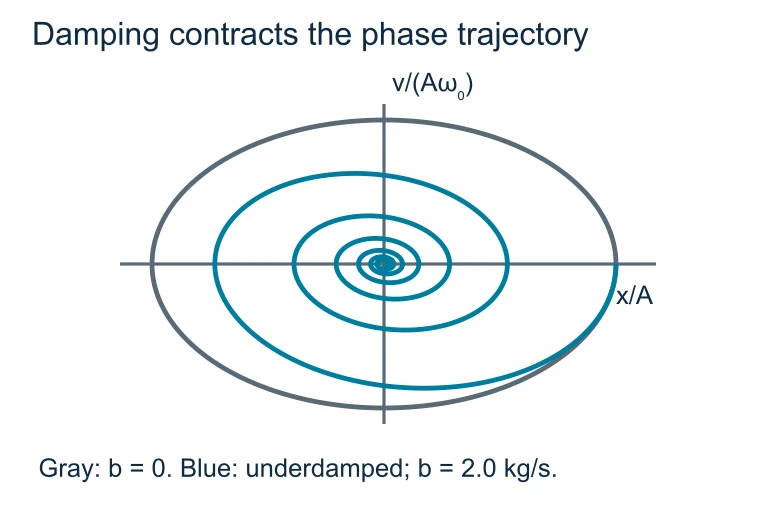 With linear damping, the phase trajectory contracts and mechanical energy decreases at the rate −bv². The undamped comparison has constant total mechanical energy.
SECTION 8
Connection to Advanced Theory — SHM Beyond the Spring
The power of SHM lies in its universality: any system whose potential energy has a local minimum can be approximated as a simple harmonic oscillator for small displacements about that minimum. If U(x) is the potential energy function for a one-dimensional system, a Taylor expansion about the equilibrium position x₀ gives U(x) ≈ U(x₀) + ½U″(x₀)(x − x₀)². The linear term vanishes because dU/dx = 0 at equilibrium, and the constant term merely shifts the energy reference. Identifying the effective spring constant as keff = U″(x₀), we recover the SHM equation d²x/dt² = −(keff/m)x. This technique is used extensively in classical mechanics, molecular physics, and even general relativity to analyze small oscillations about equilibria.
| System | Restoring 'Force' / Torque | Effective ω | SHM Condition |
|---|---|---|---|
| Mass–spring | F = −kx | ω = √(k/m) | Hooke's law valid (spring not overstretched) |
| Simple pendulum | τ = −mgL sin θ ≈ −mgLθ | ω = √(g/L) | Small angle: sin θ ≈ θ |
| Physical pendulum | τ = −mgh sin θ ≈ −mghθ | ω = √(mgh/I) | Small angle; I about pivot |
| Torsional oscillator | τ = −κθ | ω = √(κ/I) | Linear restoring torque (Hooke analog) |
| LC circuit | V = −Q/C (analogous to F = −kx) | ω = 1/√(LC) | No resistance; ideal L and C |
Systems that exhibit SHM under appropriate conditions
For the AP Physics C: Mechanics exam, you are expected to recognize and analyze SHM in mass–spring systems and simple pendulums quantitatively. Physical pendulums and torsional oscillators also appear, requiring you to set up the rotational analog of the SHM differential equation (Iα = −κθ or equivalent). The LC circuit analogy belongs to AP Physics C: E&M, but appreciating the structural similarity deepens your understanding of why SHM is such a universal paradigm. In more advanced mechanics courses, the small-oscillation approximation via Taylor expansion becomes a standard tool for analyzing motion near any stable equilibrium in multi-degree-of-freedom systems.
SECTION 9
Practice Problems
Question 1: CONCEPTUAL
- A. The motion is SHM with angular frequency ω = 3 rad/s.
- B. The motion is SHM with angular frequency ω = 9 rad/s.
- C. The motion is SHM with angular frequency ω = 81 rad/s.
- D. The motion is not SHM because no spring constant is given.
Show answer (A)
Question 2: BASIC CALCULATION
- A. k ≈ 9.9 N/m
- B. k ≈ 19.7 N/m
- C. k ≈ 39.5 N/m
- D. k ≈ 78.9 N/m
Show answer (C)
Question 3: INTERMEDIATE
- A. x = 0.10 m
- B. x ≈ 0.15 m
- C. x ≈ 0.17 m
- D. x ≈ 0.19 m
Show answer (C)
Question 4: APPLIED
10 ptsShow answer
Question 5: CRITICAL THINKING
7 ptsShow answer
SUMMARY
Lesson Summary
Summary
Simple harmonic motion is defined by a linear restoring force proportional to displacement: F = −kx. Applying Newton's second law yields the defining differential equation d²x/dt² = −ω²x, whose general solution is the sinusoidal function x(t) = A cos(ωt + φ). The angular frequency ω = √(k/m) determines the period T = 2π/ω, which is independent of amplitude (isochronism). Velocity v(t) = −Aω sin(ωt + φ) leads position by 90°, and acceleration a(t) = −ω²x is always anti-parallel to displacement.
Energy in SHM is conserved: E = ½kA² is constant, with kinetic and potential energy exchanging at twice the oscillation frequency. The SHM framework applies to any system with a quadratic potential energy minimum—mass–spring systems, small-angle pendulums, torsional oscillators, and more. Master the differential equation, the energy conservation relation v = ω√(A² − x²), and the ability to identify effective spring constants in novel contexts, and you will be well-prepared for the AP exam's Oscillations questions.