

SECTION 1
Historical Context & Motivation
The idea that something about rotational motion is "conserved" emerged gradually over several centuries, evolving from Kepler's empirical observation that planets sweep out equal areas in equal times to the fully formalized vector treatment in Newtonian and Lagrangian mechanics. Unlike linear momentum, which is relatively intuitive—a heavier or faster object is harder to stop—angular momentum requires careful attention to the axis of rotation, the distribution of mass, and the coupling between spinning and orbiting motions. The story of angular momentum conservation is therefore a story about physicists learning to see rotational symmetry as a deep feature of nature, not merely a convenient calculation trick.
1609 • Kepler's Second Law
1687 • Newton's Principia
1736 • Euler's Rigid-Body Mechanics
1788 • Lagrange & Analytical Mechanics
1918 • Noether's Theorem
The central question that conservation of angular momentum answers is deceptively simple: what stays the same when a system spins, and under what conditions? From collapsing gas clouds that form rapidly spinning neutron stars to the figure skater who pulls in her arms and accelerates her spin, the principle provides a single quantitative framework. In this lesson, we will develop the formal statement of the law, connect it to the rotational analogue of Newton's second law, and apply it to the kinds of problems that appear on the AP Physics C: Mechanics exam.
SECTION 2
Core Principles & Definitions
Before tackling conservation, we need a precise definition of angular momentum and the conditions under which it is conserved. Angular momentum is the rotational analogue of linear momentum; just as linear momentum p = mv measures the tendency of a translating object to keep translating, angular momentum L measures the tendency of a rotating or orbiting object to keep rotating. The vector nature of L is critical: it has a direction (given by the right-hand rule) as well as a magnitude, and conservation applies to the full vector.
Angular Momentum of a Particle
Angular Momentum of a Rigid Body
Torque as the Agent of Change
Conservation Statement
System Definition Matters
KEY TAKEAWAY
SECTION 3
Visual Explanation
The following diagram illustrates the classic demonstration of angular momentum conservation: a figure skater (modeled as a cylinder with extendable arms) changes her moment of inertia by pulling her arms inward, causing her angular velocity to increase while the product Iω remains constant. The diagram shows the before and after states side by side, with the key quantities labeled.
Notice that the ice exerts negligible torque on the skater about the vertical axis (friction is very small), so the system satisfies the condition τext ≈ 0. The internal muscular forces that pull the arms inward are internal forces and produce internal torques that redistribute angular momentum among body parts but cannot change the system total. The result is a dramatic increase in spin rate, which is easily observed in competitive figure skating.
SECTION 4
Mathematical Framework
The mathematical structure of angular momentum conservation follows directly from Newton's second law in its rotational form. We start with the definition for a single particle, generalize to a system, and derive the conservation law by requiring zero net external torque.
ANGULAR MOMENTUM OF A PARTICLE
where r⃗ is the position vector from the reference point to the particle, p⃗ = mv⃗ is the linear momentum, and × denotes the cross product. The magnitude is |L| = rp sin θ = rmv sin θ, where θ is the angle between r⃗ and v⃗.
ROTATIONAL NEWTON'S SECOND LAW
The net external torque on a system equals the time rate of change of its total angular momentum. This is the rotational analogue of F⃗net = dp⃗/dt. Note: internal torques cancel in pairs (Newton's third law), so only external torques contribute.
CONSERVATION LAW
When the net external torque vanishes, dL⃗/dt = 0, so L⃗ does not change. This holds for each component independently: if τz,ext = 0, then Lz is conserved even if the other components are not.
FIXED-AXIS SPECIAL CASE
For rotation about a fixed axis with no external torque about that axis, the product of moment of inertia and angular velocity remains constant. This is the form most commonly used in AP Physics C problems involving collapsing or expanding systems.
Component-wise Conservation
It is worth noting the derivation from first principles. Taking the time derivative of L⃗ = r⃗ × p⃗ and applying the product rule: dL⃗/dt = (dr⃗/dt) × p⃗ + r⃗ × (dp⃗/dt). The first term is v⃗ × (mv⃗) = 0 because the cross product of any vector with itself is zero. The second term is r⃗ × F⃗net = τ⃗net. Thus τ⃗net = dL⃗/dt is derived directly from Newton's second law, confirming that angular momentum conservation is not an independent postulate but a consequence of the underlying force laws when net external torque is absent.
SECTION 5
Detailed Breakdown — Common Scenarios
Angular momentum conservation manifests in a wide variety of physical situations. On the AP Physics C exam, the most frequently tested scenarios fall into several categories: systems where the moment of inertia changes (like the spinning skater), collisions involving rotation (such as a projectile embedding in a rotating rod), and orbital motion under central forces. The diagram below classifies these scenarios and identifies what stays constant in each case.
Scenario Details
In changing-inertia problems, the system's mass distribution changes while no external torque acts. The classic example is a point mass sliding radially inward on a frictionless turntable: as the mass moves closer to the axis, I decreases and ω increases. The kinetic energy actually increases in this process because the internal force does positive work. This is a common source of confusion: angular momentum conservation does not imply kinetic energy conservation. The work done by the internal forces accounts for the energy change.
In rotational collision problems, two objects interact over a short time interval. If the collision is about a pivot where the pivot force exerts no torque (because its moment arm is zero), then angular momentum about the pivot is conserved through the collision. A common example is a ball of putty striking the end of a rod that is free to rotate about its other end. The ball's initial angular momentum mvd (where d is the distance from the pivot to the point of impact) equals the system's final angular momentum Itotalωf. Note that linear momentum is generally not conserved in such problems because the pivot exerts an impulsive force.
In central-force orbit problems, the force is always directed toward (or away from) a fixed center, so the torque about that center is zero. For a particle of mass m, the angular momentum L = mr²(dθ/dt) = mrvsinθ is constant throughout the orbit. At the closest approach (perihelion) the velocity is tangential and sin θ = 1, so L = mrminvmax; at the farthest point (aphelion), L = mrmaxvmin. This recovers Kepler's equal-area law.
 Equal time intervals during ideal gravitational coasting sweep equal areas about the planet at the ellipse’s focus. Angular speed changes along the orbit while angular momentum remains constant.
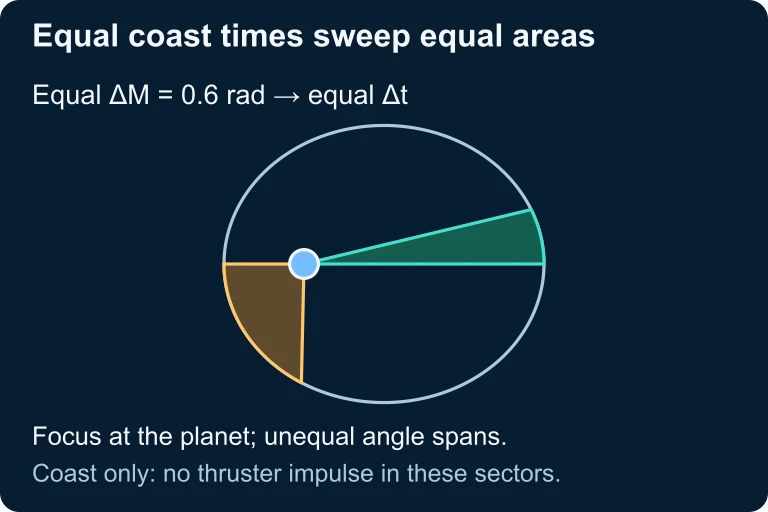 Equal changes of mean anomaly, ΔM = 0.6 rad, correspond to equal coast times and equal swept areas about the occupied focus. The angular span is larger near periapsis.
SECTION 6
Worked Example — Rotational Collision
A uniform thin rod of mass M = 2.0 kg and length L = 1.2 m is pivoted at one end and hangs vertically at rest. A small ball of mass m = 0.50 kg is launched horizontally with speed v₀ = 8.0 m/s and strikes the rod at its free end, embedding itself. Find the angular velocity of the rod-ball system immediately after the collision.
Rotational Collision: Ball Embeds in Pivoted Rod
- 1
Step 1 — Identify the System and Conservation Principle
The system consists of the rod and the ball. The pivot exerts a force, but that force acts at the pivot point (r = 0), so it produces zero torque about the pivot. Gravity also acts, but during the brief collision interval the angular impulse from gravity is negligible. Therefore angular momentum about the pivot is conserved through the collision. - 2
Step 2 — Calculate Initial Angular Momentum
Before the collision, the rod is at rest so its angular momentum is zero. The ball moves horizontally with speed v₀ at a perpendicular distance L from the pivot (it strikes the free end). Its angular momentum about the pivot is: Li = mv₀L = (0.50 kg)(8.0 m/s)(1.2 m).Li = 4.80 kg·m²/s - 3
Step 3 — Calculate Final Moment of Inertia
After the collision, the ball is embedded at the end of the rod. The total moment of inertia about the pivot is: Itotal = Irod + Iball = (1/3)ML² + mL² = (1/3)(2.0)(1.2)² + (0.50)(1.2)² = 0.960 + 0.720.Itotal = 1.68 kg·m² - 4
Step 4 — Apply Conservation and Solve
Setting Li = Lf: mv₀L = Itotalωf. Therefore ωf = Li / Itotal = 4.80 / 1.68.ω_f ≈ 2.86 rad/s - 5
Step 5 — Check: Is Kinetic Energy Conserved?
KEi = ½mv₀² = ½(0.50)(8.0)² = 16.0 J. KEf = ½Itotalω² = ½(1.68)(2.86)² ≈ 6.87 J. The collision is perfectly inelastic (the ball embeds), so kinetic energy is not conserved; about 9.1 J is lost to deformation and heat. This is expected: angular momentum is conserved but mechanical energy is not.ΔKE ≈ −9.1 J (energy lost to inelastic deformation)
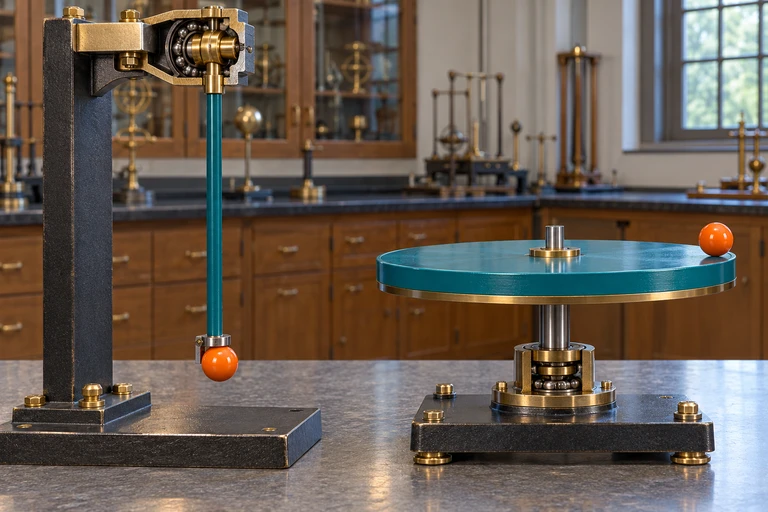 During a short impact, choose the pivot as the angular-momentum reference. Its support force has zero lever arm about that pivot; angular momentum can be conserved even though linear momentum and kinetic energy are not.
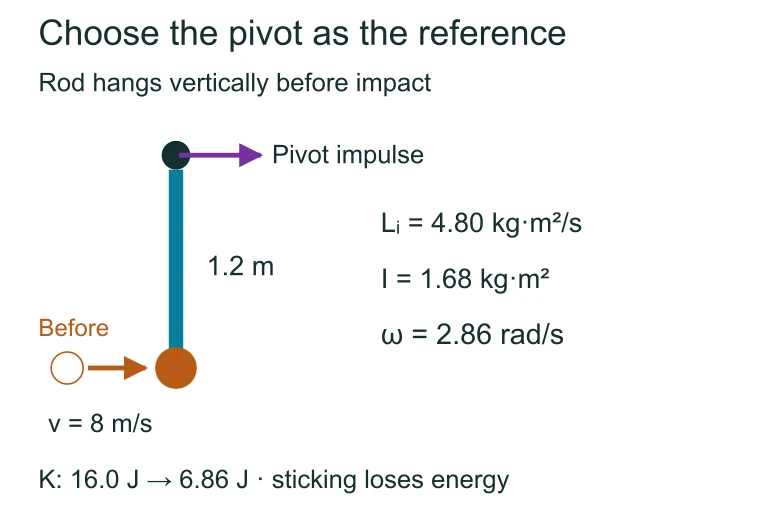 During a short impact, choose the pivot as the angular-momentum reference. Its support force has zero lever arm about that pivot; angular momentum can be conserved even though linear momentum and kinetic energy are not.
SECTION 7
Common Pitfalls & Comparisons
Students frequently make predictable errors when applying angular momentum conservation. The table below compares common correct and incorrect reasoning patterns, as well as the relationship between angular momentum conservation and the conservation of linear momentum and energy.
| Situation / Question | Common Mistake | Correct Reasoning |
|---|---|---|
| Ball strikes pivoted rod: is linear momentum conserved? | Yes—momentum is always conserved in collisions. | No. The pivot exerts an external impulsive force on the system, so linear momentum is not conserved. Angular momentum about the pivot is conserved because the pivot force has zero moment arm. |
| Skater pulls arms in: is kinetic energy conserved? | Yes—no external forces do work. | No. Internal muscular forces do positive work, increasing KE. L is conserved, but KE increases (since KE = L²/2I and I decreases). |
| Choosing the reference point for torque | Any reference point gives the same L. | Angular momentum depends on the chosen reference point. Pick the point where the external forces produce zero torque (typically a pivot or center of mass) to simplify the problem. |
| Disk dropped onto spinning disk | Use I₁ω₁ = I₂ω₂ with I₂ = I₁ (same disk). | I₂ = I₁ + I_dropped because both disks rotate together afterward. The system's total I increases, so ω decreases. |
| Object in orbit: can L change direction? | L is just a number (scalar). | L is a vector. Conservation means both magnitude and direction are fixed. The orbital plane does not precess under a central force. |
Common errors and correct approaches in angular momentum problems
WHEN IS WHAT CONSERVED?
SECTION 8
Connection to Advanced Theory
The conservation of angular momentum as presented in AP Physics C is the tip of a much deeper mathematical iceberg. In Lagrangian and Hamiltonian mechanics, angular momentum conservation is a direct consequence of Noether's theorem: any system whose Lagrangian is invariant under continuous rotations possesses a conserved angular momentum. The table below draws explicit parallels between the AP-level treatment and the more advanced formulations you may encounter in upper-division physics.
| Aspect | AP Physics C Treatment | Advanced / Analytical Mechanics |
|---|---|---|
| Why is L conserved? | Because τ_ext = 0 → dL/dt = 0 | Because the Lagrangian is rotationally symmetric (Noether's theorem) |
| Mathematical object | Scalar L = Iω (about a fixed axis) or vector L = r × p | Component of generalized momentum p_θ = ∂ℒ/∂θ̇ conjugate to cyclic angle θ; tensor = I_ij ω_j for general 3D rotation |
| Precession / gyroscopic motion | Qualitative: torque changes direction of L, causing precession | Euler's equations for rigid body: I₁ω̇₁ − (I₂ − I₃)ω₂ω₃ = τ₁, etc. Precession rate Ω = τ/(Iω) |
| Quantum mechanics | Not addressed | Angular momentum is quantized: L² = ℓ(ℓ+1)ħ², = mℓħ. Rotational symmetry of the Hamiltonian yields conserved quantum numbers. |
AP Physics C angular momentum vs. advanced treatments
For the AP exam, the key takeaway from these advanced connections is conceptual: angular momentum conservation is not merely a useful computational shortcut but reflects a fundamental symmetry of nature. Whenever a physical law looks the same regardless of how you orient your coordinate system, angular momentum is conserved. This deep link between symmetry and conservation is one of the most powerful organizing principles in all of physics, and mastering the AP-level version prepares you to engage with it in greater mathematical generality.
SECTION 9
Practice Problems
Question 1: CONCEPTUAL
- A. ω increases, I decreases, KE stays the same
- B. ω increases, I decreases, KE increases
- C. ω increases, I decreases, KE decreases
- D. ω stays the same, I decreases, KE decreases
Show answer (B)
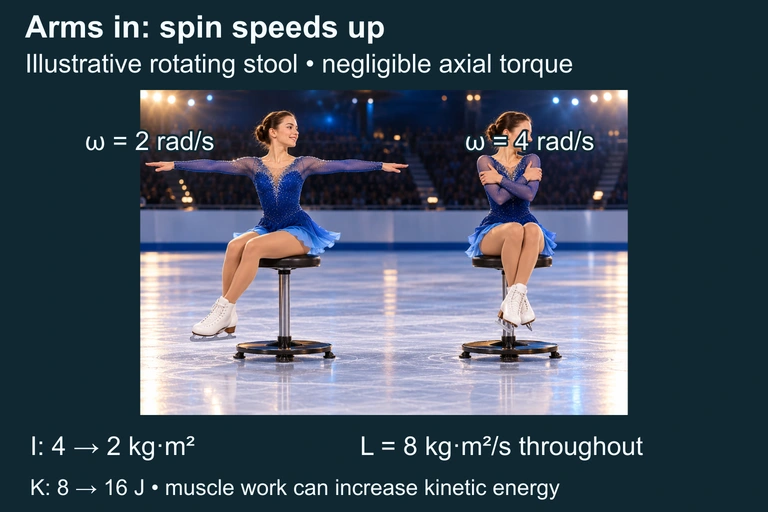 Illustrative arms-in rotation: I decreases from 4 to 2 kg·m² while ω increases from 2 to 4 rad/s, keeping L = 8 kg·m²/s. K increases from 8 to 16 J through internal work.
Question 2: BASIC CALCULATION
- A. 4.0 rad/s
- B. 6.0 rad/s
- C. 8.0 rad/s
- D. 12 rad/s
Show answer (B)
Question 3: INTERMEDIATE
- A. 9.0 rad/s
- B. 12 rad/s
- C. 18 rad/s
- D. 22.5 rad/s
Show answer (A)
Question 4: APPLIED
7 ptsShow answer
Question 5: CRITICAL THINKING
7 ptsShow answer
SUMMARY
Summary
Summary
Angular momentum is the rotational analogue of linear momentum, defined for a particle as L⃗ = r⃗ × p⃗ and for a rigid body rotating about a fixed axis as L = Iω. The rotational form of Newton's second law, τ⃗net = dL⃗/dt, tells us that angular momentum changes only when a net external torque acts. When that torque is zero—whether because all forces pass through the axis, or because the system is isolated—the total angular momentum is conserved: = .
Key application categories include variable-inertia systems (I₁ω₁ = I₂ω₂), rotational collisions (conserve L about the pivot, but KE and linear momentum may not be conserved), and central-force orbits (r₁v₁ = r₂v₂ at turning points). Remember that angular momentum is a vector: conservation applies component by component, and the choice of reference point matters. At its deepest level, this conservation law reflects the rotational symmetry of the physical laws governing the system, a connection formalized by Noether's theorem.