
SECTION 1
Historical Context & Motivation
The study of circular motion sits at the intersection of kinematics and dynamics, bridging the description of curved paths with the forces required to sustain them. Ancient Greek philosophers recognized that celestial bodies traced circular arcs, yet they lacked a coherent framework for explaining why an object moving in a circle requires a continuous inward force. The intellectual journey from Aristotle's notion that circular motion is a "natural" state to Newton's realization that it demands a centripetal acceleration took nearly two millennia, and the resolution profoundly reshaped our understanding of force, inertia, and the structure of the cosmos.
1609 • Kepler's Laws of Planetary Motion
1659 • Huygens and Centripetal Acceleration
1687 • Newton's Principia
1905–1915 • Einstein's Relativity and Non-Inertial Frames
The central question that drives this lesson is deceptively simple: what makes an object move in a circle instead of a straight line? Newton's first law tells us that an object in motion remains in uniform, straight-line motion unless acted upon by a net external force. Circular motion is therefore never "natural" — it always requires a net inward force. Identifying that force, computing the required centripetal acceleration, and applying Newton's second law along the radial direction form the backbone of almost every AP Physics C: Mechanics problem involving curves, loops, orbits, and banked turns.
SECTION 2
Core Principles & Definitions
Before diving into the mathematics, it is essential to anchor several foundational concepts that distinguish circular motion from linear dynamics. An object moving along a circular path of radius r at constant speed v undergoes uniform circular motion. Even though the speed is constant, the velocity vector is continuously changing direction, which means the object is accelerating — a subtlety that trips up many students accustomed to associating acceleration exclusively with changes in speed.
Centripetal Acceleration
Centripetal Force
Angular Velocity (ω)
Non-Uniform Circular Motion
KEY TAKEAWAY
SECTION 3
Visual Explanation — Velocity & Acceleration Vectors
The diagram above illustrates the defining geometric feature of uniform circular motion: the velocity vector v⃗ is always tangent to the circle, while the centripetal acceleration a⃗c points radially inward. Because these two vectors are perpendicular, the acceleration does no work on the particle (the dot product v⃗ · a⃗c = 0), and the kinetic energy — and hence the speed — remains constant. This perpendicularity is not merely a geometric curiosity; it is the physical reason that uniform circular motion at constant speed is possible in the first place. Whenever a tangential component of acceleration appears (non-uniform circular motion), the speed changes, and the total acceleration vector tilts away from the radial direction.
SECTION 4
Mathematical Framework
We now derive the key equations of circular motion from first principles, beginning with kinematics and then connecting to Newton's second law. Consider a particle moving along a circle of radius r. We describe its position using the angle θ measured from a reference axis. In the calculus-based treatment appropriate for AP Physics C, we express the position vector as r⃗(t) = r cos θ(t) x̂ + r sin θ(t) ŷ. Differentiating with respect to time yields the velocity and acceleration vectors, revealing the centripetal acceleration naturally.
CENTRIPETAL ACCELERATION
where v = tangential speed, r = radius, ω = angular velocity (rad/s), T = period. Derived by differentiating the position vector r⃗(t) = r cos(ωt) x̂ + r sin(ωt) ŷ twice with respect to time.
NEWTON'S SECOND LAW — RADIAL
The sum of all radial force components (positive toward center) equals m × centripetal acceleration. This is not a new force — it is the requirement that real forces (gravity, tension, normal, friction) satisfy to produce circular motion.
TANGENTIAL ACCELERATION (NON-UNIFORM)
where α = dω/dt is the angular acceleration. When at ≠ 0, the net acceleration has magnitude |a⃗| = √(ac² + at²) and points at an angle arctan(at/ac) from the radial direction.
VELOCITY–ANGULAR VELOCITY RELATION
Arc length s = rθ (θ in radians). Differentiating: ds/dt = r dθ/dt, giving v = ωr. These relations convert between linear and angular descriptions of circular motion.
Derivation Sketch
SECTION 5
Common Applications & Force Analysis
Circular motion problems on the AP exam typically come in several recurring flavors, each involving a different real force providing the centripetal acceleration. Mastery requires identifying which forces act radially and then applying ΣFradial = mv²/r. Below is a diagram showing the free-body analysis for a vertical loop — one of the most frequently tested scenarios.
| Scenario | Centripetal Force Provider(s) | Key Equation |
|---|---|---|
| Object on a string (horizontal circle) | Horizontal component of tension | T sin θ = mv²/r |
| Car on flat road | Static friction | fs = mv²/r |
| Car on banked turn (no friction) | Normal force component | tan θ = v²/(rg) |
| Vertical loop — top | Weight + Normal force | mg + N = mv²/r |
| Satellite in orbit | Gravitational force | GMm/r² = mv²/r |
Common circular-motion scenarios and their centripetal force sources
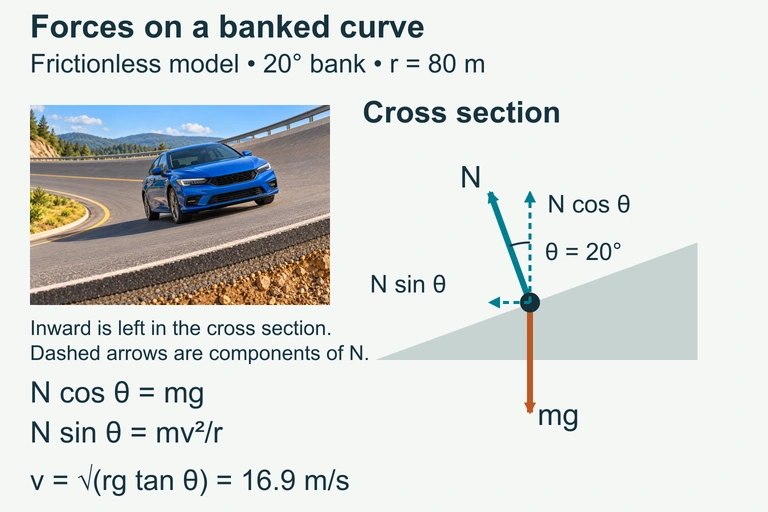 On a frictionless 20° bank of radius 80 m, the normal force has upward component N cos θ = mg and inward component N sin θ = mv²/r. Dashed arrows are components of N, not additional forces. The ideal speed is 16.9 m/s.
 For a car inside a vertical circular track, gravity and the normal force can both point toward the center at the top. Contact requires a nonnegative normal force, giving v ≥ √(gr).
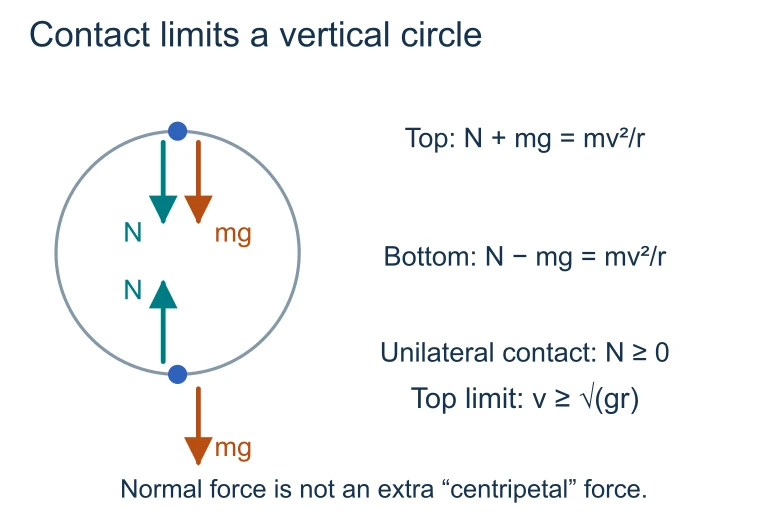 For a car inside a vertical circular track, gravity and the normal force can both point toward the center at the top. Contact requires a nonnegative normal force, giving v ≥ √(gr).
 On a banked turn, static friction points up the bank below the friction-free design speed and down the bank above it. Its magnitude adjusts up to the limiting value μsN.
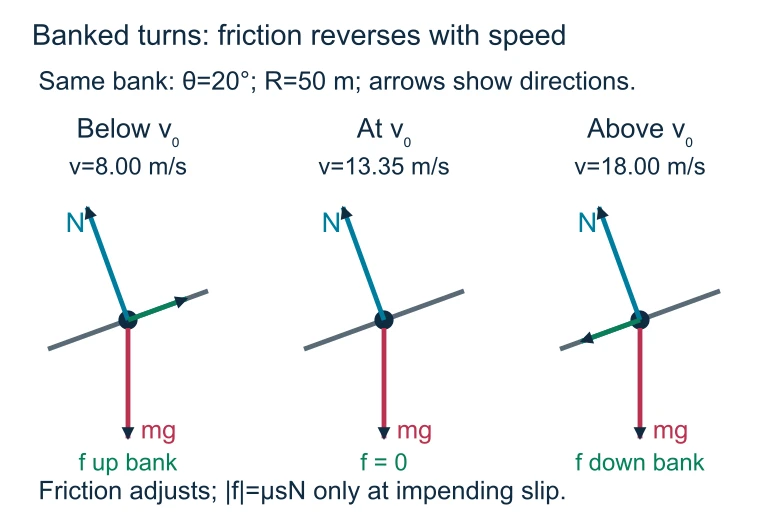 For a 20° bank and a 50 m radius, the friction-free design speed is about 13.35 m/s. The shown 8 m/s case needs friction up the bank and the 18 m/s case needs friction down the bank.
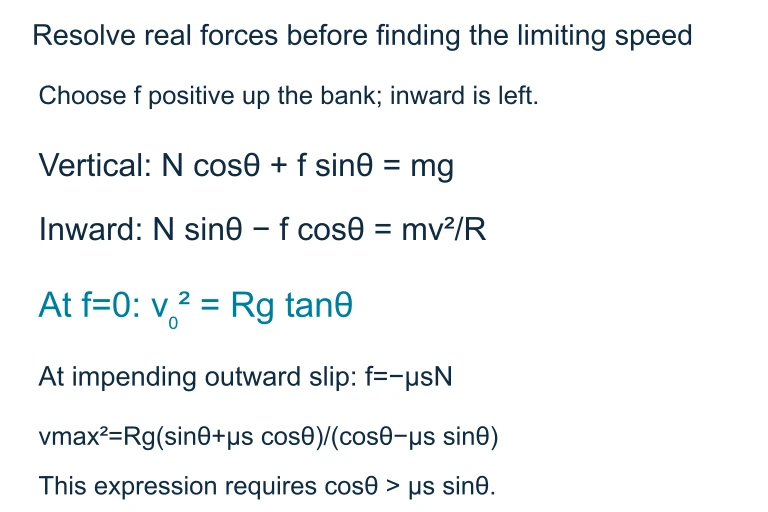 Taking friction positive up the bank gives N cosθ + f sinθ = mg and N sinθ − f cosθ = mv²/R. At impending outward slip, substitute f = −μsN; the displayed maximum-speed expression requires cosθ > μs sinθ.
SECTION 6
Worked Example — Vertical Loop
A 0.50 kg ball is attached to a string of length 0.80 m and swung in a vertical circle. At the top of the loop, the tension in the string is 2.0 N. Find (a) the speed of the ball at the top, (b) the tension at the bottom of the loop (assuming negligible energy loss), and (c) the minimum speed at the top for the string to remain taut.
Vertical Loop — Speed and Tension Analysis
- 1
Step 1 — Draw free-body diagram at the top
At the top, the center of the circle is directly below the ball. Both the tension T and the weight mg point toward the center (downward). Applying Newton's second law in the radial direction (positive toward center): T + mg = mv²top/r. - 2
Step 2 — Solve for speed at the top
Rearranging: v²top = (T + mg)r/m = (2.0 + 0.50 × 9.8)(0.80)/0.50 = (2.0 + 4.9)(0.80)/0.50 = (6.9)(0.80)/0.50 = 11.04 m²/s².vtop = √11.04 ≈ 3.32 m/s - 3
Step 3 — Use energy conservation to find speed at the bottom
Taking the bottom of the loop as the reference height (h = 0), the top is at h = 2r = 1.60 m. By conservation of energy (no friction): ½mv²bot = ½mv²top + mg(2r). Therefore v²bot = v²top + 4gr = 11.04 + 4(9.8)(0.80) = 11.04 + 31.36 = 42.40 m²/s².vbot = √42.40 ≈ 6.51 m/s - 4
Step 4 — Find tension at the bottom
At the bottom, the center is above the ball. The tension points up (toward center) and weight points down (away from center). Newton's second law: Tbot − mg = mv²bot/r. Therefore Tbot = m(v²bot/r + g) = 0.50(42.40/0.80 + 9.8) = 0.50(53.0 + 9.8) = 0.50(62.8).Tbot = 31.4 N - 5
Step 5 — Minimum speed at the top
The string goes slack when T = 0. Setting T = 0 at the top: mg = mv²min/r, so vmin = √(gr) = √(9.8 × 0.80) = √7.84.vmin = 2.80 m/s
SECTION 7
Common Pitfalls & Comparisons
Students frequently make several recurring errors on circular motion problems. Understanding these misconceptions is just as important as mastering the equations, because the AP exam actively tests whether students can distinguish correct physical reasoning from plausible-sounding but incorrect arguments.
| Common Mistake | Why It's Wrong | Correct Approach |
|---|---|---|
| Including 'centripetal force' as a separate force on the FBD | Centripetal force is not a new force — it is the net radial effect of real forces (tension, gravity, normal, friction). | Draw only real forces. Set ΣF_radial = mv²/r. |
| Adding a 'centrifugal force' pointing outward | Centrifugal force is fictitious and only appears in non-inertial (rotating) reference frames. AP Physics C works in inertial frames. | Use Newton's 2nd law in an inertial frame; there is no outward force on the object. |
| Assuming the normal force equals mg in circular motion | N = mg only holds on a flat, non-accelerating surface. In circular motion, N adjusts to provide the needed centripetal acceleration. | Apply Newton's 2nd law radially at each position separately. |
| Confusing centripetal and tangential acceleration | Centripetal acceleration changes direction; tangential acceleration changes speed. They are perpendicular components. | Decompose acceleration: = v²/r (radial) and = dv/dt (tangential). |
| Forgetting that speed varies in a vertical loop | Gravity does work on the object as it moves along the loop, changing KE and therefore speed. | Use energy conservation to relate speeds at different positions before applying F = mv²/r. |
Common circular-motion mistakes and corrections
EXAM STRATEGY
SECTION 8
Connection to Advanced Theory
Uniform circular motion is a special case of a much broader framework. In more advanced mechanics courses and engineering practice, objects follow arbitrary curved paths — ellipses, parabolas, or irregular trajectories. The concept of centripetal acceleration generalizes naturally: at any point on any curved path, the component of acceleration perpendicular to the velocity is v²/ρ, where ρ is the instantaneous radius of curvature at that point. This connects circular motion to the broader study of curvilinear motion using the tangential–normal (TNB) coordinate system studied in multivariable calculus and dynamics.
| Concept | AP Physics C (This Course) | Advanced Mechanics |
|---|---|---|
| Path shape | Circle (fixed radius r) | Arbitrary curve with varying radius of curvature ρ(s) |
| Normal acceleration | = v²/r toward center | = v²/ρ along the unit normal n̂ |
| Reference frame | Inertial (lab) frame | Rotating frames with Coriolis and centrifugal pseudo-forces (Lagrangian/Hamiltonian formulation) |
| Gravitational orbits | Circular orbits: GMm/r² = mv²/r | General conic sections via the orbit equation; vis-viva equation |
| Energy approach | KE + PE conservation | Effective potential with centrifugal barrier: U_eff = U(r) + L²/(2mr²) |
Comparison of circular motion concepts at AP and advanced levels
For now, the AP Physics C exam only requires analysis of circular (and occasionally nearly circular) motion. However, understanding that v²/r is a special case of v²/ρ will give you intuitive leverage on FRQ problems that involve objects transitioning from curved to straight paths (e.g., leaving a circular ramp), where the relevant radius changes from a finite value to infinity at the point of departure. The framework you build here also prepares you for the study of gravitational orbits, which the exam treats in the context of Kepler's laws and the gravitational potential energy U = −GMm/r.
SECTION 9
Practice Problems
Question 1: CONCEPTUAL
- A. Zero, because the speed is constant
- B. Directed tangent to the path in the direction of motion
- C. Directed radially inward toward the center of the circular track
- D. Directed radially outward away from the center of the circular track
Show answer (C)
Question 2: BASIC CALCULATION
- A. 0.25
- B. 0.38
- C. 0.51
- D. 0.64
Show answer (C)
Question 3: INTERMEDIATE
- A. v = √(gL sin θ tan θ)
- B. v = √(gL cos θ)
- C. v = √(gL tan θ)
- D. v = √(gL / (sin θ cos θ))
Show answer (A)
Question 4: APPLIED
7 ptsShow answer
Question 5: CRITICAL THINKING
4 ptsShow answer
SUMMARY
Circular Motion — Summary
Summary
An object in circular motion experiences a continuously changing velocity direction, producing a centripetal acceleration of magnitude ac = v²/r = ω²r directed radially inward. By Newton's second law, the net radial force must equal mv²/r — this is provided by real forces such as tension, gravity, friction, or the normal force. Centripetal force is never a separate entity on a free-body diagram; it is the name given to the net inward component of all actual forces.
In non-uniform circular motion, a tangential acceleration at = dv/dt coexists with the centripetal component, and energy conservation is essential for relating speeds at different positions — particularly in vertical loops where v²bot = v²top + 4gr. Remember: the minimum speed at the top of a vertical loop is vmin = √(gr), and the minimum entry speed at the bottom is √(5gr). Mastering the systematic approach — identify the path, draw the FBD at the specific point, write ΣFradial = mv²/r, and invoke energy conservation when needed — will allow you to solve any circular motion problem on the AP exam.