

SECTION 1
Historical Context & Motivation
The concept of angular momentum has deep roots in the study of celestial mechanics, where early astronomers sought to explain why planets sweep out equal areas in equal times as they orbit the Sun. Although the formal mathematical language took centuries to develop, the intuition that spinning and orbiting objects possess a conserved quantity of rotational motion guided physicists from Kepler's empirical laws through Newton's grand synthesis and beyond. Understanding angular momentum ultimately unified the treatment of translational and rotational dynamics, providing one of the most powerful conservation laws in all of physics.
1609 • Kepler's Second Law
1687 • Newton's Principia
1736 • Euler's Rigid Body Dynamics
1788 • Lagrange's Analytical Mechanics
1918 • Noether's Theorem
The central question that angular momentum addresses is straightforward yet profound: how do we quantify rotational motion, and under what conditions does it change or remain constant? Just as linear momentum p = mv captures translational inertia, angular momentum captures the tendency of a rotating system to keep spinning. The concept of angular impulse—the rotational analog of linear impulse—then answers the follow-up question: what agent changes angular momentum, and by how much? Mastering these ideas is essential for the AP Physics C: Mechanics exam, where problems involving spinning disks, orbiting satellites, and colliding rotational systems appear frequently.
SECTION 2
Core Principles & Definitions
Angular momentum and angular impulse rest on a small set of foundational ideas that mirror their translational counterparts. In translational mechanics, momentum is the product of mass and velocity, and impulse is the integral of force over time. The rotational analogs replace mass with moment of inertia, velocity with angular velocity, and force with torque. By building on these parallels, you can leverage your existing understanding of linear dynamics to master rotational problems efficiently.
Angular Momentum (L)
Torque (τ)
Angular Impulse (J)
Conservation of Angular Momentum
Particle vs. Rigid Body Formulations
KEY TAKEAWAY
SECTION 3
Visual Explanation
Angular Momentum of a Particle and a Rigid Body
The diagram above illustrates the two essential formulations of angular momentum you need for AP Physics C. On the left, a particle of mass m moves with velocity v at position r relative to a chosen reference point O. The angular momentum is L = r × p = r × mv, whose magnitude is mvr sin θ, where θ is the angle between r and p. On the right, a rigid body (here a uniform disk) rotates about a fixed symmetry axis. Every mass element contributes dm·v·r⊥ to the total angular momentum, and summing (integrating) these contributions yields the compact expression L = Iω. Notice that in both cases, the direction of L is determined by the right-hand rule: curl the fingers of your right hand in the direction of rotation (or from r toward p), and your thumb points along L.
SECTION 4
Mathematical Framework
The mathematical treatment of angular momentum and angular impulse rests on the rotational form of Newton's second law. Because this course uses calculus, we express all relationships in differential form and derive the impulse–momentum theorem through integration. These equations are directly tested on the AP exam in both free-response and multiple-choice formats.
ANGULAR MOMENTUM OF A PARTICLE
L = angular momentum vector (kg·m²/s), r = position vector from reference point to particle (m), p = linear momentum (kg·m/s), m = mass (kg), v = velocity (m/s). Magnitude: |L| = mvr sin θ, where θ is the angle between r and v.
ANGULAR MOMENTUM OF A RIGID BODY
I = moment of inertia about the rotation axis (kg·m²), ω = angular velocity (rad/s). This scalar form applies when the rotation axis is a principal axis of symmetry, so L is parallel to ω.
NEWTON'S SECOND LAW FOR ROTATION
τnet = net external torque (N·m). When I is constant, this reduces to τnet = Iα, where α = dω/dt is the angular acceleration. When I varies (e.g., a figure skater changing arm position), the full derivative d(Iω)/dt must be used.
ANGULAR IMPULSE–MOMENTUM THEOREM
J = angular impulse (N·m·s = kg·m²/s). For constant torque, this simplifies to J = τnet × Δt. This is the rotational analog of the linear impulse–momentum theorem ∫F dt = Δp.
Derivation of the Angular Impulse–Momentum Theorem
SECTION 5
Conservation of Angular Momentum & Applications
The conservation of angular momentum is arguably the most heavily tested rotational concept on the AP Physics C exam. When the net external torque on a system is zero, the system's angular momentum remains constant: Iiωi = Ifωf. This result is powerful because it applies even when internal forces redistribute mass, as long as no external torque acts. The classic example is a figure skater who pulls her arms inward: the moment of inertia decreases, so the angular velocity must increase to keep L constant.
| Scenario | What Changes | Why L Is Conserved |
|---|---|---|
| Figure skater pulls in arms | I decreases → ω increases | No external torque about vertical axis; ice friction is negligible |
| Clay drops onto spinning turntable | I increases → ω decreases | Gravity and normal force act through the axis, producing zero torque about it |
| Satellite in elliptical orbit | r changes → v changes | Central gravitational force has zero torque about the focus (r × F = 0) |
| Collapsing star (pulsar formation) | I drops dramatically → ω soars | Self-gravity is internal; no net external torque on the system |
Common conservation of angular momentum scenarios on the AP exam
Exam Tip: Choosing Your Reference Point
 During the brief interaction between the particle and turntable, negligible external torque about the axle makes their total angular momentum constant. Their combined rotational inertia sets the final angular speed.
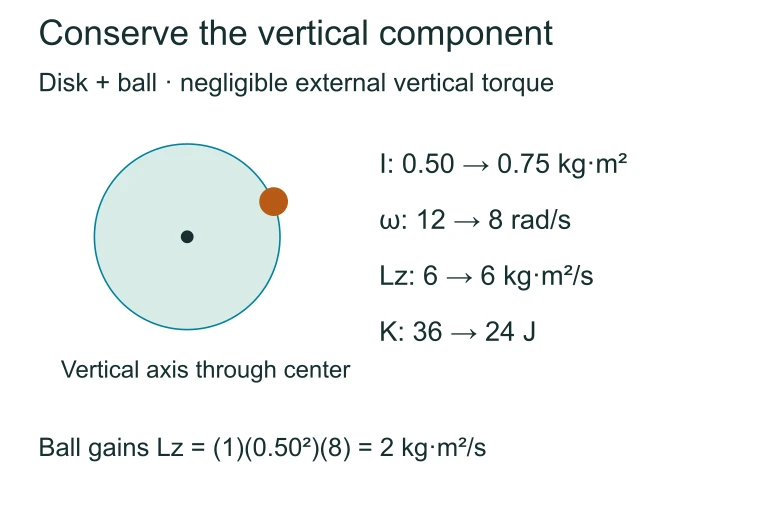 A vertical landing changes the combined inertia from 0.50 to 0.75 kg·m² and angular speed from 12 to 8 rad/s. Axial angular momentum stays 6 kg·m²/s while kinetic energy falls from 36 to 24 J.
SECTION 6
Worked Example
Turntable Collision Problem
A uniform disk of mass M = 4.0 kg and radius R = 0.50 m is spinning freely at ωi = 12 rad/s about a vertical axis through its center. A small ball of mass m = 1.0 kg is dropped vertically onto the rim of the disk and sticks. Find (a) the final angular velocity, (b) the angular impulse delivered to the ball by friction during the collision, and (c) the fraction of kinetic energy lost.
Turntable Collision
- 1
Step 1 — Identify the System and Conservation Law
Take the system as the disk + ball. The only external vertical-axis torques come from the support bearing (frictionless) and gravity, both of which act through the rotation axis and produce zero torque. Therefore, angular momentum about the vertical axis is conserved: Li = Lf. - 2
Step 2 — Compute Initial Angular Momentum
The disk is a uniform solid disk: Idisk = ½MR² = ½(4.0)(0.50)² = 0.50 kg·m². The ball starts with zero angular momentum (dropped vertically onto the rim). Therefore, Li = Idiskωi = (0.50)(12) = 6.0 kg·m²/s.Li = 6.0 kg·m²/s - 3
Step 3 — Compute Final Moment of Inertia
After the ball sticks at the rim, it acts as a point mass at distance R from the axis. Its contribution to the moment of inertia is Iball = mR² = (1.0)(0.50)² = 0.25 kg·m². The total final moment of inertia is If = Idisk + Iball = 0.50 + 0.25 = 0.75 kg·m².If = 0.75 kg·m² - 4
Step 4 — Solve for Final Angular Velocity (Part a)
Conservation of angular momentum gives Idiskωi = Ifωf, so ωf = Li / If = 6.0 / 0.75 = 8.0 rad/s.ωf = 8.0 rad/s - 5
Step 5 — Angular Impulse on the Ball (Part b)
The angular impulse on the ball equals the change in the ball's angular momentum. Initially, the ball has Lball,i = 0. After the collision, Lball,f = Iballωf = (0.25)(8.0) = 2.0 kg·m²/s. Therefore Jball = ΔLball = 2.0 − 0 = 2.0 kg·m²/s. This angular impulse is delivered by the friction between the ball and the disk rim.Jball = 2.0 kg·m²/s - 6
Step 6 — Fraction of Kinetic Energy Lost (Part c)
KEi = ½Idiskωi² = ½(0.50)(12)² = 36 J. KEf = ½Ifωf² = ½(0.75)(8.0)² = 24 J. Fraction lost = (36 − 24)/36 = 12/36 = 1/3 ≈ 33%. This energy is converted to heat by the friction that brings the ball up to speed.Fraction lost = 1/3 ≈ 33%
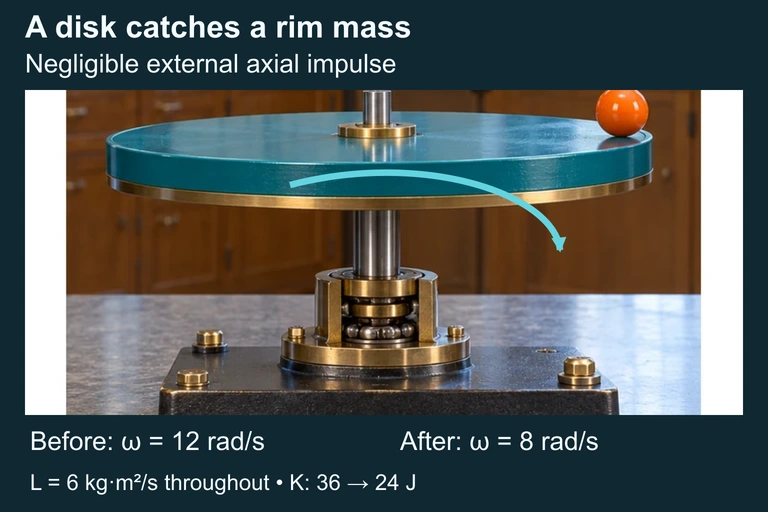 A disk catches a mass dropped vertically onto its rim. With negligible external axial impulse, total L remains 6 kg·m²/s as ω decreases from 12 to 8 rad/s. The required ledger shows disk L falling from 6 to 4 and ball L rising from 0 to 2; K falls from 36 to 24 J.
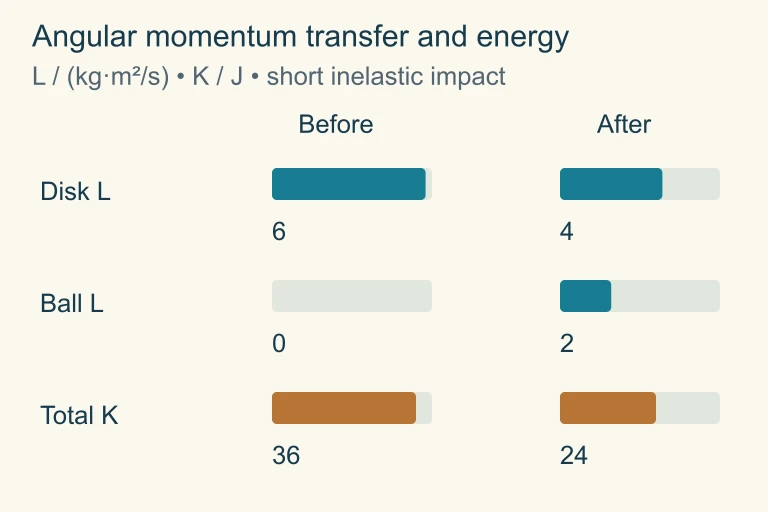 I_disk = 0.50 kg·m²; I_ball = 0.25 kg·m²; combined I = 0.75 kg·m². Disk angular momentum changes from 6 to 4 kg·m²/s and ball angular momentum from 0 to 2 kg·m²/s. Friction supplies angular impulses J_ball = +2 kg·m²/s and J_disk = −2 kg·m²/s. Total L remains 6 kg·m²/s; K decreases from 36 J to 24 J. The mass is dropped vertically onto the rim, and external axial impulse is negligible.
SECTION 7
Linear vs. Rotational Analogs
One of the most effective study strategies for AP Physics C is to exploit the deep structural parallel between linear and rotational mechanics. Every linear quantity has a rotational counterpart, and every linear equation has an angular analog. The table below maps these correspondences for the momentum and impulse relationships, making it easier to transfer your intuition from one domain to the other.
| Concept | Linear | Rotational |
|---|---|---|
| Inertia | Mass m (kg) | Moment of inertia I (kg·m²) |
| Velocity | v (m/s) | ω (rad/s) |
| Momentum | p = mv | L = Iω |
| Force / Torque | F (N) | τ (N·m) |
| Newton's 2nd Law | F = dp/dt | τ = dL/dt |
| Impulse | J = ∫F dt = Δp | J = ∫τ dt = ΔL |
| Conservation Condition | F_ext = 0 → p = const | τ_ext = 0 → L = const |
| Kinetic Energy | ½mv² | ½Iω² |
Complete linear–rotational analogy table for momentum and impulse
KEY TAKEAWAY
Common Pitfall: Inelastic Rotational Collisions
SECTION 8
Connections to Advanced Theory
While the AP Physics C exam focuses on angular momentum about fixed axes, the full vector treatment extends into more sophisticated territory that you may encounter in university-level mechanics courses. Understanding where the AP curriculum fits within the broader theoretical landscape will deepen your conceptual understanding and prepare you for physics beyond the exam.
| AP Physics C Level | University / Advanced Level |
|---|---|
| L = Iω (scalar, fixed axis) | L = Ĩω (tensor equation, L may not be parallel to ω for non-principal axes) |
| τ = dL/dt in the lab frame | Euler's equations of motion in the body frame, accounting for rotating reference frames |
| Conservation when τ_ext = 0 | Noether's theorem: L conservation ↔ rotational symmetry of the Lagrangian |
| L = r × p for a particle | Generalized angular momentum as ∂L/∂(dθ/dt) in Lagrangian mechanics |
| Precession mentioned qualitatively | Full gyroscopic precession and nutation analysis via Euler angles |
AP-level concepts and their advanced generalizations
One particularly elegant result is gyroscopic precession. When a spinning top or gyroscope is subjected to a torque (due to gravity acting on its center of mass), its angular momentum vector does not simply decrease—it rotates in a direction perpendicular to both L and τ. This is because τ = dL/dt points horizontally, causing L to sweep out a cone. The precession rate Ω = τ/L sin θ = Mgd/(Iω sin θ), where d is the distance from the pivot to the center of mass. While full derivations are beyond the AP exam, a qualitative understanding of precession is valuable, and the underlying principle—that torque changes the direction of L, not its magnitude—is a direct consequence of the vector nature of angular momentum.
Looking Ahead
SECTION 9
Practice Problems
Question 1: CONCEPTUAL
- A. The angular momentum increases because the sphere gains gravitational potential energy.
- B. The angular momentum remains constant because the sphere rolls without slipping.
- C. The angular momentum decreases because the net torque about the center of mass opposes the angular velocity.
- D. The angular momentum decreases because gravity exerts a torque about the center of mass.
Show answer (C)
Question 2: BASIC CALCULATION
- A. 10 kg·m²/s
- B. 16 kg·m²/s
- C. 40 kg·m²/s
- D. 80 kg·m²/s
Show answer (C)
Question 3: INTERMEDIATE
- A. 2.9 kg·m²/s
- B. 4.3 kg·m²/s
- C. 5.1 kg·m²/s
- D. 7.2 kg·m²/s
Show answer (D)
Question 4: APPLIED
10 ptsShow answer
Question 5: CRITICAL THINKING
7 ptsShow answer
SUMMARY
Summary & Review
Summary
Angular momentum quantifies the rotational motion of a system. For a particle, L = r × p, and for a rigid body rotating about a fixed axis, L = Iω. The rotational form of Newton's second law, τ_net = dL/dt, connects net external torque to the rate of change of angular momentum. Integrating this relationship over time yields the angular impulse–momentum theorem: J = ∫τ dt = ΔL, the rotational analog of ∫F dt = Δp.
When the net external torque is zero, angular momentum is conserved: Iiωi = Ifωf. This principle governs figure skaters, turntable collisions, planetary orbits, and collapsing stars. In inelastic rotational collisions, angular momentum is conserved but kinetic energy is not—always compute KE separately. Master the linear-to-rotational analogy (m → I, v → ω, F → τ, p → L) to efficiently translate between the two domains on the AP exam.