01 / 20

Wave Interference
and Standing Waves

Explore how waves combine, create patterns of constructive and destructive interference, and form standing waves with nodes and antinodes.

AP Physics 2

What Is Wave Interference?

When two or more waves travel through the same medium at the same time, their displacements add together at every point. This phenomenon is called superposition, and the resulting combined wave pattern is called interference.

Constructive vs Destructive Interference

Constructive
Waves arrive in phase: crests align with crests. Amplitudes add, producing a larger resultant wave.
Destructive
Waves arrive out of phase: crests align with troughs. Amplitudes cancel, producing a smaller (or zero) resultant wave.
Constructive Result: 2A amplitude Destructive Result: zero amplitude

Path Difference and Phase

Whether interference is constructive or destructive depends on the path difference \( \Delta x \) between the two waves compared to the wavelength \( \lambda \).

Constructive
\( \Delta x = m\lambda \) where \( m = 0, \pm1, \pm2, \ldots \)
Destructive
\( \Delta x = \left(m + \tfrac{1}{2}\right)\lambda \) where \( m = 0, \pm1, \pm2, \ldots \)

What Are Standing Waves?

When two waves of equal amplitude and frequency travel in opposite directions through the same medium, they superpose to form a standing wave: a pattern that oscillates in place rather than traveling.

N N N A A A N = Node (zero displacement) A = Antinode (max displacement)

The Standing Wave Equation

If two identical waves travel in opposite directions:

Their superposition gives the standing wave:

Here \( 2A\sin(kx) \) is the spatial amplitude envelope. Nodes occur where \( \sin(kx) = 0 \), i.e. \( x = \frac{m\lambda}{2} \). Antinodes occur where \( |\sin(kx)| = 1 \), i.e. \( x = \frac{(2m+1)\lambda}{4} \).

Boundary Conditions and Harmonics

Standing waves form only at specific frequencies called harmonics or resonant frequencies. The allowed wavelengths depend on the boundary conditions.

Both Ends Fixed
\( \lambda_n = \frac{2L}{n} \) and \( f_n = \frac{nv}{2L} \) for \( n = 1, 2, 3, \ldots \)
One End Open
\( \lambda_n = \frac{4L}{n} \) and \( f_n = \frac{nv}{4L} \) for odd \( n = 1, 3, 5, \ldots \)

A water-column resonance experiment with the air length exposed

Two open resonance tubes connect by hoses to adjustable water reservoirs,with tuning forks held above their open mouths.Successive resonances of the air column differ in length by half a wavelength. Comparing the two lengths cancels a common open-end correction when the tube geometry stays fixed.

Successive air-column resonances
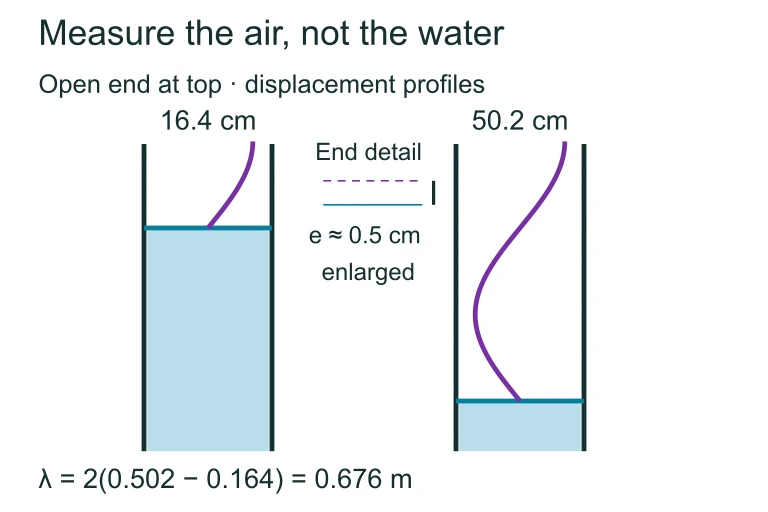
Successive air-column resonances. Resonance lengths 16.4 cm and 50.2 cm differ by half a wavelength, giving λ = 0.676 m. At 512 Hz, the sound speed is about 346.1 m/s; the common end correction is about 0.5 cm.Resonance lengths 16.4 cm and 50.2 cm differ by half a wavelength, giving λ = 0.676 m. At 512 Hz, the sound speed is about 346.1 m/s; the common end correction is about 0.5 cm.

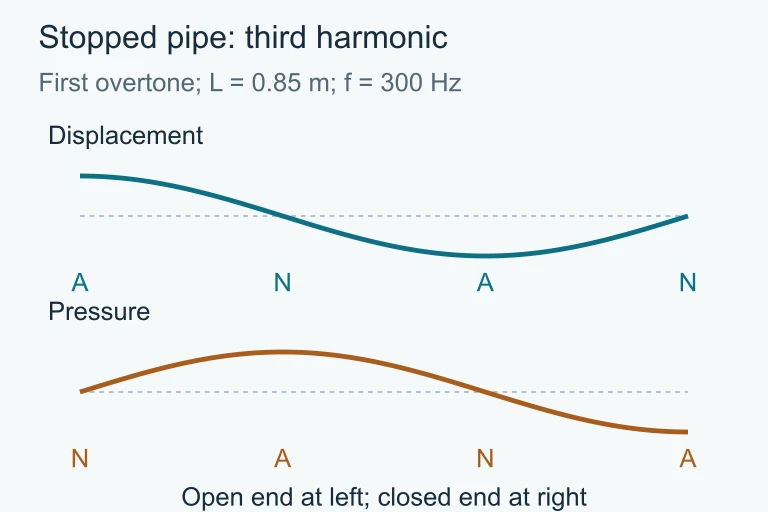
Pressure and displacement in an air column
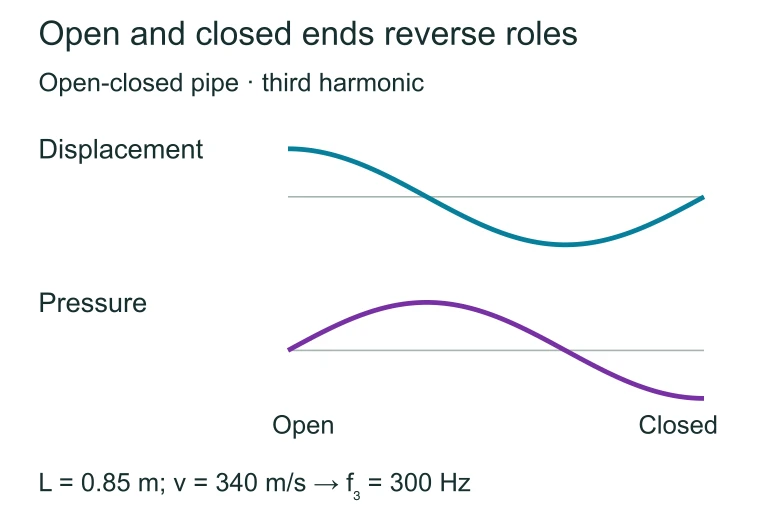
Pressure and displacement in an air column. In an open–closed pipe, displacement has an antinode at the open end and a node at the closed end; pressure reverses those roles. For L = 0.85 m and v = 340 m/s, the third harmonic is 300 Hz.In an open–closed pipe, displacement has an antinode at the open end and a node at the closed end; pressure reverses those roles. For L = 0.85 m and v = 340 m/s, the third harmonic is 300 Hz.

Harmonics on a Fixed String

n=1
\( L = \frac{\lambda}{2} \)
n=2
\( L = \lambda \)
n=3
\( L = \frac{3\lambda}{2} \)
Fixed Fixed

A separate fixed-string example

For an ideal fixed-end string with length 1 m and wave speed 31.62 m/s, the first two mode frequencies are 15.81 Hz and 31.62 Hz. The dots are displacement nodes.
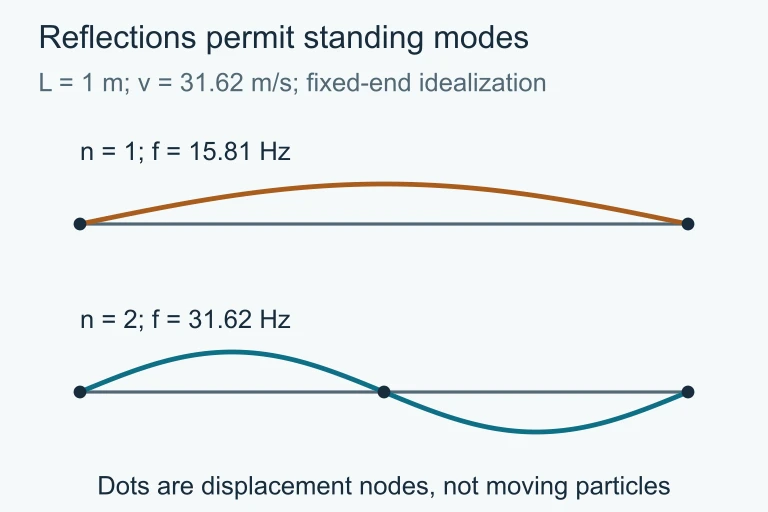
Fixed 1 m string n 1/n 2 have 15.81/31.62 Hz,2/3 nodes and 1/2 antinodes.
Fixed-end ideal standing modes; nodes mark zero displacement.

Travelling vs Standing Waves

Travelling Wave Standing Wave
Energy Transports energy No net energy transport
Amplitude Same at all points Varies: zero at nodes, max at antinodes
Phase Phase changes continuously along propagation All points between adjacent nodes oscillate in phase
Formation Single wave source Two identical waves in opposite directions
Equation \( y = A\sin(kx - \omega t) \) \( y = 2A\sin(kx)\cos(\omega t) \)

How to Analyze Standing Waves

1
Identify boundary conditions: Are both ends fixed? One open? Both open?
2
Determine the harmonic number \( n \): Count the number of half-wavelengths (fixed-fixed) or quarter-wavelengths (fixed-open) fitting in the length.
3
Calculate wavelength: Use \( \lambda_n = \frac{2L}{n} \) (fixed-fixed) or \( \lambda_n = \frac{4L}{n} \) (fixed-open, odd \( n \)).
4
Find frequency: Apply \( f_n = \frac{v}{\lambda_n} \) where \( v \) is the wave speed in the medium.
5
Locate nodes and antinodes: Nodes are at \( \frac{m\lambda}{2} \) from a fixed end. Antinodes are midway between nodes.

Example 1: Guitar String

A guitar string of length \( L = 0.65 \) m is fixed at both ends. The wave speed on the string is \( v = 325 \) m/s. Find the fundamental frequency and the frequency of the third harmonic.

Example 2: Open Pipe

An organ pipe is closed at one end and open at the other. Its length is \( L = 0.50 \) m and the speed of sound is \( v = 340 \) m/s. Find the first three resonant frequencies.

Comparing pipe ends

This separate comparison uses 0.85 m pipes and 340 m/s sound speed. The existing worked example uses a 0.50 m pipe. The open–closed pipe’s third harmonic is its first overtone.
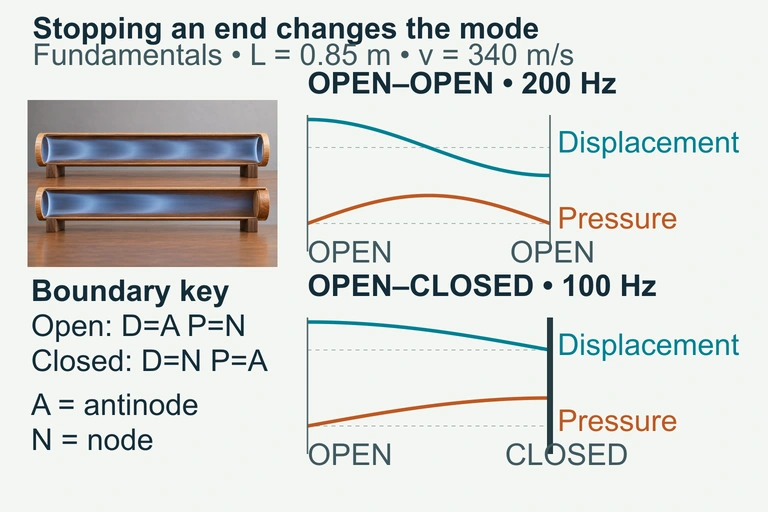
Complementary displacement and pressure boundary conditions; open–open 200 Hz, open–closed 100 Hz for L=0.85 m and v=340 m/s.
Fundamental displacement and pressure amplitude profiles for ideal equal-length open and stopped pipes. D means displacement, P means pressure, A antinode and N node; vertical height is normalized amplitude, not sideways air motion.
For an open–closed pipe, the first overtone is the third harmonic: f3 = 3v/(4L) = 300 Hz for v = 340 m/s and L = 0.85 m. Displacement and pressure nodes are complementary; the pipe is open left and closed right.

Example 3: Double-Slit Interference

Two speakers separated by \( d = 2.0 \) m emit sound waves of frequency \( f = 680 \) Hz in phase. The speed of sound is \( v = 340 \) m/s. At what path difference does a listener hear destructive interference?

Common Mistakes

✕ Using Even Harmonics for Closed Pipes
A pipe closed at one end supports only odd harmonics (\( n = 1, 3, 5, \ldots \)). Using \( n = 2 \) gives a non-existent resonance.
✕ Confusing Node and Antinode
A fixed end is always a node. An open end is always an antinode. Swapping them changes the entire harmonic series.
✕ Wrong Formula Selection
Using \( f_n = \frac{nv}{2L} \) for a closed pipe (should be \( \frac{nv}{4L} \)) or vice versa gives frequencies off by a factor of 2.

Summary of Key Formulas

Scenario Wavelength Frequency Allowed \( n \)
Both ends fixed \( \frac{2L}{n} \) \( \frac{nv}{2L} \) 1, 2, 3, ...
Both ends open \( \frac{2L}{n} \) \( \frac{nv}{2L} \) 1, 2, 3, ...
One end closed \( \frac{4L}{n} \) \( \frac{nv}{4L} \) 1, 3, 5, ... (odd only)
Constructive \( \Delta x = m\lambda \) \( m = 0, \pm1, \pm2, \ldots \)
Destructive \( \Delta x = (m + \tfrac{1}{2})\lambda \) \( m = 0, \pm1, \pm2, \ldots \)

Question 1 of 5

Two waves of equal amplitude \( A \) interfere constructively. What is the amplitude of the resultant wave?

Question 2 of 5

A string fixed at both ends has length \( L = 1.2 \) m. For the third harmonic, what is the wavelength?

Question 3 of 5

A pipe closed at one end has a fundamental frequency of 85 Hz. What is the frequency of its next allowed harmonic?

Question 4 of 5

Two speakers emit identical 440 Hz waves. The speed of sound is 340 m/s. What is the minimum path difference for destructive interference?

Question 5 of 5

In a standing wave on a string, the distance between two consecutive nodes is 0.30 m. What is the wavelength of the standing wave?