Thin-Film
Interference
Discover how light waves reflecting from thin coatings produce vivid colors: from soap bubbles to anti-reflective lenses, governed by path difference and phase shifts.
What Is Thin-Film Interference?
When light hits a thin transparent layer, part of the wave reflects from the top surface and part transmits through, reflects off the bottom surface, and exits again. These two reflected waves overlap and interfere.
Thin Films in Everyday Life
Key Physics Concepts
The Phase Shift Rule
The Core Equations
Destructive: \( 2\,n\,t = \left(m + \tfrac{1}{2}\right)\lambda \)
Destructive: \( 2\,n\,t = m\,\lambda \)
When Does a Phase Shift Occur?
A reflected wave undergoes a \( \frac{1}{2}\lambda \) phase inversion if and only if it reflects off a medium with a higher index of refraction.
| Reflection | Condition | Phase Shift |
|---|---|---|
| Low \( n \) → High \( n \) | \( n_1 < n_2 \) | \( \frac{1}{2}\lambda \) inversion |
| High \( n \) → Low \( n \) | \( n_1 > n_2 \) | No phase shift |
0 or 2 vs 1 Inversion
The equations for constructive and destructive interference swap depending on the number of phase-inverting reflections. Always determine this first.
| Setup | Inversions | Constructive | Destructive |
|---|---|---|---|
| Air / Film / Glass (\( n_{\text{air}} < n_f < n_g \)) |
2 | \( 2nt = m\lambda \) | \( 2nt = (m+\tfrac{1}{2})\lambda \) |
| Air / Film / Air (\( n_{\text{air}} < n_f > n_{\text{air}} \)) |
1 | \( 2nt = (m+\tfrac{1}{2})\lambda \) | \( 2nt = m\lambda \) |
| Glass / Film / Air (\( n_g > n_f > n_{\text{air}} \)) |
0 | \( 2nt = m\lambda \) | \( 2nt = (m+\tfrac{1}{2})\lambda \) |
How to Solve a Thin-Film Problem
Example 1: Soap Bubble
A soap film (\( n = 1.33 \)) in air appears bright green (\( \lambda = 532 \) nm) in reflected light. Find the minimum thickness of the film.
Example 2: Anti-Reflective Coating
A MgF\(_2\) coating (\( n = 1.38 \)) is applied to glass (\( n = 1.52 \)). What minimum thickness minimizes reflection of \( \lambda = 550 \) nm light?
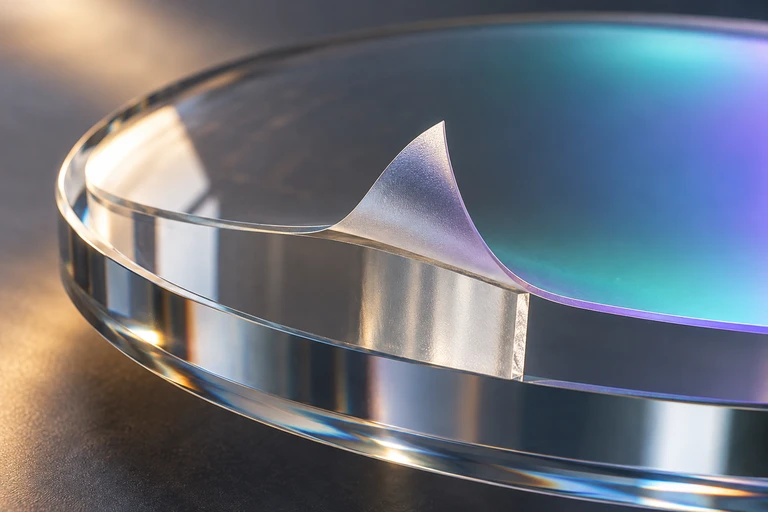
A lens coating seen as a nanoscale layered material
 At normal incidence, both reflections in this air–MgF₂–glass film undergo a phase inversion. A quarter-wave optical thickness minimizes reflection near the design wavelength; incomplete amplitude matching leaves a nonzero minimum.
Quarter-wave phase cancellation requires amplitude matching for zero design-wavelength reflection.
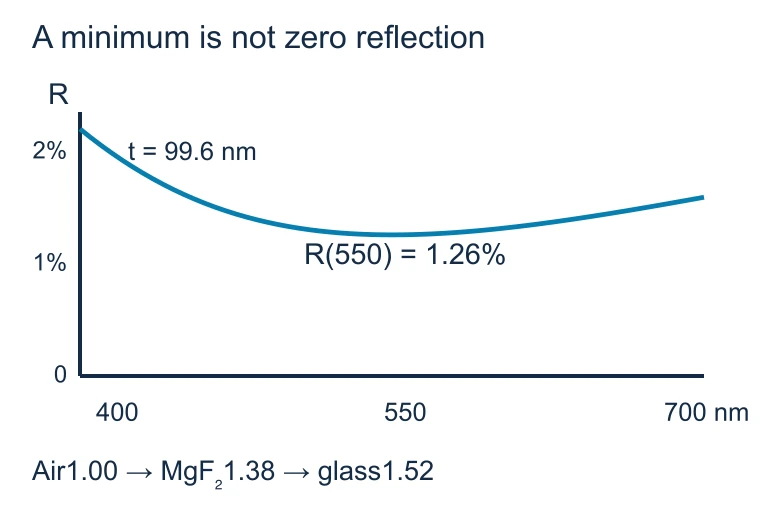 At normal incidence, both reflections in this air–MgF₂–glass film undergo a phase inversion. A quarter-wave optical thickness minimizes reflection near the design wavelength; incomplete amplitude matching leaves a nonzero minimum.
Example 3: Finding the Wavelength
An oil film (\( n = 1.45 \)) on water (\( n = 1.33 \)) is 200 nm thick. Which visible wavelength is most strongly reflected?
Minimum vs Higher-Order Thickness
Problems often ask for the minimum non-zero thickness. That corresponds to the smallest allowed value of \( m \). But thicker films can also satisfy the condition at higher orders.
Wedge Films and Newton's Rings
When a thin film varies in thickness, different locations satisfy the constructive or destructive condition for different wavelengths. This produces alternating bright and dark fringes.
Common Mistakes
Summary Reference
| Quantity | Symbol / Formula | Notes |
|---|---|---|
| Optical path difference | \( 2\,n\,t \) | Extra distance in vacuum-equivalent units |
| Phase shift per reflection | \( 0 \) or \( \tfrac{1}{2}\lambda \) | \( \frac{1}{2}\lambda \) when reflecting off higher \( n \) |
| Constructive (0 or 2 inv.) | \( 2nt = m\lambda \) | \( m = 0, 1, 2, \ldots \) |
| Destructive (0 or 2 inv.) | \( 2nt = (m+\tfrac{1}{2})\lambda \) | \( m = 0, 1, 2, \ldots \) |
| Constructive (1 inv.) | \( 2nt = (m+\tfrac{1}{2})\lambda \) | Equations swap! |
| Destructive (1 inv.) | \( 2nt = m\lambda \) | Equations swap! |
| Min. thickness (1 inv., constr.) | \( t = \dfrac{\lambda}{4n} \) | Set \( m = 0 \) |
Question 1 of 5
A soap film (\( n = 1.33 \)) in air appears bright at its minimum thickness. How many phase-inverting reflections occur?
Question 2 of 5
For a thin film with one phase-inverting reflection, which equation gives constructive interference?
Question 3 of 5
A MgF\(_2\) coating (\( n = 1.38 \)) on glass (\( n = 1.52 \)) should eliminate reflection of \( \lambda = 550 \) nm light. What is the minimum coating thickness?
Question 4 of 5
An oil film (\( n = 1.45 \)) on water (\( n = 1.33 \)) is 200 nm thick. For which vacuum wavelength is reflected light most strongly enhanced?
Question 5 of 5
A student uses the equation \( 2nt = m\lambda \) for a soap bubble in air and claims it gives constructive interference. What is wrong?