Thermal Energy Transfer
and Equilibrium
Master the physics of heat flow, the three modes of transfer, and how systems reach thermal equilibrium governed by \( Q = mc\Delta T \).
What is Thermal Energy?
Thermal energy is the total kinetic energy of all particles in a substance due to their random motion. It depends on temperature, mass, and the type of substance.
Three Modes of Heat Transfer
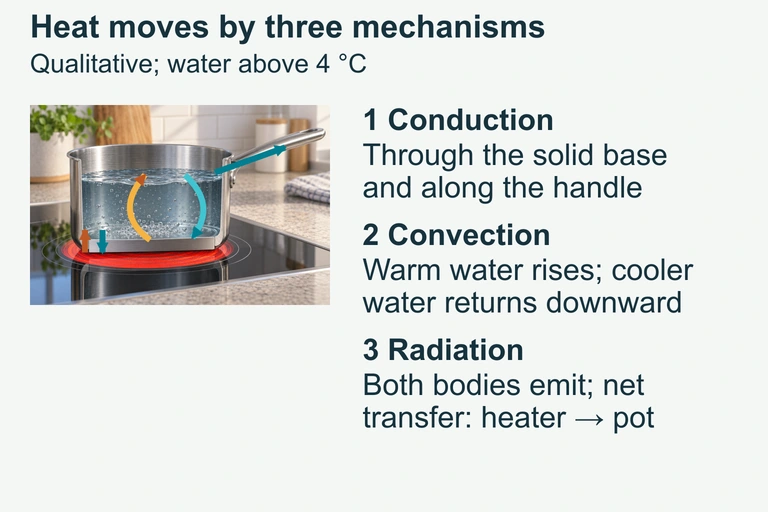
Three heat-transfer mechanisms
This qualitative liquid-circulation model is distinct from boiling bubbles; both heater and pot radiate, with net radiation from hotter heater to cooler pot.
The Zeroth Law of Thermodynamics
If system A is in thermal equilibrium with system C, and system B is also in thermal equilibrium with system C, then A and B are in thermal equilibrium with each other.
The Calorimetry Equation
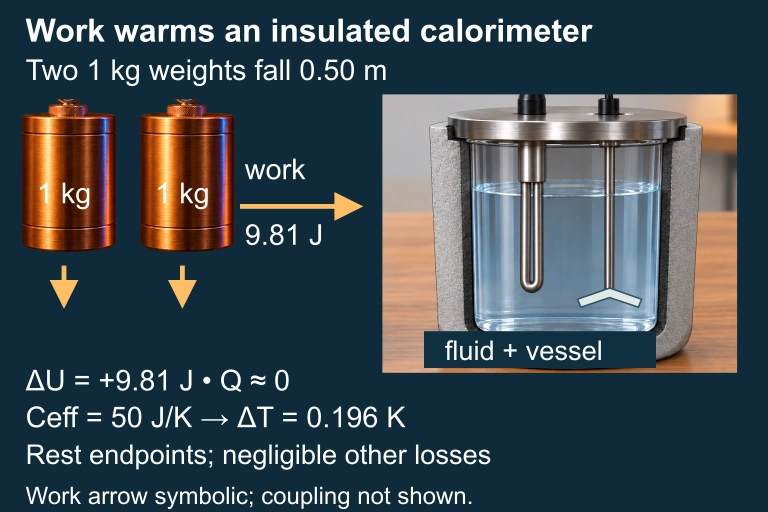
Work warms an insulated system
This separate model transfers 9.81 J from falling weights into the fluid and vessel with negligible heat transfer.
Thermal Equilibrium Condition
When two objects at different temperatures are placed in contact in an isolated system, heat flows from hot to cold until both reach the same final temperature \( T_f \).
An insulated cup with a visible phase-change checkpoint
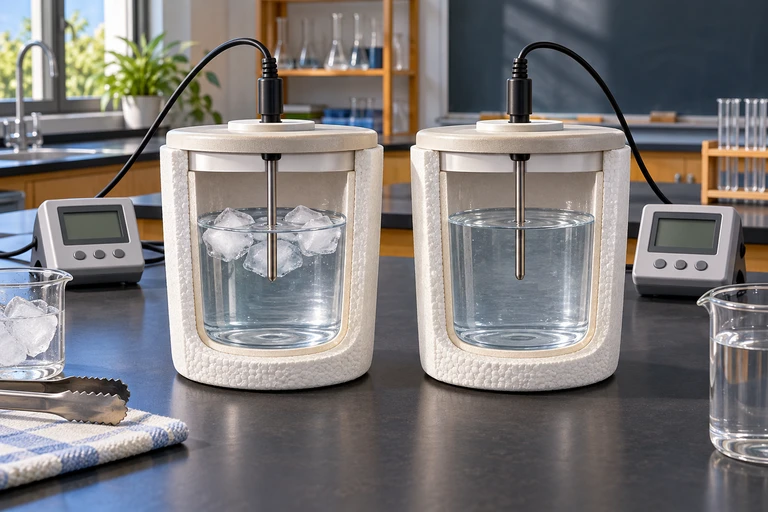
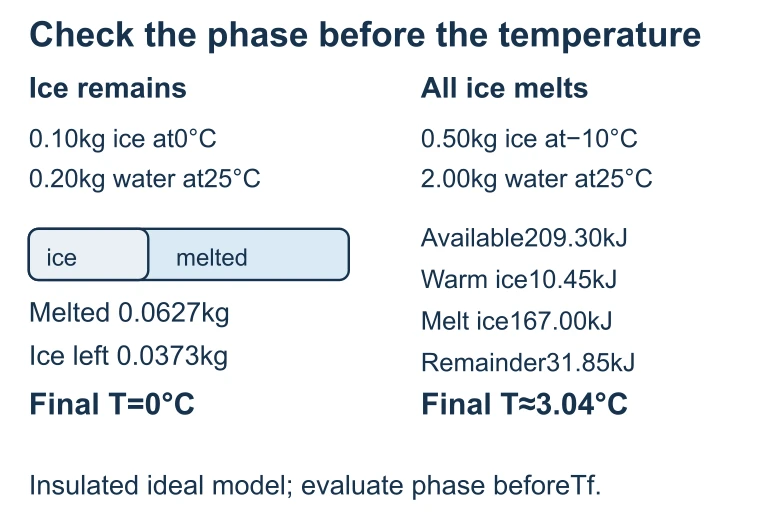
Before finding the final temperature of an ice–water mixture, compare the heat available from cooling the warm water with the energy required to melt the ice.Check the phase before the temperature
Before finding the final temperature of an ice–water mixture, compare the heat available from cooling the warm water with the energy required to melt the ice.Specific Heat Capacity
Specific heat capacity \( c \) tells you how much energy is needed to raise \(1\ \text{kg}\) of a substance by \(1\ \text{K}\). A higher \( c \) means the substance resists temperature change.
| Substance | \( c \) (\(\text{J/kg}\cdot\text{K}\)) | Implication |
|---|---|---|
| Water | 4186 | Heats and cools slowly |
| Aluminum | 900 | Moderate thermal response |
| Copper | 385 | Heats and cools quickly |
| Lead | 128 | Very rapid temperature change |
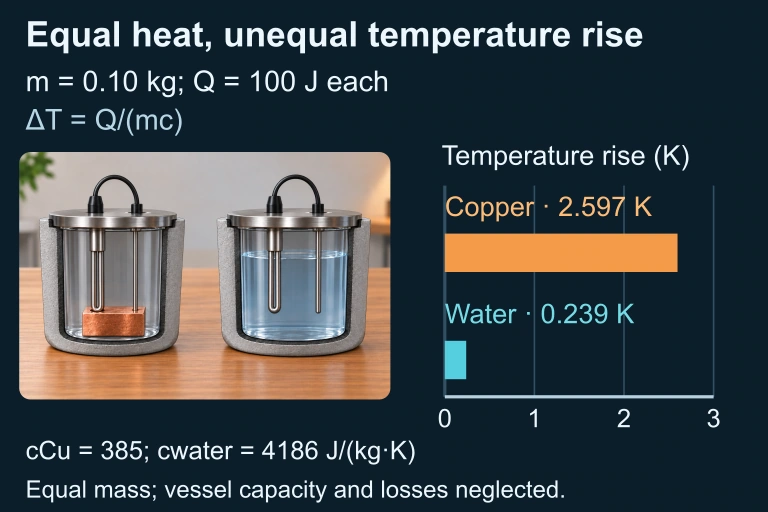
Separate equal-heat comparison
Neglecting heat losses and vessel heat capacity, each 0.10 kg sample receives 100 J. Equal masses do not imply equal volumes.
Compare the temperature rises of copper and water for c = 385 and 4186 J/(kg·K), respectively.
Show answer and explanation
Using ΔT = Q/(mc), copper rises about 2.597 K and water about 0.239 K. This compares specific heat, not thermal conductivity.
Conduction vs Convection vs Radiation
| Property | Conduction | Convection | Radiation |
|---|---|---|---|
| Medium required? | Solid (best) | Fluid (liquid/gas) | None |
| Mechanism | Molecular collisions | Bulk fluid motion | EM waves |
| Rate law | \( \frac{dQ}{dt} = kA\frac{\Delta T}{L} \) | \( \frac{dQ}{dt} = hA\Delta T \) | \( P = \varepsilon\sigma A T^4 \) |
| Example | Metal spoon in soup | Boiling water | Sunlight warming Earth |
Fourier's Law of Conduction
\( k \) = thermal conductivity (\(\text{W/m}\cdot\text{K}\)). Metals have high \( k \): copper is \(385 \ \text{W/m}\cdot\text{K}\). Insulators like styrofoam: \(\approx 0.03 \ \text{W/m}\cdot\text{K}\).
How to Solve Equilibrium Problems
Example 1: Finding \( T_f \)
A \(0.5\ \text{kg}\) block of copper at \(100\,{}^\circ\text{C}\) is dropped into \(2.0\ \text{kg}\) of water at \(20\,{}^\circ\text{C}\). Find the equilibrium temperature. (\( c_{\text{Cu}} = 385 \ \text{J/kg}\cdot\text{K} \), \( c_w = 4186 \ \text{J/kg}\cdot\text{K} \))
Example 2: Finding Specific Heat
A \(0.3\ \text{kg}\) unknown metal at \(200\,{}^\circ\text{C}\) is placed in \(0.5\ \text{kg}\) of water at \(22\,{}^\circ\text{C}\). Equilibrium is reached at \(25\,{}^\circ\text{C}\). Find the metal's specific heat.
Example 3: Conduction Rate
A glass window is \(0.5\ \text{cm}\) thick with area \(2.0\ \text{m}^2\). The inside surface is at \(20\,{}^\circ\text{C}\) and the outside is at \(-5\,{}^\circ\text{C}\). Glass has \( k = 0.80 \ \text{W/m}\cdot\text{K} \). Find the rate of heat loss.
Radiation and the Stefan-Boltzmann Law
Common Mistakes
Summary of Key Equations
| Concept | Equation | Key Variable |
|---|---|---|
| Calorimetry | \( Q = mc\Delta T \) | \( c \): specific heat |
| Equilibrium | \( \sum Q_i = 0 \) | \( T_f \): final temp |
| Conduction | \( \frac{dQ}{dt} = kA\frac{\Delta T}{L} \) | \( k \): conductivity |
| Radiation | \( P = \varepsilon\sigma A T^4 \) | \( T \) in Kelvin |
| Convection | \( \frac{dQ}{dt} = hA\Delta T \) | \( h \): transfer coeff. |
Question 1 of 5
A \(1.0\ \text{kg}\) block of iron (\( c = 450 \ \text{J/kg}\cdot\text{K} \)) at \(80\,{}^\circ\text{C}\) is placed in \(2.0\ \text{kg}\) of water (\( c = 4186 \ \text{J/kg}\cdot\text{K} \)) at \(20\,{}^\circ\text{C}\). What is the approximate equilibrium temperature?
Question 2 of 5
Which mode of heat transfer does not require a material medium?
Question 3 of 5
If the absolute temperature of a blackbody is doubled, by what factor does its radiated power change?
Question 4 of 5
A wall has thermal conductivity \( k = 0.04 \ \text{W/m}\cdot\text{K} \), area \( 10 \ \text{m}^2\), and thickness \(20\ \text{cm}\). If the temperature difference across it is \(30\ \text{K}\), what is the rate of heat flow?
Question 5 of 5
Two identical blocks at \(100\,{}^\circ\text{C}\) and \(0\,{}^\circ\text{C}\) are brought into contact. The blocks have equal mass and specific heat. What is the equilibrium temperature?