01 / 21

The Photoelectric
Effect

Discover how light ejects electrons from metal surfaces and why this phenomenon proved that light has particle-like properties.

AP Physics 2

What Is the Photoelectric Effect?

When light of sufficiently high frequency strikes a metal surface, it ejects electrons from that surface. These emitted electrons are called photoelectrons. The effect was first observed by Heinrich Hertz in 1887 and explained by Albert Einstein in 1905.

Key Terms to Know

Photon
A discrete packet of electromagnetic energy with energy \( E = hf \).
Work Function \( \phi \)
The minimum energy needed to free an electron from the metal surface.
Threshold Frequency \( f_0 \)
The minimum frequency of light required: \( f_0 = \frac{\phi}{h} \).

Classical vs. Quantum Predictions

Classical wave theory predicted that any frequency of light should eject electrons if you shine it long enough (energy accumulates over time). But experiments showed something completely different:

Classical (Wrong)
Brighter light = more energetic electrons. Any frequency works given enough time.
Quantum (Correct)
Only frequency above \( f_0 \) ejects electrons. Higher intensity = more electrons, not faster ones.

How the Effect Works

Metal Surface Photons \( E = hf \) \( e^- \) \( e^- \) \( e^- \) Photoelectrons Condition: \( hf \geq \phi \)

Einstein's Photoelectric Equation

The photon's energy \( hf \) is split between overcoming the work function \( \phi \) (the "escape cost") and giving the electron kinetic energy \( K_{\max} \).

Energy Bar Diagram

Photon \( hf \) \( = \) \( \phi \) Work Function \( + \) \( K_{\max} \) Kinetic Energy 0 E

Intensity vs. Frequency

Increase Intensity Increase Frequency
Number of photons More Same
Energy per photon Same Higher
Number of electrons More Same
\( K_{\max} \) of electrons Same Higher
Current Increases Same

Scattering and absorption

The photoelectric example absorbs a 6.20 eV photon with a 2.00 eV work function; the adjacent Compton event retains an outgoing photon.
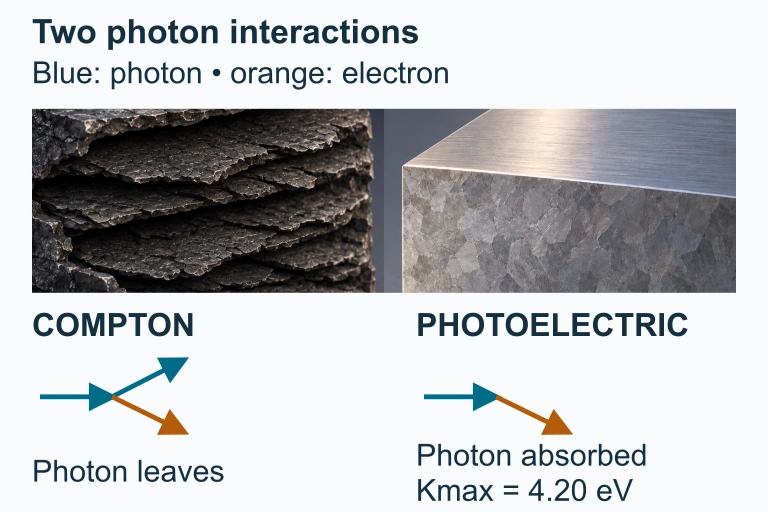
Compton retains scattered photon plus recoil electron; photoelectric absorption consumes photon and emits electron.
In Compton scattering a photon leaves after transferring momentum to an electron. In the selected photoelectric example, a 6.20 eV photon is absorbed and a 2.00 eV work function leaves a maximum electron kinetic energy of 4.20 eV.

The Stopping Potential

We can measure \( K_{\max} \) by applying a reverse voltage \( V_0 \) that just stops the most energetic electrons. This gives us:

This means \( V_0 \) depends only on frequency, not on light intensity. Plotting \( V_0 \) vs. \( f \) gives a straight line with slope \( \frac{h}{e} \).

Separate work-function comparison

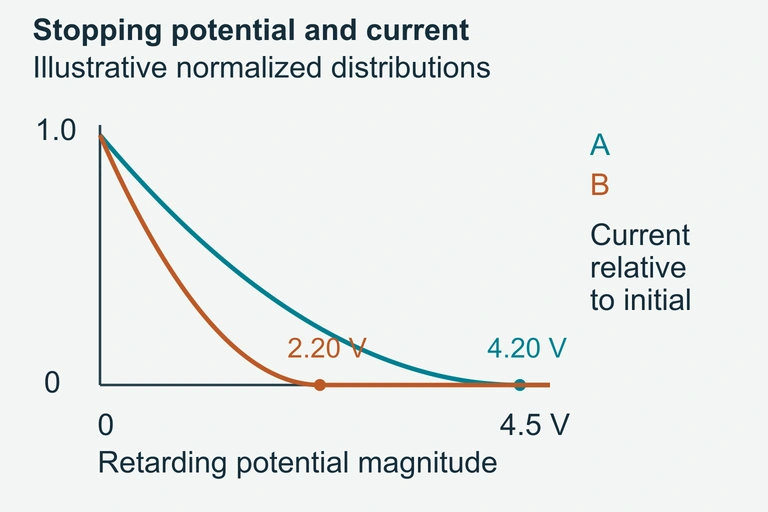
These hypothetical cathodes share 200 nm illumination; the normalized photocurrent curves are illustrations, not measurements.
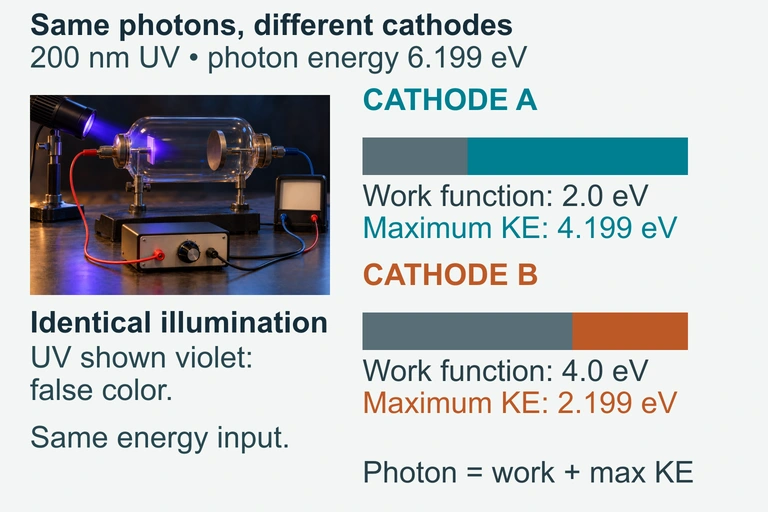
Phototube illustration beside equal photon-energy bars. Work functions 2 and 4 eV leave maximum electron kinetic energies 4.199 and 2.199 eV.
At the same 200 nm photon energy, hypothetical work functions 2 and 4 eV leave maximum electron kinetic energies 4.199 and 2.199 eV. The UV beam is false color. Use the separate illustrative photocurrent panel for stopping potentials.
Two normalized photocurrent curves compare stopping-potential magnitudes for the hypothetical cathodes in the companion energy diagram.
Illustrative normalized photocurrent curves reach zero at retarding-potential magnitudes 4.2 and 2.2 V. Their shapes are chosen illustrations, not measured data.

A light beam opens a window into a vacuum phototube
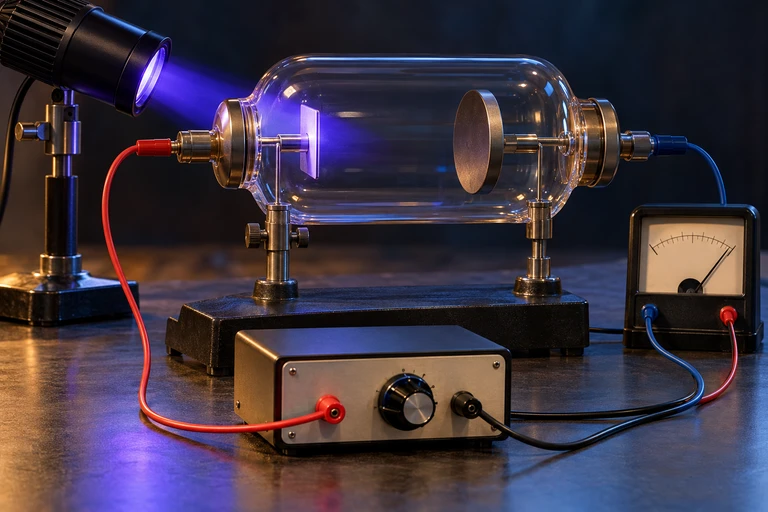
Transparent envelope exposes two electrodes and external circuit context; violet light is a schematic convention. Visible meter face is uncalibrated and supplies no stopping voltage.A collector held negative relative to the emitter retards emitted electrons. The stopping-potential magnitude gives the maximum kinetic energy through Kmax = eVstop.

A light beam opens a window into a vacuum phototube
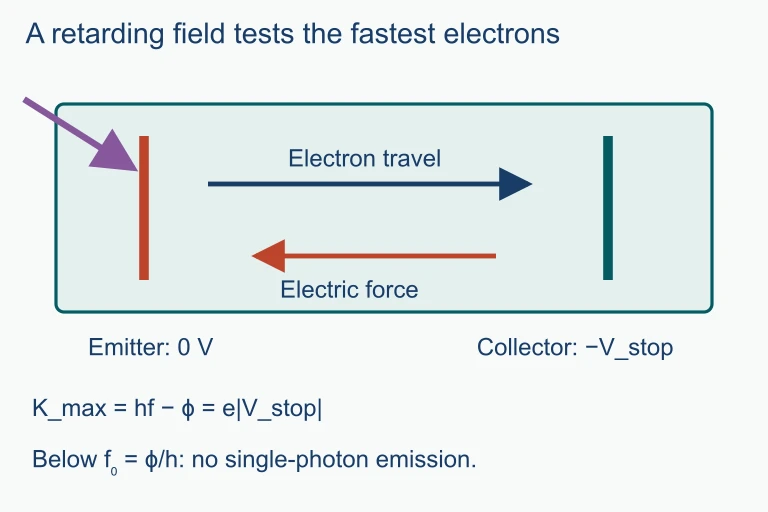
A light beam opens a window into a vacuum phototube. A collector held negative relative to the emitter retards emitted electrons. The stopping-potential magnitude gives the maximum kinetic energy through Kmax = eVstop.A collector held negative relative to the emitter retards emitted electrons. The stopping-potential magnitude gives the maximum kinetic energy through Kmax = eVstop.

Graph: \( V_0 \) vs. \( f \)

f \( V_0 \) 0 \( f_0 \) slope = \( h/e \) No electrons \( f < f_0 \) Electrons ejected \( f \geq f_0 \)

How to Solve Problems

1
Identify the given values: frequency \( f \) (or wavelength \( \lambda \)), work function \( \phi \), or stopping potential \( V_0 \).
2
Convert wavelength to frequency if needed: \( f = \frac{c}{\lambda} \) where \( c = 3 \times 10^8 \text{ m/s} \).
3
Compute photon energy: \( E = hf \) or equivalently \( E = \frac{hc}{\lambda} \).
4
Apply Einstein's equation: \( K_{\max} = hf - \phi \). If \( K_{\max} < 0 \), no electrons are ejected.
5
Find stopping potential if asked: \( V_0 = \frac{K_{\max}}{e} \).

Example 1: Finding \( K_{\max} \)

Light of frequency \( f = 8.0 \times 10^{14} \text{ Hz} \) strikes a metal with work function \( \phi = 3.0 \text{ eV} \). Find \( K_{\max} \).

Example 2: Wavelength Given

UV light of wavelength \( \lambda = 250 \text{ nm} \) hits a cesium surface with \( \phi = 2.1 \text{ eV} \). Find the stopping potential.

Example 3: Threshold Frequency

A metal has work function \( \phi = 4.5 \text{ eV} \). What is the maximum wavelength of light that can eject electrons?

Common Mistakes

✕ Confusing Intensity and Frequency
Brighter light does NOT give electrons more energy. Only higher frequency increases \( K_{\max} \).
✕ Forgetting Unit Conversions
Mixing eV and Joules, or nm and meters. Always convert: \( 1 \text{ eV} = 1.6 \times 10^{-19} \text{ J} \).
✕ Ignoring the Threshold
If \( hf < \phi \), no electrons are emitted regardless of intensity. Check threshold first.

Summary of Key Relationships

Quantity Symbol Formula
Photon energy \( E \) \( E = hf = \frac{hc}{\lambda} \)
Work function \( \phi \) \( \phi = hf_0 \)
Max kinetic energy \( K_{\max} \) \( K_{\max} = hf - \phi \)
Stopping potential \( V_0 \) \( eV_0 = K_{\max} \)
Threshold frequency \( f_0 \) \( f_0 = \frac{\phi}{h} \)
Threshold wavelength \( \lambda_0 \) \( \lambda_0 = \frac{hc}{\phi} \)

Question 1 of 5

In the photoelectric effect, what happens when you increase the intensity of light (keeping frequency constant and above threshold)?

Question 2 of 5

A photon with energy 5.0 eV strikes a metal with work function \( \phi = 2.3 \) eV. What is the maximum kinetic energy of the emitted electron?

Question 3 of 5

Light of frequency \( 4.0 \times 10^{14} \) Hz is shone on a metal with threshold frequency \( 5.5 \times 10^{14} \) Hz. What happens?

Question 4 of 5

On a graph of stopping potential \( V_0 \) vs. frequency \( f \), what does the slope of the line represent?

Question 5 of 5

Two metals, A and B, have work functions \( \phi_A = 2.0 \) eV and \( \phi_B = 4.0 \) eV. The same light ejects electrons from both metals. Which statement is correct?