The Ideal Gas Law
Master the relationship between pressure, volume, temperature, and amount of gas with the equation \( PV = nRT \).
What Is an Ideal Gas?
An ideal gas is a theoretical model where gas particles are treated as point masses that undergo perfectly elastic collisions and exert no intermolecular forces on each other.
The Four State Variables
Every gas sample is described by four measurable quantities called state variables. The ideal gas law connects all four in a single equation.
Building Up to \( PV = nRT \)
The ideal gas law unifies three earlier empirical gas laws into one powerful equation:
The Ideal Gas Law
Visualizing \( P \) vs \( V \) (Isotherms)
Ideal vs Real Gases
| Ideal Gas | Real Gas | |
|---|---|---|
| Particle Volume | Zero (point masses) | Finite: occupies real space |
| Intermolecular Forces | None | Attractive and repulsive |
| Collisions | Perfectly elastic | Slightly inelastic |
| Equation | \( PV = nRT \) | \(\left(P + \frac{an^2}{V^2}\right)(V - nb) = nRT\) |
| Best Accuracy | High \( T \), low \( P \) | All conditions |
Microscopic Meaning of Temperature
The ideal gas law connects to the kinetic theory of gases. The temperature of a gas is directly related to the average translational kinetic energy of its molecules:
Connecting \( R \) and \( k_B \)
The gas constant \( R \) and the Boltzmann constant \( k_B \) are related through Avogadro's number \( N_A \):
This means we can also write the ideal gas law in terms of total number of molecules \( N \) instead of moles \( n \):
How to Apply \( PV = nRT \)
Example 1: Finding Volume
A balloon contains \( 0.50 \;\text{mol} \) of helium at \( 300 \;\text{K} \) and \( 1.01 \times 10^5 \;\text{Pa} \). What is the volume of the balloon?
Example 2: Finding Temperature
A sealed container of volume \( 0.020 \;\mathrm{m}^3 \) holds \( 1.5 \;\text{mol} \) of nitrogen gas at a pressure of \( 2.5 \times 10^5 \;\text{Pa} \). What is the temperature?
Example 3: Changing Conditions
A gas at \( P_1 = 1.0 \times 10^5 \;\text{Pa} \), \( V_1 = 0.030 \;\mathrm{m}^3 \), \( T_1 = 300 \;\text{K} \) is compressed to \( V_2 = 0.010 \;\mathrm{m}^3 \) and heated to \( T_2 = 450 \;\text{K} \). Find \( P_2 \). (Amount \( n \) is fixed.)
A separate balloon model
Assume two moles of ideal gas, equilibrium pressure and negligible membrane tension. This example uses different values from the deck’s existing calculation.
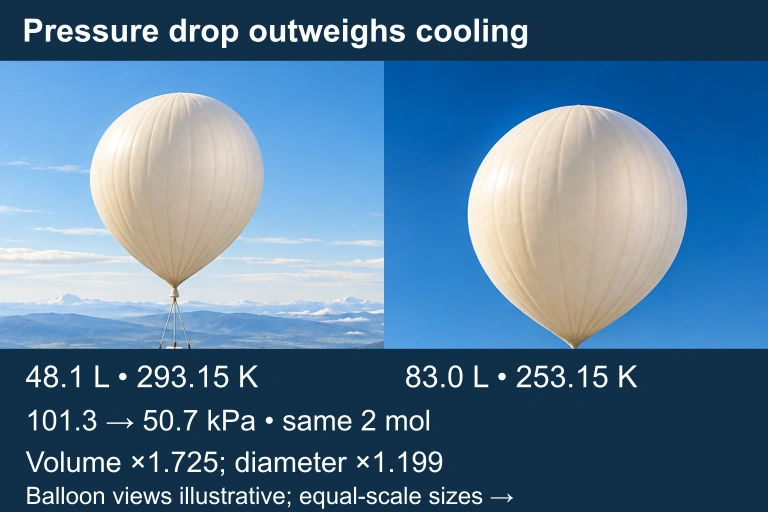
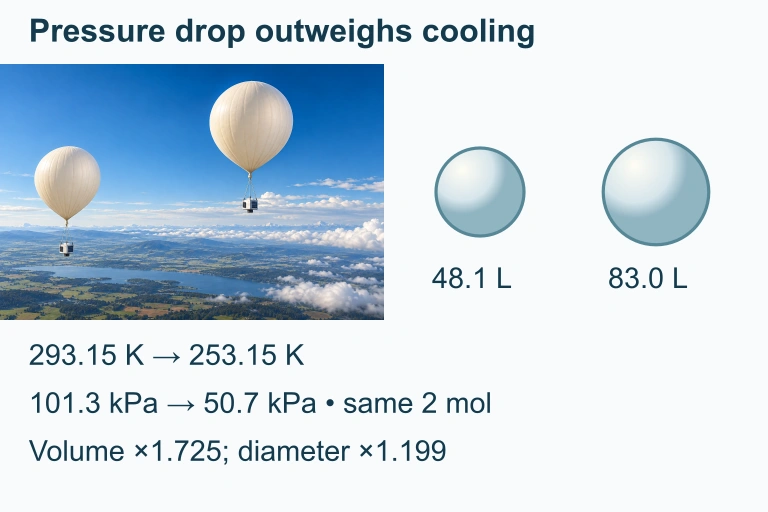
A balloon cools from 293.15 K to 253.15 K while its pressure falls from 101.3 kPa to 50.7 kPa. How do its volume and equivalent-sphere diameter change?
Show answer and explanation
The volume increases by about 1.725, from 48.1 L to 83.0 L. The equivalent-sphere diameter increases by approximately 1.199.
A transparent piston makes heat and mechanical work visible
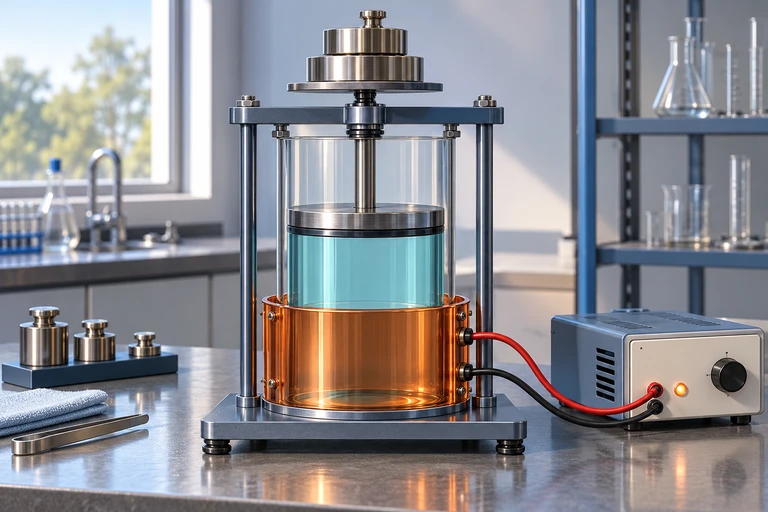 For a fixed amount of ideal gas, compare equilibrium states using P₁V₁/T₁ = P₂V₂/T₂, with absolute pressure and temperature in kelvin. Endpoint states alone do not determine work.
Changing pressure and temperature together
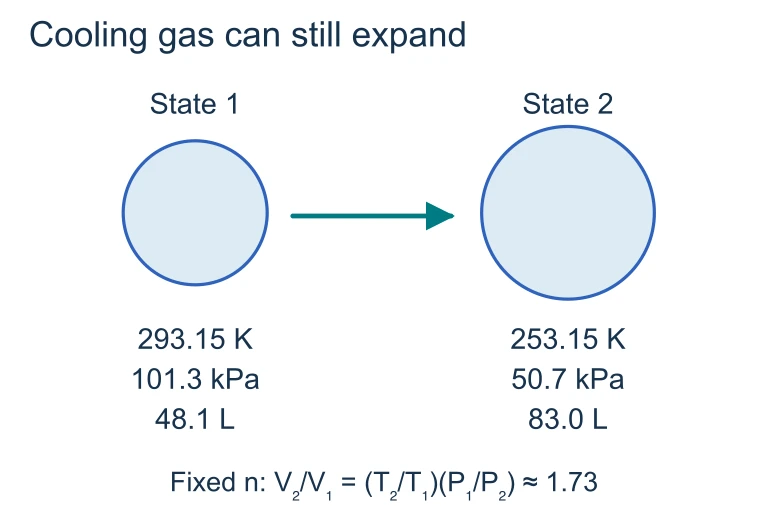 For the same amount of gas, temperature falls from 293.15 K to 253.15 K while pressure falls from 101.3 to 50.7 kPa. Volume rises from about 48.1 to 83.0 L because the pressure decrease outweighs the temperature decrease.
Graphical Processes
Common Mistakes to Avoid
Gas Law Summary
| Law | Equation | Held Constant | Relationship |
|---|---|---|---|
| Boyle's | \( P_1V_1 = P_2V_2 \) | \( T, n \) | Inverse |
| Charles's | \( \frac{V_1}{T_1} = \frac{V_2}{T_2} \) | \( P, n \) | Direct |
| Gay-Lussac's | \( \frac{P_1}{T_1} = \frac{P_2}{T_2} \) | \( V, n \) | Direct |
| Avogadro's | \( \frac{V_1}{n_1} = \frac{V_2}{n_2} \) | \( P, T \) | Direct |
| Ideal Gas | \( PV = nRT \) | None required | Unifies all |
Question 1 of 5
A fixed amount of ideal gas is in a sealed container. If the temperature is doubled while the volume is held constant, what happens to the pressure?
Question 2 of 5
What is the volume of \( 2.0 \;\text{mol} \) of an ideal gas at \( 400 \;\text{K} \) and \( 2.0 \times 10^5 \;\text{Pa} \)?
Question 3 of 5
Which assumption is NOT part of the ideal gas model?
Question 4 of 5
A gas at \( 1.0 \times 10^5 \;\text{Pa} \) and \( 0.040 \;\mathrm{m}^3 \) is compressed isothermally to \( 0.010 \;\mathrm{m}^3 \). What is the final pressure?
Question 5 of 5
The average translational kinetic energy of the molecules in an ideal gas depends on which of the following?