The First Law of
Thermodynamics
Master the principle of energy conservation applied to thermal systems: \(\Delta U = Q - W\). Learn how heat, work, and internal energy interact in every physical process.
What Is a Thermodynamic System?
In thermodynamics, we divide the universe into two parts: the system (the object or region we study) and the surroundings (everything else). Energy can cross the boundary between them as heat or work.
Understanding Internal Energy \(\Delta U\)
The internal energy \(U\) of a system is the total microscopic kinetic and potential energy of all its particles. It depends on temperature and phase, not on bulk motion or position.
Heat \(Q\) vs. Work \(W\): Two Ways to Transfer Energy
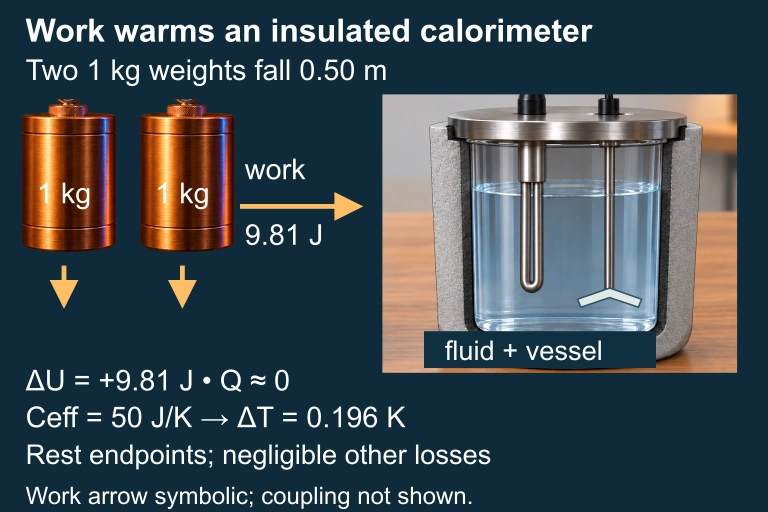
Work warms a fluid and vessel
In this separate ideal model two 1 kg weights fall 0.50 m, giving 9.81 J of work; heat transfer and other losses are negligible. The fluid and vessel form the system.
The First Law: \(\Delta U = Q - W\)
The change in a system's internal energy equals the heat added minus the work done by the system. This is conservation of energy applied to thermal systems.
Work as Area Under the Curve
State Functions vs. Path Functions
| State Function | Path Function | |
|---|---|---|
| Depends on | Current state only | Path taken between states |
| Examples | \(U\), \(T\), \(P\), \(V\) | \(Q\), \(W\) |
| Round trip | \(\Delta U = 0\) (returns to start) | \(Q\) and \(W\) may be nonzero |
| Analogy | Elevation (altitude) | Distance walked |
Four Special Processes
So \(Q = W\)
So \(\Delta U = -W\)
So \(W = P\Delta V\)
So \(\Delta U = Q\)
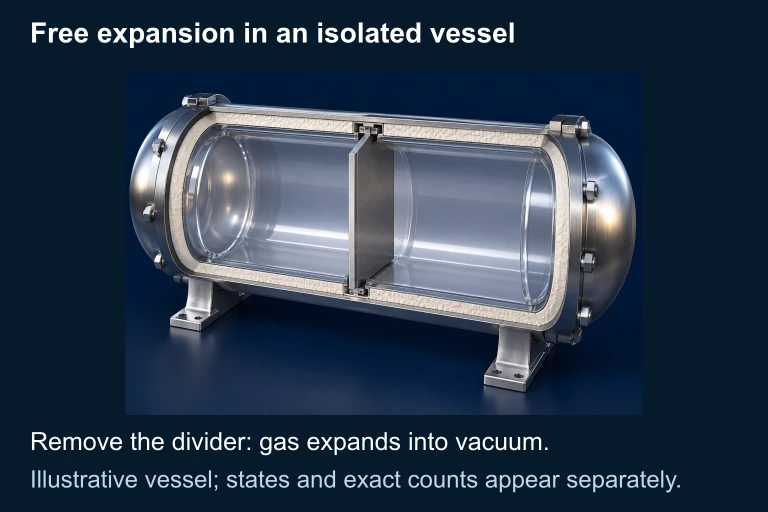
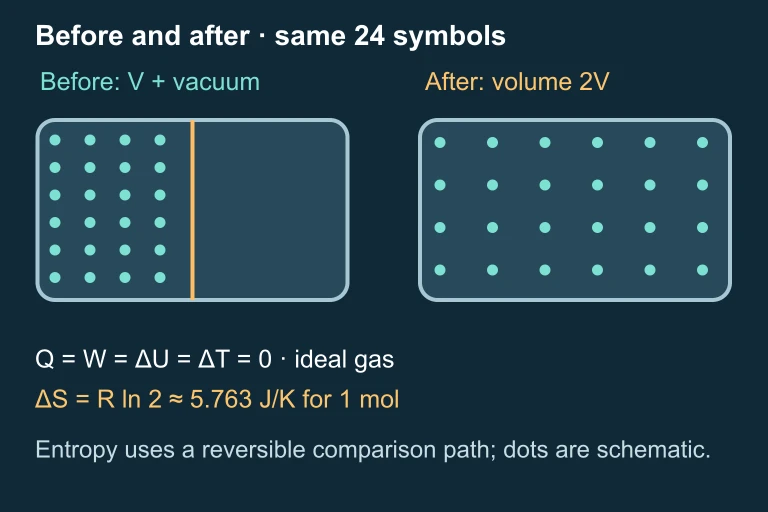
Free expansion of an ideal gas
For one mole freely expanding from V to 2V in an isolated rigid vessel, Q = W = ΔU = ΔT = 0 and entropy increases by R ln 2.
Processes on a PV Diagram
How to Apply the First Law
Example 1: Isobaric Expansion
A gas at constant pressure \(P = 2.0 \times 10^5 \text{ Pa}\) expands from \(V_1 = 0.010 \text{ m}^3\) to \(V_2 = 0.025 \text{ m}^3\). During this process, \(Q = 7500 \text{ J}\) of heat is added. Find \(\Delta U\).
A transparent piston makes heat and mechanical work visible
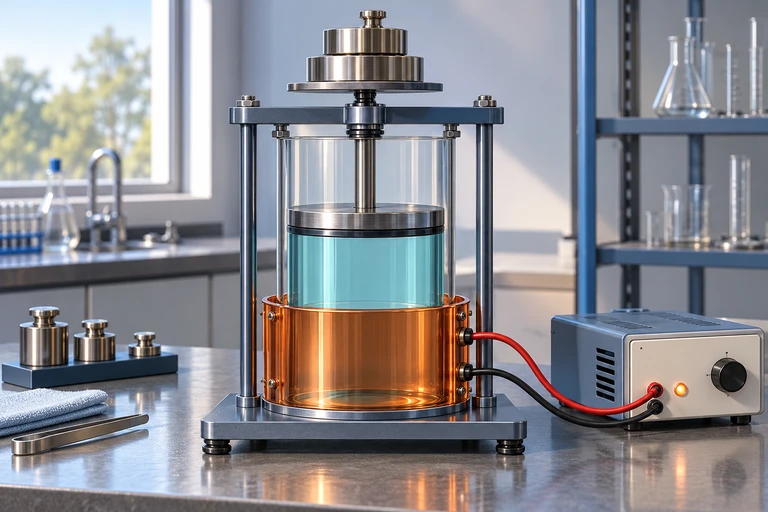 Consider a fixed amount of monatomic ideal gas expanding at 150 kPa from 0.020 to 0.050 m³. Work by the gas is 4500 J and its internal-energy increase is 6750 J, so the heat input is 11250 J.
Self-consistent monatomic expansion
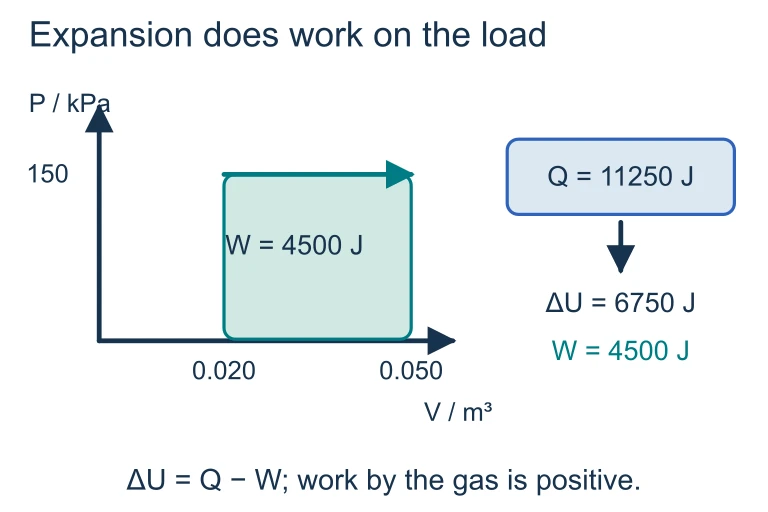 Consider a fixed amount of monatomic ideal gas expanding at 150 kPa from 0.020 to 0.050 m³. Work by the gas is 4500 J and its internal-energy increase is 6750 J, so the heat input is 11250 J.
Example 2: Isochoric Heating
A sealed rigid container holds an ideal gas. We add \(Q = 1200 \text{ J}\) of heat. Find the work done and the change in internal energy.
Example 3: Adiabatic Compression
An insulated piston compresses a gas. The work done by the gas is \(W = -500 \text{ J}\) (negative because the gas is compressed). Find \(\Delta U\).
Cyclic Processes and Heat Engines
Common Mistakes to Avoid
Summary: First Law by Process
| Process | Constraint | First Law Simplifies To |
|---|---|---|
| Isothermal | \(\Delta T = 0, \Delta U = 0\) | \(Q = W\) |
| Adiabatic | \(Q = 0\) | \(\Delta U = -W\) |
| Isobaric | \(\Delta P = 0\) | \(\Delta U = Q - P\Delta V\) |
| Isochoric | \(\Delta V = 0, W = 0\) | \(\Delta U = Q\) |
| Cyclic | \(\Delta U = 0\) | \(Q_{net} = W_{net}\) |
Question 1 of 5
A gas in a sealed, rigid container absorbs 800 J of heat. What is the change in internal energy \(\Delta U\)?
Question 2 of 5
During an isothermal expansion of an ideal gas, 500 J of work is done by the gas. How much heat was added?
Question 3 of 5
A gas undergoes an adiabatic compression and its internal energy increases by 350 J. What is the work done by the gas?
Question 4 of 5
A heat engine completes one full cycle. During the cycle, it absorbs \(Q_H = 2000 \text{ J}\) from the hot reservoir and expels \(Q_C = 1400 \text{ J}\) to the cold reservoir. What is the net work done per cycle?
Question 5 of 5
A gas at constant pressure does \(W = 1500 \text{ J}\) of work while its internal energy increases by \(\Delta U = 2500 \text{ J}\). How much heat was added to the gas?