The Doppler Effect
Understand how relative motion between a source and observer changes the observed frequency and wavelength of waves.
Waves Have Frequency and Wavelength
Every wave—sound, light, or water—is characterized by its frequency \( f \) (how many cycles per second) and its wavelength \( \lambda \) (the distance between successive crests). These are related by the wave speed:
When neither the source nor the observer is moving, the frequency emitted equals the frequency received. But what happens when they are moving?
What Is the Doppler Effect?
The Doppler Effect is the change in observed frequency (and wavelength) of a wave when there is relative motion between the source and the observer. Named after Austrian physicist Christian Doppler (1842).
Visualizing Compressed and Stretched Wavefronts
The General Doppler Equation
The signs depend on relative motion: use the upper signs when motion is toward the other party, and the lower signs when motion is away.
Sound vs Light: Two Flavors
| Sound Waves | Light (EM) Waves | |
|---|---|---|
| Medium Required? | Yes (air, water, etc.) | No (travels in vacuum) |
| Formula | \( f_o = f_s \frac{v \pm v_o}{v \mp v_s} \) | \( f_o = f_s \sqrt{\frac{1 \pm \beta}{1 \mp \beta}} \) |
| Depends on Medium? | Yes: \( v \) is fixed | No: only relative \( \beta = v/c \) |
| Observable Effect | Pitch change | Color shift (red/blue) |
Special Cases of the Equation
How to Solve Doppler Problems
Use the general formula and choose signs based on the direction of motion. Remember: "toward" increases frequency, "away" decreases it.
Example 1: Moving Source
An ambulance emits a siren at \( f_s = 700 \) Hz. It approaches a stationary observer at \( v_s = 30 \) m/s. The speed of sound is \( v = 343 \) m/s. Find \( f_o \).
Example 2: Moving Observer
A stationary speaker emits \( f_s = 500 \) Hz. An observer drives away at \( v_o = 25 \) m/s. Speed of sound: \( v = 343 \) m/s.
Example 3: Both Moving
A train (\( f_s = 400 \) Hz, \( v_s = 20 \) m/s) approaches a car driving toward the train at \( v_o = 15 \) m/s. Speed of sound: \( v = 343 \) m/s.
How Does Wavelength Change?
The wavelength in the medium changes when the source moves. If the source moves toward the observer at \( v_s \):
If the source moves away:
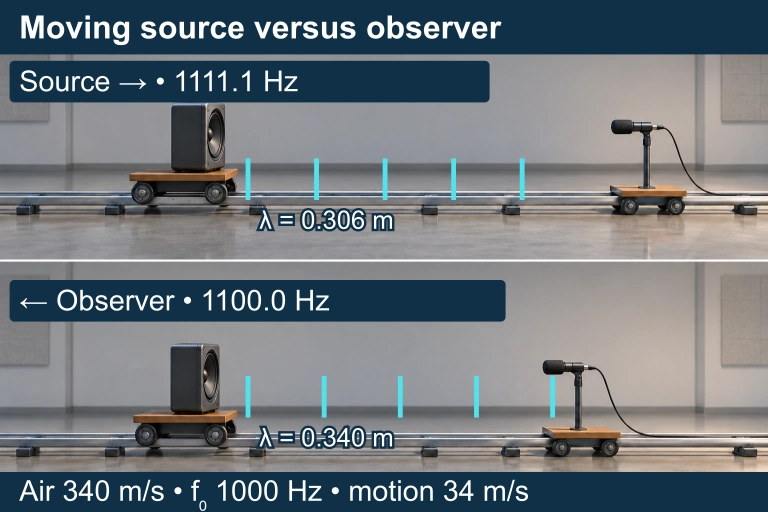
Source versus observer motion
This separate medium-frame model uses sound speed 340 m/s, source frequency 1000 Hz and motion 34 m/s. A moving source compresses wavelength; a moving observer changes encounter rate without changing medium-frame wavelength.
Real-World Applications
A sonography probe shows the outgoing and returning measurement
 A moving scatterer shifts the returning ultrasound frequency according to its velocity component along the beam. Motion away from the probe gives a negative echo shift; motion toward it gives a positive shift.
The echo shift depends on the velocity component along the beam.
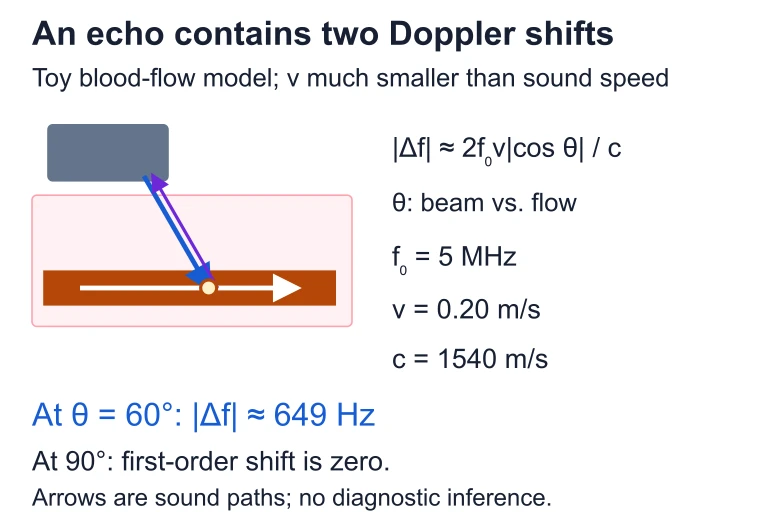 A moving scatterer shifts the returning ultrasound frequency according to its velocity component along the beam. Motion away from the probe gives a negative echo shift; motion toward it gives a positive shift.
Common Mistakes to Avoid
Summary Table
| Scenario | \( f_o \) vs \( f_s \) | \( \lambda' \) vs \( \lambda \) |
|---|---|---|
| Source approaches | \( f_o > f_s \) | \( \lambda' < \lambda \) |
| Source recedes | \( f_o < f_s \) | \( \lambda' > \lambda \) |
| Observer approaches | \( f_o > f_s \) | No change in medium |
| Observer recedes | \( f_o < f_s \) | No change in medium |
| Both approach | Maximum increase | \( \lambda' < \lambda \) |
| Both recede | Maximum decrease | \( \lambda' > \lambda \) |
Question 1 of 5
A fire truck siren emits sound at 800 Hz and drives toward a stationary observer at 35 m/s. If the speed of sound is 343 m/s, what frequency does the observer hear?
Question 2 of 5
An observer moves away from a stationary source at 20 m/s. The source emits 600 Hz and the speed of sound is 343 m/s. What is the observed frequency?
Question 3 of 5
A moving source does not change which of the following in the medium?
Question 4 of 5
A train (\( f_s = 500 \) Hz, \( v_s = 25 \) m/s) and a car (\( v_o = 10 \) m/s) move toward each other. With \( v = 343 \) m/s, what is \( f_o \)?
Question 5 of 5
An observer at rest hears a 600 Hz tone from a source moving away at 40 m/s. What is the actual frequency \( f_s \) emitted by the source? (Use \( v = 343 \) m/s.)